
Understanding Logical Layers in End-to-End Network Slicing for 5G and Beyond
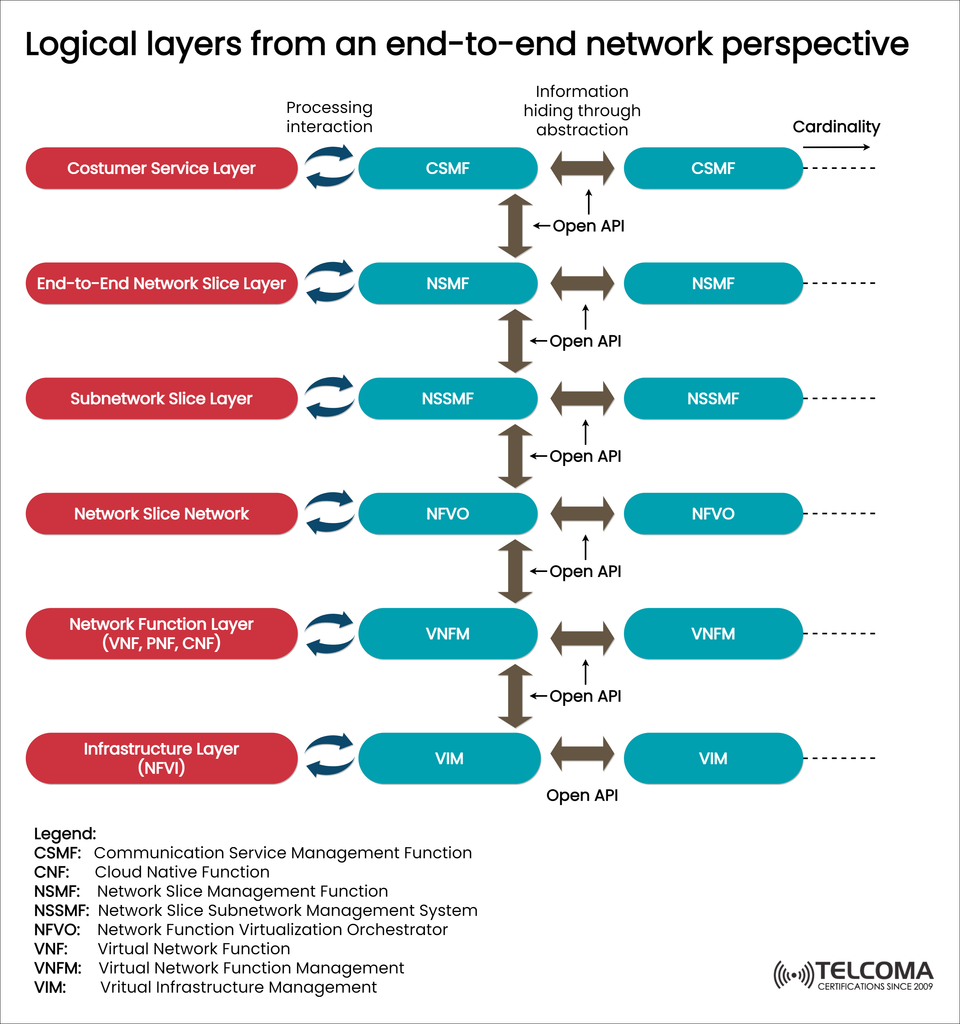

In-Depth Look into Logical Layers of End-to-End Network Slicing in 5G
As networks continue to evolve with 5G and prepare for 6G, end-to-end network slicing is an increasingly important concept. It enables operators to configure a single physical network into multiple virtual networks based on a unique service and performance requirement.
The image shown previously identifies the logical layers of end-to-end network slicing, each serving its own purpose with its interfaces. Although the 3GPP provided minimal explanation of the logical layers, upon seeing the layers, network engineers, network architects, and telecommunications industry professionals should be able to define their role in designing, operating, and automating very complex mobile networks.
What Are Logical Layers in End-to-End Network Slicing?
Logical layers represent the hierarchical management and orchestration framework required to deliver and sustain a complete network slice, starting from the infrastructure through the management service that operates within a customer-facing service.
The logical layers' engagement will be through open APIs. They are designed to allow abstraction, automation and modularity to provide for scalability and vendor independence.
A Top Overview of the Layers of Logical Layer
The layers show both the processing engagement, with horizontal arrows, and the information hiding, through abstraction, with vertical arrows allowing a modular and scalable management engagement.
Overview of the Logical Layer Stack
The logical layered model has horizontal processing interactions (horizontal arrows) and vertical abstraction, or information hiding (vertical arrows), that create a modular and scalable manageability scheme.
Layer Name Functional Module Function
Customer Service Layer CSMF Manages communication service requests and transforms them into slice requirements.
End-to-End Network Slice Layer NSMF Manages the total lifecycle of network slices across all domains.
Subnetwork Slice Layer NSSMF Manages slices (same as above) per subnetwork (RAN, transport network slice, core).
Network Slice Network NFVO Orchestrates the lifecycle of all virtual resources operating in each slice.
Network Function Layer VNFM Manages the lifecycle of VNFs (both CNFs and PNFs included).
Infrastructure Layer (NFVI) VIM Manages physical and virtual infrastructure resources.
Let’s describe the key aspects:
🧠 CSMF – Communication Service Management Function — interfaces to an external business application or OSS/BSS system
Converts customer service requirements to network slice requirements, etc.
🌐 NSMF – Network Slice Management Function
— if there are many NSSMF functions, this does coordinating, etc.
Manages the end-to-end slice lifecycle, i.e., instantiate, scale, etc.
🧩 NSSMF – Network Slice Subnet Management Function — manages slices in a specific domain (you have RAN Slice Subnet, Core Slice Subnet, Transport Slice Subnet)
Presents abstraction to the NSMF.
🧵 NFVO – Network Function Virtualization Orchestrator — must
ensures appropriate allocation of virtualized resources, and scaling.
Also must cross VIM and VNFMs.
⚙️ VNFM – Virtual Network Function Management - manages the life cycle of its VNFs ( (remember CNFs and PNFs)).
🖥️ VIM - Virtualized Infrastructure Manager
Manages compute, storage and networking
Interfaces with hypervisors, SDN Controllers and physical servers
Core Strengths of Layered Abstraction
✅ Decoupling of functions facilitates independent upgrades and scale.
✅ Open api allows multiple vendors to create an inter-operable, common ecosystem.
✅ Abstraction enables higher level orchestration to take place without concern about the underlying infrastructure.
✅ Each layer supports increasingly higher levels of automation through modular orchestration.
✅ Service-level agility aligns logical structures with service requirements.
Logical Layer Architecture Implemented
Let's think about deploying a private 5G network for an industrial site.
The CSMF receives a demand for ultra-reliable low-latency service.
The NSMF will create an E2E slice, identifying/ providing the tasks to domain-specific task NSSMFs.
The NFVO provides mappings to VNFs on the right resources.
The VNFM deploys these VNFs on the NFVI which is governed by the VIM.
This layered arrangement allows every stakeholder to have a clearly defined interface and domain of responsibility, extending from service designer to infrastructure operator, which promotes simplified operations that mistakes can be minimized.
Concluding Thoughts: Why Logical Layers Matter for Telecom Transformation
The concept of logical layering in network slicing is not just a matter of architectural convenience. It is a strategic necessity for designing programmable, agile, and autonomous 5G networks.
By decomposing the end-to-end network into manageable, inter-operable, and automated data pathways, telecommunications service providers.
Core Benefits (and General Layers of Law) of Layered Abstraction
✅ Decoupling of functions allows functions to be upgraded and scaled independently
✅ Open API integration enables a multi-vendor, interoperable systems
✅ Abstraction of complexity enables higher-level orchestration without exposing details of the infrastructure
✅ On each layer, increased automation is possible through modularization callback orchestration
✅ Agility at the service level can be aligned with the logical architecture to meet the service requirements
When the Logical Layer Architecture is put in action
For instance, deploying a private 5G network for an industrial operation.
- The CSMF receives a request for ultra-reliable low-latency service.
- The NSMF defines an E2E slice and passes tasks for further configuration to the relevant NSSMF.
- The NFVO finds VNFs and maps these VNFs to the appropriate resources.
- The VNFM deploys the above VNFs across the NFVI, utilizing the data on the NFVI provided by the VIM.
This abstraction through layers allows for greater collaboration between each of the roles including the service designer level and the VIM infrastructure operator level by providing each stakeholder a more clearly-defined domain and interface, improving operations and reducing mistakes.
Conclusion:
The Importance of Logical Layers in the Transformation of Telecoms
It should be evident that logical layers of network slicing are more than just an architectural option; it is a fundamental requirement to support timely, programmable, agile, and autonomous 5G networks.
The application of 5G is less abstract than the notion of virtualizing the end-to-end network and logically slicing it to provide customers a seamless service experience by breaking up the end-to-end network into distinct and manageable, interoperable, and automated layers in the most efficient manner available.
Telecoms can then realize the benefits of more rapid service deployment and enable greater multi-domain coordination; support dynamic slice lifecycle management; and prepare for automated or autonomous network functions and more.