
Understanding Magma 5G Architecture: Integration with ONAP, Kubernetes, and SDN

Understanding Magma's 5G Architecture: How It Works with ONAP, Kubernetes, and SDN
As 5G networks continue to evolve, telecom companies are facing growing pressures to provide greater scalability, automation, and flexibility. Open-source solutions like Magma, which is developed under the Linux Foundation, are changing the game in how we build and manage networks.
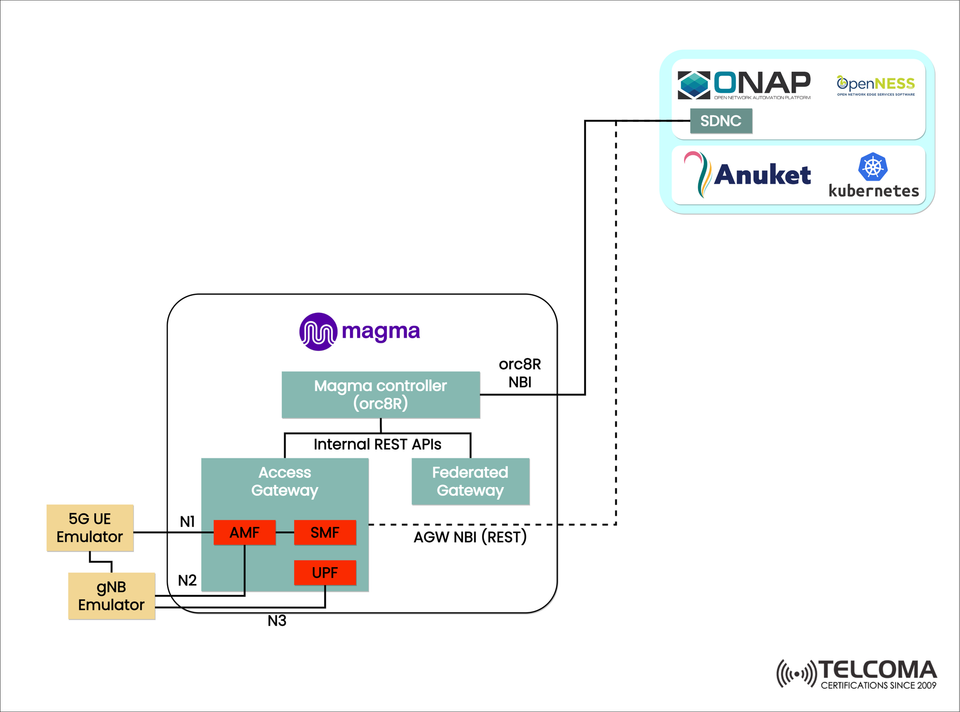
The diagram provided gives us a glimpse into a contemporary Magma-based 5G architecture, highlighting its integration with ONAP (Open Network Automation Platform), Kubernetes, Anuket, and SDN controllers. This combination represents what the future holds for open, cloud-native telecom systems.
What is Magma?
Magma is an open-source platform designed to facilitate flexible, scalable, and budget-friendly mobile core networks. It started as a project by Facebook Connectivity (now known as Meta Connectivity) with the goal of bringing carrier-grade networking closer to the cloud edge.
Magma supports both 4G LTE and 5G Core (5GC) networks, making it a good fit for:
Mobile Network Operators (MNOs)
Mobile Virtual Network Operators (MVNOs)
Private LTE/5G network providers
Solutions for rural and enterprise connectivity
Its modular and microservices-oriented architecture provides the kind of agility, resilience, and compatibility that fits well with cloud-native principles.
Key Components of the Magma Architecture
In the accompanying image, you’ll see Magma’s internal architecture displayed within the main Magma box, emphasizing its important subsystems:
Magma Controller (orc8r)
Access Gateway (AGW)
Federated Gateway
Integration with ONAP and Kubernetes
a. Magma Controller (orc8r)
The Orchestrator (orc8r) serves as the control and management core of Magma. Its main responsibilities include:
Managing configurations for Access Gateways.
Gathering metrics, logs, and health information from various distributed nodes.
Offering northbound APIs (orc8r NBI) for connecting with automation frameworks like ONAP.
The orc8r NBI (Northbound Interface) allows external systems to keep track of and control Magma's operations, ensuring it works well with higher-level orchestration tools.
b. Access Gateway (AGW)
The Access Gateway (AGW) takes care of the data and control plane functions for the network, linking user equipment (UE) and base stations (gNB/eNodeB) to the core network and the internet.
In the illustration, AGW includes the following components of 5G Core (5GC):
Component Function AMF (Access and Mobility Management Function)Handles UEs’ registration, connection management, and mobility tasks. SMF (Session Management Function)Oversees session creation, alteration, and termination while assigning IP addresses to UEs. UPF (User Plane Function)Redirects user data packets to the internet or other networks (using the N3 interface).
These components use 3GPP-defined interfaces like N1, N2, and N3:
N1 links the UE Emulator to the AMF.
N2 connects the gNB Emulator with AMF/SMF.
N3 ties the UPF to external networks or the internet.
Magma AGW acts as an edge processing unit, deployable either on-premises or at various edge locations.
c. Federated Gateway
The Federated Gateway in Magma serves as a connection between the access network and external core networks or roaming partners.
Its roles include:
Communicating with legacy EPC or external operator cores.
Handling authentication, roaming, and subscriber data exchanges.
Facilitating smooth interaction between networks using REST APIs (AGW NBI).
This allows operators to expand Magma’s open architecture while still being compatible with traditional telecom setups.
Integrating with ONAP, SDNC, and Kubernetes
Magma really shines with its ability to seamlessly integrate with open-source network automation and orchestration frameworks such as ONAP and Kubernetes, as illustrated in the image.
a. ONAP (Open Network Automation Platform)
ONAP offers a streamlined platform for real-time, policy-driven automation of both physical and virtual network functions. As shown in the diagram, Magma’s connection to ONAP happens through the orc8r NBI, which allows ONAP to:
Automate the lifecycle management of Magma’s components.
Dynamically provision network slices or edge functions.
Monitor network performance through telemetry from Magma’s orchestrator.
This integration enables operators to implement zero-touch, automated 5G networks.
b. SDNC (Software-Defined Network Controller)
The SDNC, part of the ONAP ecosystem, offers programmable control over the underlying transport and network topology. It interacts with Magma through northbound interfaces (NBI) to:
Dynamically modify data paths between Access Gateways.
Oversee QoS, bandwidth, and policy control.
Enable closed-loop automation for optimizing the network.
With SDN control in the mix, Magma can handle advanced scenarios like network slicing and dynamic traffic management.
c. Anuket and Kubernetes Integration
Anuket, previously known as OPNFV, outlines reference models for NFV and cloud-native telecommunications deployments. Alongside Kubernetes, it provides the container orchestration layer for Magma.
This partnership allows Magma components to:
Operate as cloud-native microservices.
Scale up or down based on demand.
Offer better availability and resilience.
Kubernetes takes charge of deployment, scaling, and health monitoring for Magma’s pods while Anuket guarantees compliance with telecom-grade NFV standards.
d. OpenNESS Edge Platform
By adding OpenNESS (Open Network Edge Services Software), Magma’s capabilities extend to the edge cloud, providing:
Multi-access edge computing (MEC) functionality.
Effective management of latency-sensitive 5G applications.
Smooth integration between RAN and the core network at the edge.
This combination creates end-to-end cloud-native 5G ecosystems — from the radio layer all the way to the core.
5G UE and gNB Emulation
The diagram also showcases a 5G UE Emulator and a gNB Emulator connected to the Magma AGW via the N1 and N2 interfaces, respectively.
These emulators mimic:
The behavior of User Equipment (UE) for tasks like registration, authentication, and session setup.
gNB (5G base station) signaling and data transmission.
This setup is essential for testing network performance, compatibility, and end-to-end session management in lab settings prior to real-world implementation.
Advantages of Magma-Based 5G Architecture
This integrated approach provides several major benefits for network operators:
a. Cloud-Native Design
Operates on Kubernetes and fits well within cloud setups.
Supports microservices deployment and automatic scaling.
b. Cost Efficiency
Open-source framework minimizes reliance on proprietary hardware and licenses.
Ideal for affordable rural or enterprise deployments.
c. Automation and Orchestration
Integration with ONAP allows for complete automation of deployment, configuration, and upkeep.
d. Security and Flexibility
TLS-encrypted APIs and SDN control enhance security measures.
REST interfaces ensure compatibility with OSS/BSS systems.
e. Multi-Access Capabilities
Works with both LTE and 5G cores.
Supports roaming and partnerships with existing operator networks.
Practical Applications
Magma’s versatile and open structure makes it perfect for:
Private 5G networks for companies and smart factories.
Rural broadband initiatives using community-powered LTE/5G cores.
Mobile edge computing (MEC) applications in Industry 4.0.
Virtualized network laboratories for research and telecom training.
Its cloud-native integration enables operators to deploy, manage, and evolve networks more rapidly than ever.
Conclusion
The Magma 5G architecture, as shown in the diagram, represents the next-level telecom blueprint — merging cloud-native principles, open-source innovation, and automated orchestration. By working alongside ONAP, Anuket, Kubernetes, and SDN controllers, Magma supports scalable, flexible, and cost-effective 5G networks that are easier to deploy and maintain.
This open, programmable model is steering the future of telecom, making networks smarter, more adaptable, and equipped to meet the challenges of digital transformation.