
Understanding MTP Latency in Cloud VR Gaming: Challenges and Solutions

Grasping MTP Latency in Cloud VR Gaming
Cloud-based Virtual Reality (VR) gaming has come a long way, opening doors for truly immersive experiences. Unlike standard VR that relies on local devices for rendering, cloud VR hinges on robust servers and fast networks to offer seamless gameplay.
But with this transition comes a significant hurdle: Motion-to-Photon (MTP) latency. So, what’s MTP latency? It’s essentially the lag time between when a player moves and when they see that movement reflected in their VR headset. Even slight delays, anything over about 20 milliseconds, can lead to issues like motion sickness, a drop in immersion, and an overall frustrating experience.
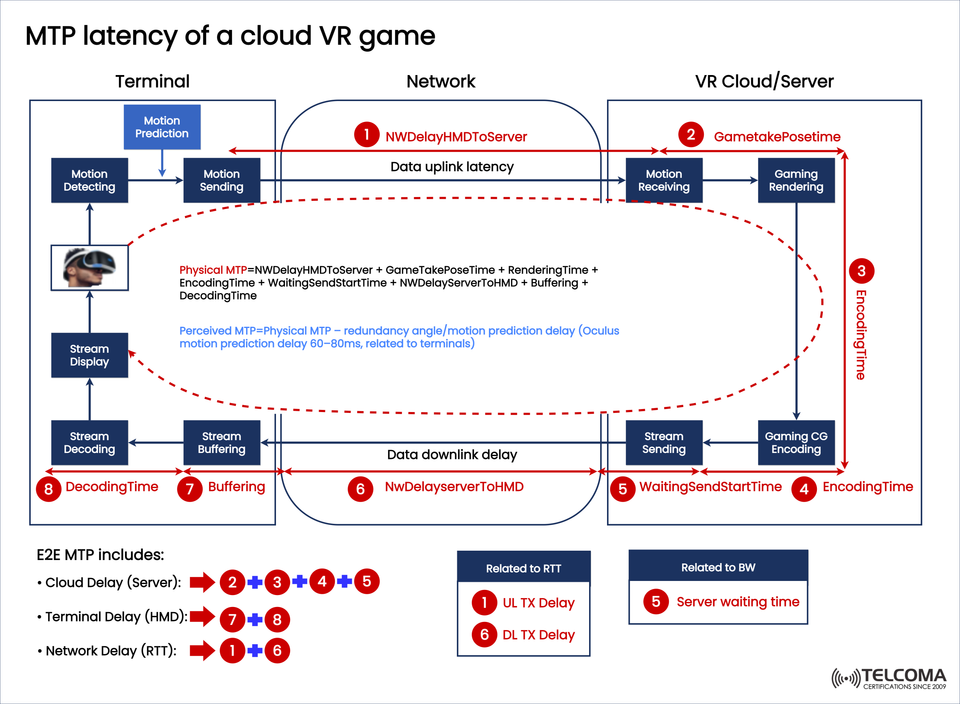
The diagram included gives a closer look at MTP latency in cloud VR gaming, breaking down the factors like uplink delays, server-side processing, and downlink delays. We’ll explore how each of these elements adds to the overall latency and what can be done to enhance network efficiency.
What’s MTP Latency?
MTP latency refers to the total duration from:
Motion detection (where sensors in the VR headset pick up movement) →
Data transfer (sending that data to the cloud server) →
Rendering and encoding (processing on the server) →
Transmission back to the headset →
Decoding and display (showing it in the headset).
This entire process consists of three main parts:
Cloud Delay (Server): The time the VR server spends processing the motion, generating frames, and encoding them.
Network Delay (RTT): The round-trip time for data moving between the headset and the server.
Terminal Delay (HMD): The delays within the VR headset itself, like buffering and decoding.
Minimizing each phase is crucial to ensure fluid and immersive VR gameplay.
Analyzing the Stages of MTP Latency
The accompanying figure breaks down MTP latency into eight key factors:
NW Delay HMD To Server (Uplink Latency): This is the time it takes for motion data to travel from the VR headset to the server, heavily influenced by network quality, transmission delays, and available wireless bandwidth.
Game Take Pose Time: After receiving the data, the server processes it to figure out the new camera perspective or player viewpoint. The faster the game engines and optimized algorithms, the less time this takes.
Rendering Time: This is where it gets resource-heavy — creating high-res VR graphics. Rendering delays depend on GPU capability, cloud resources, and scene complexity.
Encoding Time: The server compresses those graphics into a format suitable for streaming. Using hardware-accelerated encoders can significantly speed up this part.
Waiting Send Start Time (Server Queueing): Time spent waiting in the server queue before sending the stream back to the user, often linked to server load and bandwidth availability.
NW Delay Server To HMD (Downlink Latency): The delay in data moving from the server to the headset, which also hinges on bandwidth, congestion, and routing efficiency.
Buffering: The headset buffers incoming data to deal with jitter and packet loss. While this helps prevent freezing, it does add some extra delay.
Decoding Time: The headset decodes the compressed video back into frames. Efficient H.265/AV1 decoding hardware can help lessen this terminal-side latency.
Physical vs. Perceived MTP
The figure also distinguishes between:
Physical MTP: The actual measured latency from motion to visuals, encompassing all the delays from uplink to server to downlink.
Perceived MTP: This is how the user experiences latency, which can be improved through motion prediction techniques. For example, Oculus VR anticipates head movements 60–80 ms ahead of time, helping to smooth out the overall experience and offset system delays.
This distinction shows how smart algorithms can enhance user experience even when the physical latency seems high.
Connecting MTP Delays to Network Layers
To tackle optimization, it’s helpful to link each type of delay to the relevant components in the system:
MTP Stage Component Optimization Focus
NW Delay HMD To Server / Server To HMD Network (RAN + Core) - Reduce RTT, optimize routing, increase bandwidth
Game Take Pose Time & Rendering Server GPU/Engine - Faster hardware, scalable rendering
Encoding & Decoding Server + Headset - Hardware acceleration, codec efficiency
Waiting Send Start Time Server Scheduling - Load balancing, edge computing
Buffering Headset - Adaptive buffering, jitter control
This breakdown clearly illustrates that MTP latency isn’t just a network problem — it’s an end-to-end challenge that requires teamwork among cloud infrastructure, networks, and device developers.
The Importance of MTP Latency in Cloud VR Gaming
In traditional gaming, minor delays can often be overlooked, but VR demands ultra-low latency because:
Human Perception Sensitivity: Delays over 20ms between motion and visuals can disrupt immersion.
Motion Sickness: High latency can create conflicts between vestibular and visual inputs, leading to feelings of nausea.
Fairness in Gameplay: In multiplayer VR scenarios, lag can put players at a disadvantage, making the experience feel unfair.
Immersion and Presence: Fluid motion updates are key for creating a genuine sense of “being there.”
For cloud VR gaming, where both rendering and networking happen remotely, keeping MTP latency low is one of the biggest technical challenges.
Techniques for Reducing MTP Latency in Networks
Telecom companies and cloud service providers use various techniques to cut down on delays:
Edge Computing (MEC): By bringing rendering servers closer to users, they can significantly lower RTT.
Network Slicing in 5G: Dedicated slices for VR traffic guarantee latency and bandwidth.
Advanced Compression & Codecs: Efficient codecs like AV1 and hardware-accelerated H.265 minimize encoding and decoding time.
AI-Based Motion Prediction: Predictive algorithms can help lower perceived latency by anticipating user movements.
Optimized Wireless Networks: Utilizing higher spectrum bands, massive MIMO, and creating low-interference environments enhance both uplink and downlink performance.
Looking Ahead: The Future of MTP Latency in VR
As 5G transitions to 6G, cloud VR stands to gain from:
Sub-millisecond RTT targets with ultra-dense networks.
Distributed rendering spread across cloud and edge.
AI-driven QoE monitoring that proactively adjusts resources to keep latency low.
Immersive holographic streaming that will push the requirements even further.
Tackling MTP latency will be a key focus for both the telecom and gaming industries, influencing how immersive experiences are rolled out worldwide.
In Closing
MTP latency is the crucial element in cloud VR gaming. The path from motion detection to visual display involves several delays across the terminal, network, and server aspects. Every segment needs to be fine-tuned to ensure a seamless immersive experience.
While physical MTP latency provides the technical groundwork, perceived MTP can be boosted through predictive and compensatory methods. Ultimately, thriving in cloud VR hinges on collaborative efforts among telecom providers, cloud services, and device manufacturers.
By leveraging 5G, edge computing, and AI-driven predictions, the industry is steadily progressing toward a future where cloud VR feels instant, immersive, and indistinguishable from reality.