
Understanding Network Slice Life Cycle Management in 5G: Design, Provisioning, Onboarding, and Healing
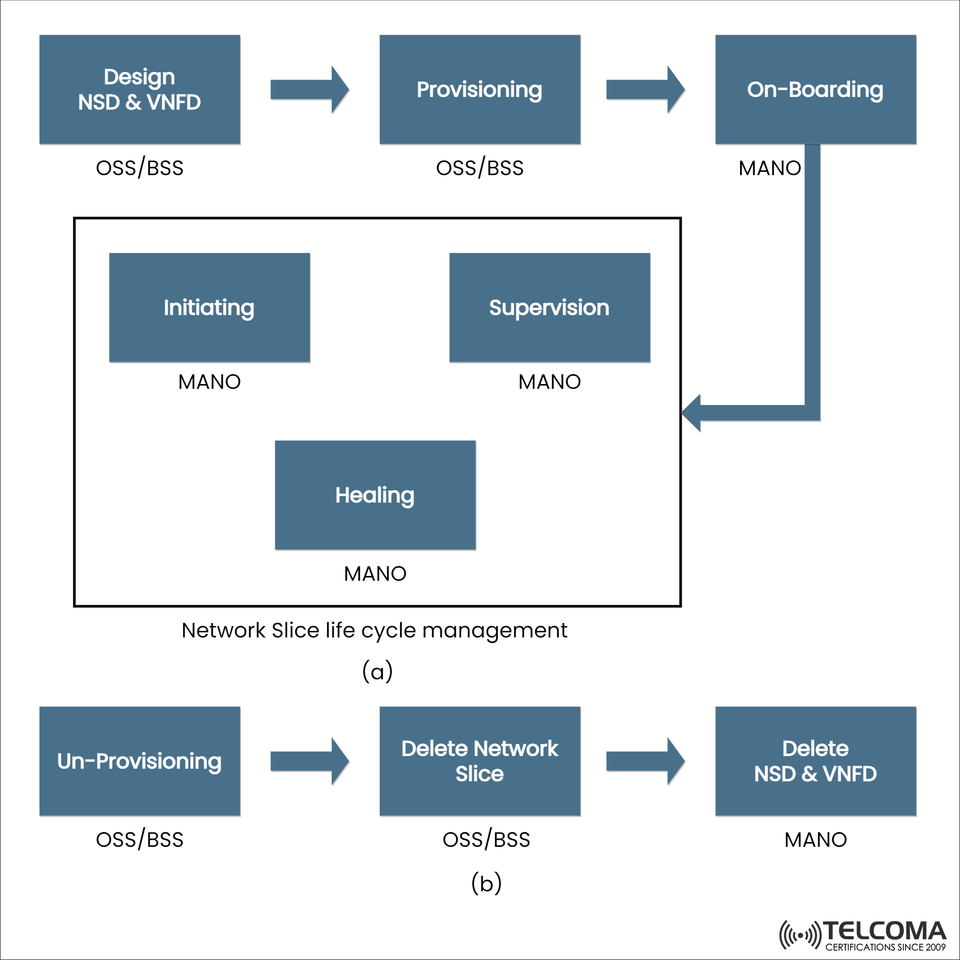

Network Slice Life Cycle Management in 5G: From Design to Deletion
As 5G keeps growing to support a wide range of applications — everything from IoT to autonomous vehicles — network slicing has really emerged as a key element in telecom innovation. It enables operators to set up numerous virtualized and isolated network instances, each one tailored to meet specific service needs.
The diagram above illustrates the Network Slice Life Cycle Management (NSLCM) process, which includes steps like design, provisioning, onboarding, initiation, supervision, healing, and deletion. These steps are crucial for maintaining automation, flexibility, and reliability throughout 5G networks.
Introduction to Network Slicing
Network slicing essentially allows a single physical network to be divided into multiple logical networks (or slices). Each slice can be fine-tuned to meet different QoS (Quality of Service), latency, bandwidth, and security demands.
For example:
An IoT slice is focused on handling many devices with low power consumption.
A URRLC slice is built for ultra-low latency (ideal for autonomous driving).
An eMBB slice provides high throughput for things like HD streaming or virtual reality.
To efficiently manage these adaptable slices, the 5G framework depends on Network Slice Life Cycle Management, mainly coordinated by OSS/BSS (Operations and Business Support Systems) and MANO (Management and Orchestration).
Overview of Network Slice Life Cycle
The life cycle of a network slice breaks down into two main phases:
Network Slice Creation and Operation (a) * Design * Provisioning * Onboarding * Initiation * Supervision * Healing
Network Slice Termination (b) * Un-provisioning * Deleting the network slice * Removing descriptors
This process makes sure that slices are created efficiently, monitored effectively, and removed when they’re no longer needed.
Phase A – Network Slice Creation and Operation
This phase is all about setting up and keeping the network slice in working order.
Design: NSD & VNFD (OSS/BSS)
NSD (Network Service Descriptor) and VNFD (Virtual Network Function Descriptor) are templates that outline the blueprint of the network slice.
The NSD details how different network functions (NFs) connect to provide a complete service.
The VNFD specifies all the particulars of each virtual network function, including resources, settings, and dependencies.
Activities at this stage include:
Setting KPIs and QoS needs.
Mapping VNFs to physical or virtual infrastructure.
Creating orchestration templates for automation.
This design work is typically managed by OSS/BSS, where business policies and service goals are converted into technical blueprints.
Provisioning (OSS/BSS)
After defining the NSD and VNFD, provisioning steps in to make sure that the necessary network and computing resources are in place.
Key tasks include:
Reserving virtualized infrastructure (compute, storage, and network).
Establishing connections between VNFs and PNFs (Physical Network Functions).
Configuring SLA-based policies and performance parameters.
Provisioning is crucial to guarantee that everything needed for the slice is available, connected, and in line with service-level objectives (SLOs).
Onboarding (MANO)
Once provisioning’s done, the onboarding phase involves bringing in and checking the network descriptors and functions within the MANO framework.
MANO (Management and Orchestration) — as defined by ETSI NFV — has three main parts:
NFVO (NFV Orchestrator) – Responsible for orchestrating network services and managing their lifecycle.
VNFM (VNF Manager) – Looks after the lifecycle of VNFs.
VIM (Virtualized Infrastructure Manager) – Manages the infrastructure resources.
During onboarding:
MANO checks the compatibility of the NSD and VNFD templates.
Service catalogs get integrated.
Slice-specific settings are registered for automation.
At this point, the network slice is set to go live.
Initiating (MANO)
After onboarding wraps up, the MANO system kicks off instantiation — creating the network slice instance (NSI).
Tasks here include:
Deploying VNFs and linking service chains.
Assigning identifiers (like Slice/Service Type - SST).
Setting service parameters in line with SLA.
The initiating phase gets the slice into an operational state, fully prepared to deliver services.
Supervision (MANO)
Once active, the slice enters the supervision phase, where real-time monitoring takes place to ensure service performance and compliance.
Supervision activities include:
Tracking KPIs (latency, throughput, packet loss, etc.).
Conducting anomaly detection with AI/ML analytics.
Adjusting resources based on network demand.
This ongoing supervision is automated via closed-loop management systems, which help optimize the network proactively.
Healing (MANO)
If something goes wrong or performance dips, healing mechanisms get to work to maintain service continuity.
Healing actions include:
Automatically detecting and isolating faults.
Restarting or redeploying failed VNFs.
Rerouting traffic through backup network paths.
Self-healing is a key feature of 5G network automation, ensuring service resilience without needing manual intervention.
Phase B – Network Slice Termination
When a network slice is no longer needed, the termination phase kicks in to deactivate and eliminate the slice, freeing up resources.
Un-Provisioning (OSS/BSS)
The first step in the termination process is un-provisioning, where OSS/BSS coordinates with MANO to release allocated resources.
Tasks include:
Disconnecting the components of the slice.
Stopping active VNFs and service flows.
Informing MANO and NFVO about the slice deactivation.
Delete Network Slice (OSS/BSS)
Once un-provisioning is done, the network slice instance (NSI) is then deleted. This step ensures that no leftover configurations are left in the network.
The OSS/BSS updates its internal records to show that the slice is no longer part of the operational catalog.
Benefits of Automated Network Slice Life Cycle Management
Putting NSLCM into action with OSS/BSS and MANO integration delivers a bunch of operational benefits:
Lower OPEX: Automation cuts out manual configuration work.
Improved Agility: Quick deployment and scaling of network slices.
Service Assurance: Real-time tracking guarantees SLA compliance.
Resilience: Self-healing and supervision help minimize downtime.
Customization: Supports various services — from IoT to URLLC — all on one infrastructure.
These points are essential for 5G operators, cloud-native networks, and the upcoming 6G ecosystems.
Real-World Applications
Network Slice Life Cycle Management is already being utilized in:
Smart cities: Dynamic slices for IoT sensors and public safety measures.
Industry 4.0: Low-latency slices for automation in factories.
Telemedicine: Reliable, high-bandwidth slices for remote surgeries.
Enterprise networks: Secure slices for private 5G networks.
Thanks to automation and orchestration, operators can provide services on-demand, cutting lead times down from weeks to just minutes.
Conclusion
The Network Slice Life Cycle Management process is key to unlocking the full capabilities of 5G and 6G networks.
By integrating OSS/BSS for business logic with MANO for orchestration, operators can design, deploy, monitor, heal, and retire network slices seamlessly.
This setup transforms telecom operations into a cloud-native, automated, and service-driven architecture, paving the way for next-gen digital ecosystems — where each service gets its own dedicated, intelligent, and optimized slice.