
Understanding NFV Infrastructure: VMware-Based Management, Edge, and Resource Clusters in Telecom Clouds

VMware-Based NFV Infrastructure: The Backbone of Telecom Cloud Networks
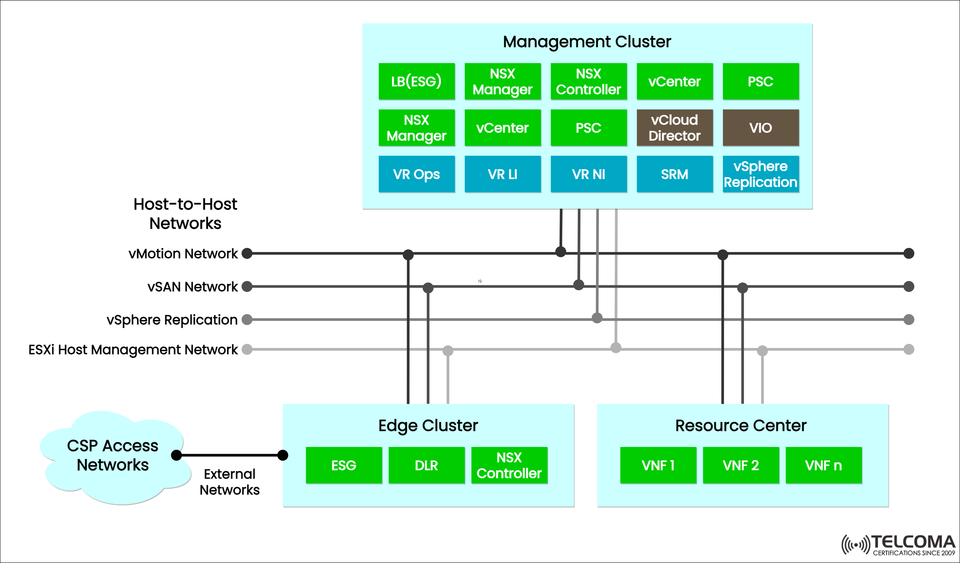
As telecom networks are evolving to better support 5G, IoT, and edge computing, moving from hardware-based setups to a virtualized, software-defined infrastructure has become essential. The image provided—“NFV Infrastructure with VMware Clusters”—shows a modern NFV (Network Functions Virtualization) framework built with VMware’s virtualization ecosystem. It highlights the management, edge, and resource clusters that are all linked by host-to-host networks.
This architecture lays the groundwork for carrier-grade telecom clouds, providing agility, scalability, and automation across distributed setups.
The Role of NFV in Modern Telecom Architecture
In traditional telecom networks, each function—like firewalls, gateways, and routers—was tied to its own piece of hardware. But with NFV, these functions can be separated from the hardware, and deployed as Virtual Network Functions (VNFs) on standard servers.
By using virtualization platforms like VMware vSphere, NSX, and vCloud Director, operators can create flexible cloud infrastructures that support:
Dynamic resource allocation
Scalable service deployment
Efficient fault recovery
Centralized orchestration
The image demonstrates how these principles come to life in a multi-cluster NFV cloud, showcasing a Management Cluster, Edge Cluster, and Resource Center connected by resilient network fabrics.
Management Cluster: The Control Plane of NFV Operations
At the top of the diagram is the Management Cluster, which is the nerve center for the entire NFV infrastructure. This cluster takes care of the orchestration, automation, and lifecycle management of VNFs and virtual resources.
Key Components of the Management Cluster
LB (ESG): Load Balancer (Edge Services Gateway) for workload distribution, managed by VMware NSX.
NSX Manager / Controller: Oversees network virtualization, overlays, and security policies, part of NSX Network Virtualization.
vCenter: Centralized management for virtual machines and hosts, integrating with VMware vSphere.
PSC (Platform Services Controller): Provides authentication and certificate management for VMware Infrastructure.
vCloud Director (vCD): Facilitates multi-tenant cloud management for service providers using VMware Cloud Director.
VIO (VMware Integrated OpenStack): Merges OpenStack APIs with VMware for hybrid NFV operations.
VR Ops / LI / NI / SRM: Operational tools for logging, network insight, and site recovery management, from VMware Cloud Operations Tools.
vSphere Replication: Handles data synchronization across sites using VMware vSphere.
Together, these components give a complete view of the NFV ecosystem, covering compute, storage, networking, and VNFs.
Functions of the Management Cluster
Orchestration and Automation: Simplifies deployment and scaling of VNFs.
Monitoring and Analytics: Keeps an eye on performance via the VMware vRealize suite.
Security and Compliance: Utilizes NSX’s micro-segmentation for controlling east-west traffic.
Disaster Recovery: Uses SRM and vSphere Replication for redundancy.
In short, the Management Cluster serves as the control plane, ensuring smooth coordination among VNFs, edge gateways, and data center resources.
Edge Cluster: The Gateway Between Telecom Cloud and External Networks
The Edge Cluster is the bridge connecting the telecom operator’s cloud with external customer-facing networks, known as CSP (Communication Service Provider) Access Networks in the image.
Key Components in the Edge Cluster
ESG (Edge Services Gateway): Connects, routes, and secures traffic between virtual and external networks.
DLR (Distributed Logical Router): Manages dynamic Layer 3 routing within the virtual network.
NSX Controller: Governs NSX logical switches, routers, and control-plane functions.
Functions of the Edge Cluster
Traffic Management: Guides data between VNFs and external networks.
Security Enforcement: Applies firewall, NAT, and VPN policies on the network edge.
High Availability: Supports failover and load balancing for VNFs.
Policy Control: Works with NSX and SDN controllers for programmable networking.
Essentially, the Edge Cluster acts as the data plane interface, ensuring secure and fast connectivity between internal NFV systems and customer access points.
Resource Center: The Compute Core of Virtualized Network Functions
At the core of NFV operations is the Resource Center, which hosts the Virtual Network Functions (VNFs). Each VNF stands for a specific telecom function, like a firewall (vFW), Session Border Controller (vSBC), or Evolved Packet Core (vEPC).
Key Elements
VNF 1, VNF 2, … VNF n: Represent various virtualized telecom services.
Managed and orchestrated via the Management Cluster through vCenter and vCloud Director.
Operate on VMware’s ESXi hypervisors supported by vSAN for distributed storage.
Functions of the Resource Center
Dynamic Service Deployment: Installs new VNFs as needed.
Elastic Resource Scaling: Scales resources up or down based on demand.
Performance Monitoring: Uses VR Ops and LI to maintain Quality of Service (QoS).
Interoperability: Allows multi-vendor VNFs through open standards (ETSI MANO).
This layer functions as the execution environment for telecom workloads, enabling operators to launch new services quickly without being tied to hardware.
Host-to-Host Networks: The Communication Fabric
The Host-to-Host Networks in the diagram act as the interconnect fabric that ties all clusters together. Each network type serves a unique role in enhancing performance, redundancy, and manageability.
Types of Networks
vMotion Network: Facilitates live migration of virtual machines across hosts without any downtime.
vSAN Network: Offers distributed storage, pooling local disks into a shared data pool.
vSphere Replication Network: Manages data synchronization between main and recovery sites for disaster recovery.
ESXi Host Management Network: Handles management traffic for host setup and monitoring.
These interconnected networks ensure high availability, fault tolerance, and data consistency throughout the NFV infrastructure.
CSP Access Networks and External Connectivity
On the left side of the diagram, CSP Access Networks represent the external telecom access points linking to Edge Clusters. These networks provide:
Customer data ingress and egress for internet, mobile, or enterprise users.
Integration with existing telecom setups like EPC or 5G Core.
Support for SLAs by routing through ESG-managed paths to optimize latency and throughput.
This link ensures VNFs can effectively deliver real-world services such as voice, video, and data to subscribers without a hitch.
How It All Works Together
The three clusters—Management, Edge, and Resource Center—function as an integrated ecosystem:
Management Cluster orchestrates and monitors everything.
Edge Cluster connects with outside networks.
Resource Center runs the VNFs.
Host-to-Host Networks ensure smooth data flow.
This collaboration creates a resilient, software-defined telecom cloud, capable of supporting 5G network slicing, edge computing, and carrier-grade automation.
Conclusion
The VMware-based NFV architecture illustrated here serves as a model for the next-generation telecom cloud. By fusing management intelligence, network virtualization, and distributed resources, telecom operators can achieve remarkable levels of agility, scalability, and service innovation.
The combination of vCloud Director, NSX, VIO, and vSphere sets up a platform ready for everything from core network virtualization to edge computing and 5G orchestration.
In short, this design is a perfect example of the move towards a fully virtualized, automated, and software-driven telecom infrastructure—where cloud agility meets the reliability that carriers need.