
Understanding NG-RAN Architecture in 5G: gNB, ng-eNB, NG & Xn Interfaces

The Basis of 5G Radio Access
The Next Generation Radio Access Network (NG-RAN) is a key part of 5G technology. It links user devices (UE) to the 5G Core (5GC) using advanced nodes like gNBs (5G base stations) and ng-eNBs (enhanced LTE base stations tied to 5GC).
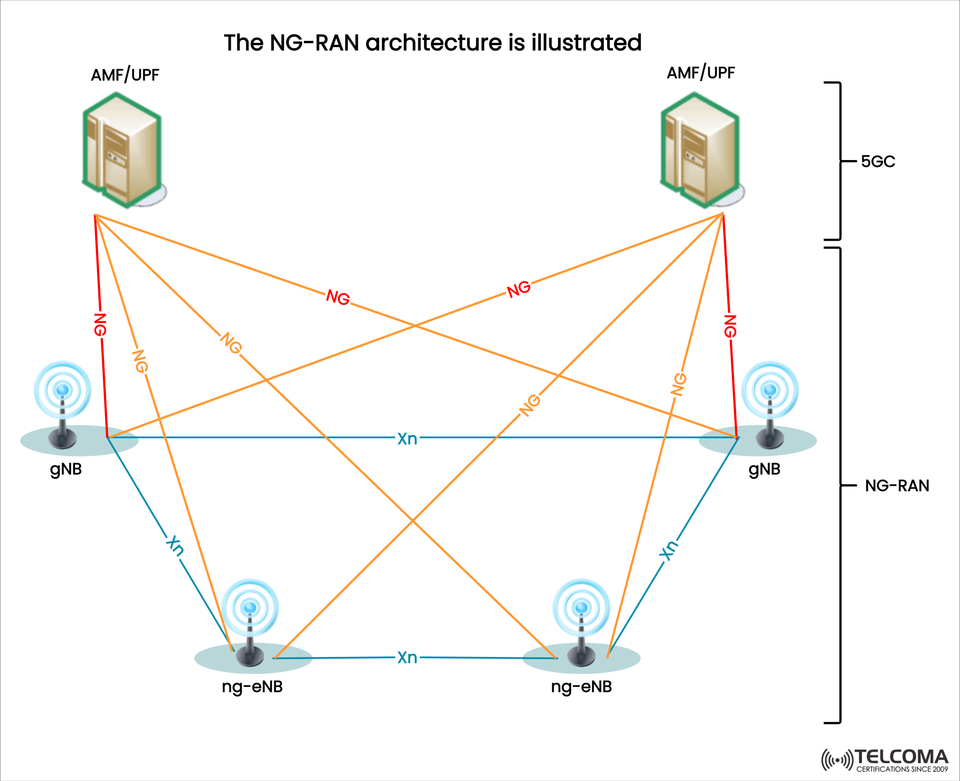
The diagram provided shows how these network components connect via NG interfaces (RAN to 5GC) and Xn interfaces (between base stations). Getting a grip on this setup is crucial for those involved in deploying and fine-tuning 5G networks.
Key Elements of NG-RAN Architecture
The NG-RAN comprises:
gNB (Next Generation NodeB) * The standard base station for 5G. * Offers NR (New Radio) connectivity. * Links to the 5G Core through the NG interface.
ng-eNB (Next Generation eNodeB) * An upgraded LTE eNodeB that connects to the 5GC. * Supports LTE radio while utilizing the new 5G Core instead of EPC. * Ensures smooth operation between LTE and NR.
5GC (5G Core) * Made up of various functional blocks, with AMF (Access and Mobility Management Function) and UPF (User Plane Function) being key here. * AMF handles signaling, mobility, and authentication. * UPF takes care of routing and forwarding user-plane traffic.
Interfaces (NG and Xn): * NG Interface: Links gNB/ng-eNB to 5GC. * Xn Interface: Connects different gNBs or links a gNB to an ng-eNB for inter-cell communication.
The NG Interface – Connecting RAN to 5G Core
The NG interface serves as the link between NG-RAN and 5GC, ensuring that both control and user-plane traffic are managed effectively.
Types of NG Interface:
NG-C (Control Plane): Between gNB and AMF, it deals with signaling like session setup, mobility, and security.
NG-U (User Plane): Between gNB and UPF, it manages user data traffic (like streaming video or browsing).
Functions of NG Interface:
Offers control and user plane separation.
Enables flexible network function deployment.
Supports handover between gNB and ng-eNB while remaining anchored in 5GC.
In the diagram, you can see the NG connections linking gNBs and ng-eNBs directly to the AMF/UPF.
The Xn Interface – Communication Between Nodes
The Xn interface plays a vital role in inter-node communication within NG-RAN, allowing gNBs and ng-eNBs to work together smoothly.
Key Functions of Xn:
Handover Support: Lets devices move between cells without putting too much pressure on the core network.
Load Balancing: Smartly spreads traffic across multiple cells.
Dual Connectivity: Allows for simultaneous connections to different nodes (like LTE and NR).
Benefits:
Reduces handover latency with direct node-to-node signaling.
Supports multi-RAT coexistence (LTE and NR).
Ensures efficient spectrum use via coordination between neighboring cells.
The diagram illustrates Xn connections between gNBs and ng-eNBs, creating a mesh network ideal for flexible handovers and collaboration.
How NG-RAN Stands Apart from LTE RAN
Feature LTE RAN (E-UTRAN)NG-RAN (5G RAN)Core Network EPC (Evolved Packet Core)5GC (Service-Based Architecture)Base Stations eNBgNB and ng-eNBInterfacesS1NG, Xn Control/User Plane Less flexible Separation of Control and User Plane Interworking Primarily LTELTE and NR interoperability
This transition enables NG-RAN to support new 5G features, including network slicing, URLLC (ultra-reliable low latency communication), and massive IoT.
Detailed Workflow in NG-RAN
Let’s sketch out a simplified data session in NG-RAN:
UE connects to gNB/ng-eNB: Initial access and RRC signaling take place.
NG-C interface: The gNB talks to the AMF to verify the user and set up mobility contexts.
NG-U interface: Once the session is active, user data moves to the UPF via the gNB.
Xn interface (if mobility occurs): * When the UE is on the move, the original gNB transfers the session to the target gNB using Xn signaling. * This helps avoid any service disruption.
5GC processes: The AMF updates mobility status, while the UPF keeps forwarding data to the UE.
This setup offers both flexibility and reliability for tackling complex 5G use cases.
Deployment Scenarios for NG-RAN
Standalone NR Deployment (gNB + 5GC): * A fully 5G setup where the gNB connects straight to the 5GC. * Delivers high speeds and ultra-low latency.
Non-Standalone Deployment (LTE + NR with ng-eNB): * Upgraded LTE eNBs (now ng-eNB) linked to the 5GC. * Ensures compatibility with older tech and a gradual 5G rollout.
Dual Connectivity: * UE can connect at the same time to LTE (ng-eNB) and NR (gNB). * Provides reliability, especially during early 5G deployments.
Advantages of NG-RAN
Scalability: Can handle a huge number of device connections for IoT.
Flexibility: Functions well in both standalone and non-standalone modes.
Low Latency: Direct Xn handovers minimize interruptions.
Spectrum Efficiency: Combines LTE and NR bands effectively.
Future-Readiness: Prepped for 5G advanced features like slicing and edge computing.
Challenges in NG-RAN
Despite its strengths, NG-RAN has its challenges:
Complex Interworking: Coordinating gNB and ng-eNB in mixed setups demands advanced management.
Signaling Overhead: More interfaces mean more signaling, especially in densely packed small cell layouts.
Backhaul Requirements: Need high-capacity, low-latency backhaul links.
Security: With more interfaces, the risk of attacks rises, necessitating strong security measures.
Real-World Example
Think of a user streaming AR/VR content on a 5G smartphone:
The gNB connects to the 5GC using NG-C and NG-U for signaling and data.
As the user moves, the Xn interface allows for quick handover to a nearby gNB.
If LTE signal is stronger indoors, the UE can switch to an ng-eNB connected to 5GC, keeping the service going.
The 5GC maintains session continuity while distributing traffic via UPF.
The outcome? A smooth AR/VR experience with hardly any lag.
Conclusion
The NG-RAN architecture is central to 5G radio access, built for flexibility, scalability, and efficiency. By connecting gNBs and ng-eNBs to the 5GC through NG interfaces and linking them via Xn interfaces, NG-RAN makes it possible to:
Support seamless mobility and handovers
Enable efficient LTE-NR coexistence
Cater to new 5G services like IoT, URLLC, and AR/VR
For those in telecom, getting a handle on NG-RAN concepts is essential for rolling out and fine-tuning next-gen 5G networks.