
Understanding NGAP in 5G Architecture: Protocol Functions, Interfaces, and Control Plane Communication
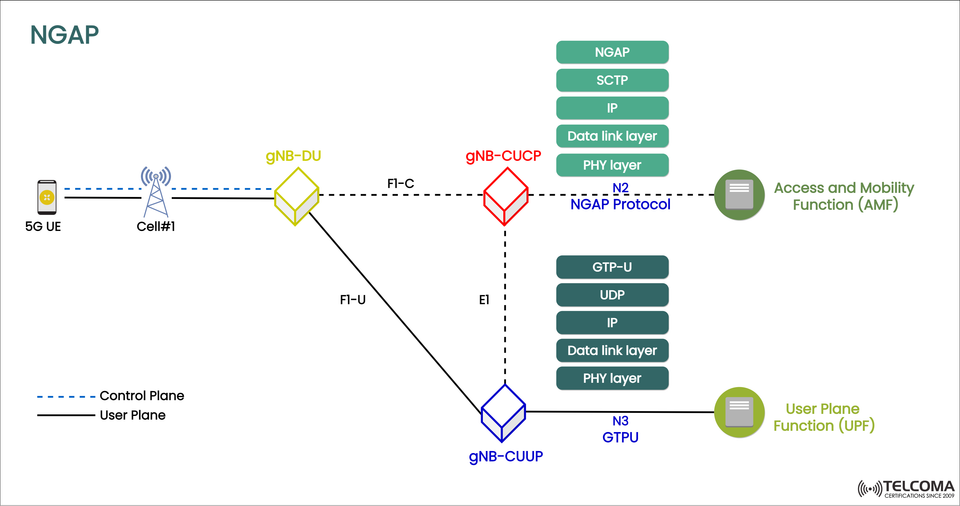

5G architecture, it's super important to have smooth coordination between the Radio Access Network (RAN) and the Core Network (5GC). The Next Generation Application Protocol (NGAP) really serves as the backbone for this interaction.
NGAP works on the control plane, allowing signaling messages to be exchanged between the gNB (Next Generation NodeB) and the AMF (Access and Mobility Management Function) over the N2 interface.
The image shared does a great job showing how everything flows — connecting the 5G UE through the gNB-DU, gNB-CUCP, and gNB-CUUP, eventually leading to the AMF and UPF through the standard 3GPP interfaces.
Now, let’s dive into what NGAP is all about, how it functions, and why it’s such a big deal in today’s 5G networks.
What Exactly is NGAP?
Defining NGAP
NGAP, short for Next Generation Application Protocol, is outlined by 3GPP TS 38.413. It’s a control plane protocol used between:
gNB-CUCP (Centralized Unit – Control Plane)
AMF (Access and Mobility Management Function)
This protocol is in charge of handling signaling, mobility, and session control for 5G UEs (User Equipment).
Where NGAP Fits in the 5G Network Stack
From the provided image, you can see that NGAP sits in the upper control layer and relies on:
SCTP (Stream Control Transmission Protocol) for reliable transport,
IP, Data Link, and PHY layers for transmission.
The communication protocol stack for NGAP looks like this:
Application Layer: NGAP
Transport Layer: SCTP
Network Layer: IP
Data Link Layer: Ethernet or similar
Physical Layer: Optical/Fiber/RF Transport
This setup ensures reliable message delivery between the gNB-CUCP and AMF via the N2 interface.
Overview of the Architecture (Referencing the Image)
The diagram highlights how the NGAP protocol relates to other entities and interfaces in the 5G system:
- 5G UE (User Equipment)
Kicks off access and mobility procedures (like registration and handover).
Sends RRC messages that are bundled into NGAP when they reach the core.
- gNB-DU (Distributed Unit)
Takes care of RLC, MAC, and PHY layer tasks.
Connects to gNB-CUCP (for control) through F1-C and to gNB-CUUP (for user plane) through F1-U.
- gNB-CUCP (Central Unit Control Plane)
Runs RRC, PDCP (control plane), and NGAP layers.
Acts as an intermediary between RAN and AMF for all signaling.
Talks to gNB-CUUP via the E1 interface.
- gNB-CUUP (Central Unit User Plane)
Takes care of user data forwarding using the GTP-U protocol.
Links up with UPF (User Plane Function) through the N3 interface.
- AMF (Access and Mobility Management Function)
It serves as the control plane anchor in 5GC.
Manages UE registration, mobility, authentication, and session setup through NGAP.
- UPF (User Plane Function)
Handles the flow of user data (data plane).
Connected via GTP-U over N3.
The N2 Interface and NGAP’s Importance
NGAP is the application layer protocol for the N2 interface (between gNB-CUCP and AMF).
Key Functions of the N2 Interface through NGAP:
Setting up and managing UE contexts.
Moving Non-Access Stratum (NAS) messages between UE and AMF.
Taking care of mobility procedures like handover and paging.
Managing bearer setup and adjustments.
The N2 interface carries the crucial signaling info needed for session establishment, handover, and QoS enforcement.
Distinguishing Control Plane from User Plane Communication
The diagram clearly illustrates the divide between control plane (blue dashed lines) and user plane (black solid lines):
Plane Protocol Used Key Interfaces Functions Control Plane NGAP, SCTPF1-C, E1, N2Signaling, registration, mobility management User Plane GTP-U, UDPF1-U, N3User data transfer
This separation boosts network efficiency and allows for independent scaling of signaling and data functions — a major perk in cloud-native 5G networks.
Let’s Break Down NGAP’s Functions
NGAP has a broad range of control functions in 5G architecture. Here are some key ones:
- UE Registration and Deregistration
When a 5G UE powers on, it sends out a registration request.
The gNB wraps this into an NGAP Initial UE Message to the AMF.
AMF checks authentication and sets up a UE context in both the RAN and Core.
- UE Context Management
Deals with UE identifiers (RAN UE NGAP ID, AMF UE NGAP ID).
Keeps everything running smoothly during mobility or session changes.
- Handover Procedures
NGAP covers both intra-AMF and inter-AMF handovers.
Uses messages like Handover Required, Handover Command, and Handover Notify to keep connections steady.
Protocols that Work with NGAP
NGAP doesn’t work alone. It interacts with various layers and protocols to maintain control and data flow:
- F1 and E1 Interfaces
F1-C (Control): Between gNB-DU and gNB-CUCP.
F1-U (User): Between gNB-DU and gNB-CUUP.
E1 Interface: Between gNB-CUCP and gNB-CUUP for coordinating control and user operations.
Benefits of Using NGAP in 5G
Bringing NGAP into the mix offers a bunch of operational and architectural perks:
Efficient Control Signaling: Minimizes signaling overhead and smooths out message flows.
Scalability: Allows for separate scaling of control and user planes.
Mobility Management: Makes sure UE can move seamlessly across cells and AMFs.
Multi-vendor Interoperability: Standardized through 3GPP TS 38.413.
Security and Reliability: SCTP guarantees message integrity and resilience.
Virtualization Ready: Can be deployed in virtualized and cloud-native setups.
Challenges and Things to Keep in Mind During Implementation
Even with its advantages, there are some challenges with NGAP implementation:
Complexity: Keeping track of state across distributed CU/DU nodes can be tricky.
Synchronization: Control and user planes have strict timing needs.
Interoperability: Making sure everything works well across different vendor setups.
Testing: Requires thorough validation of all NGAP processes (like handover and paging).
Advanced orchestration systems and the Service-Based Architecture (SBA) in 5GC help address these issues.
Wrapping Up
The Next Generation Application Protocol (NGAP) is crucial for control plane communication in the interaction between 5G RAN and Core. It handles UE registration, handovers, session setups, and NAS message transport between gNB-CUCP and AMF through the N2 interface — all while ensuring smooth mobility and solid signaling.
By working alongside SCTP, GTP-U, and F1/E1 interfaces, NGAP helps build a modular, scalable, and high-performance 5G network.