
Understanding NR-ARFCN in 5G NR: Frequency Ranges, Parameters, and Calculation Explained

Getting to Grips with NR-ARFCN in 5G NR: A Look at Frequency Ranges, Parameters, and the Calculation Process
With the launch of 5G New Radio (NR), managing frequencies has gotten quite a bit trickier. Unlike LTE, which had a limited range for its Absolute Radio Frequency Channel Number (ARFCN), 5G stretches all the way from below 1 GHz to almost 100 GHz.
To create a standard frequency reference over this broad spectrum, the 3GPP has put forth NR-ARFCN — a special identifier that corresponds to every possible 5G carrier frequency.
In this guide, we’ll dive into what NR-ARFCN is, how it’s calculated, and what the frequency ranges, offsets, and spacing parameters look like — all based on the reference chart from TELCOMA Certification.
What is NR-ARFCN?
NR-ARFCN (New Radio Absolute Radio Frequency Channel Number) is a numerical value in 5G NR that indicates a specific carrier frequency. Each ARFCN is tied to a unique center frequency, which helps base stations and user equipment (UE) synchronize on the right radio channel for transmission or reception.
Why Does It Matter?
Makes sure frequencies align across global 5G networks
Supports dynamic spectrum sharing among operators
Aids in smooth handovers and carrier aggregation across different frequency ranges
Basically, NR-ARFCN provides a universal numbering system for all 5G carrier frequencies — whether they're sub-6 GHz (FR1) or up in the millimeter wave range (FR2).
The NR-ARFCN Calculation Formula
The equation defined by 3GPP (TS 38.104) for converting between NR-ARFCN and actual frequency is:
FREF = FREF-Offs + ΔFGlobal × (NREF - NREF-Offs)
Where:
Parameter Description FREF Reference frequency in MHz FREF-Offs Offset frequency for that range (MHz)ΔFGlobalChannel spacing (kHz)NREFNR-ARFCN (the channel number)NREF-Offs Offset for that frequency range
This formula makes sure there's a consistent mapping of frequency to channel across all 5G bands.
Understanding the NR-ARFCN Table
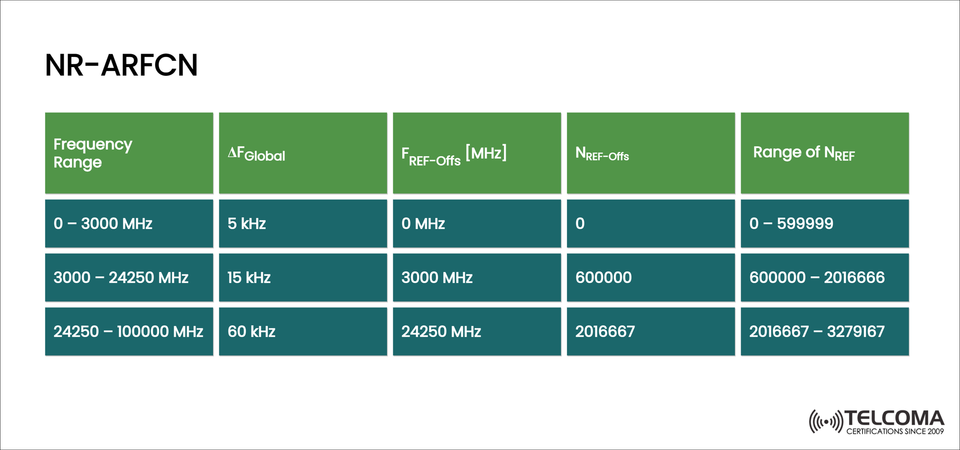
The image from TELCOMA provides a snapshot of NR-ARFCN parameters for all defined frequency ranges.
Frequency RangeΔFGlobalFREF-Offs (MHz)NREF-OffsRange of NREF0 – 3000 MHz5 kHz0 MHz00 – 599,9993000 – 24,250 MHz15 kHz3000 MHz600,000600,000 – 2,016,66624,250 – 100,000 MHz60 kHz24,250 MHz2,016,6672,016,667 – 3,279,167
Each frequency range matches up with a specific ΔFGlobal (frequency spacing) and reference offset. Let’s take a closer look at each one.
- Frequency Range 1: 0 – 3000 MHz (Sub-3 GHz)
ΔFGlobal: 5 kHz
FREF-Offs: 0 MHz
NREF-Offs: 0
NREF Range: 0 – 599,999
This range includes low-band 5G frequencies, leveraging existing LTE bands that have been repurposed for NR.
Typical examples include: n5 (850 MHz), n8 (900 MHz), n28 (700 MHz), and lower parts of n78.
Key Features
Small ΔFGlobal means finer frequency resolution
Lower frequencies provide broader coverage and better penetration
Ideal for rural and large-area deployments
Example Calculation
Let’s calculate the center frequency for NR-ARFCN = 100,000:
FREF = 0 + (5 kHz × 100,000) = 500,000 kHz = 500 MHz
So, ARFCN 100,000 corresponds to 500 MHz.
- Frequency Range 2: 3000 – 24,250 MHz (Mid-band or sub-6 GHz)
ΔFGlobal: 15 kHz
FREF-Offs: 3000 MHz
NREF-Offs: 600,000
NREF Range: 600,000 – 2,016,666
This range is really the heart of 5G — covering C-band and n78/n77 frequencies that strike a good balance between speed and coverage.
Key Features
Moderate spacing (15 kHz) balances precision with bandwidth
Supports wider channels (up to 100 MHz or more)
Used by most global operators for initial 5G rollouts
Example Calculation
Let’s find the frequency for NR-ARFCN = 700,000:
FREF = 3000 MHz + 15 kHz × (700,000 – 600,000) = 3000 MHz + 1500 MHz = 4500 MHz
Thus, NR-ARFCN 700,000 corresponds to 4.5 GHz, part of the C-band.
- Frequency Range 3: 24,250 – 100,000 MHz (mmWave bands)
ΔFGlobal: 60 kHz
FREF-Offs: 24,250 MHz
NREF-Offs: 2,016,667
NREF Range: 2,016,667 – 3,279,167
This range includes millimeter wave (mmWave) — super high frequencies that allow for multi-gigabit data rates, but their range is limited.
Typical bands are n257 (26 GHz), n258 (26.5 GHz), n260 (39 GHz), and beyond.
Key Features
Larger ΔFGlobal leads to a higher frequency step size
Great for ultra-fast, high-capacity 5G hotspots
Shorter propagation distance; best for urban or indoor settings
Example Calculation
For NR-ARFCN = 2,100,000:
FREF = 24,250 MHz + 60 kHz × (2,100,000 – 2,016,667) = 24,250 MHz + 5000 MHz = 29,250 MHz
So, ARFCN 2,100,000 is roughly 29.25 GHz.
Frequency Ranges in Context: FR1 and FR2
In 5G lingo:
FR1 = 410 MHz – 7125 MHz (includes ranges 1 plus part of 2)
FR2 = 24.25 GHz – 52.6 GHz (within range 3)
The table extends further (up to 100 GHz) for future scalability — ensuring that 5G NR is ready for next-gen applications, including 6G prep.
Visual Recap (from the TELCOMA Chart)
The TELCOMA chart neatly summarizes:
Frequency Ranges (MHz)
ΔFGlobal (spacing per range)
FREF-Offs and NREF-Offs
NREF value ranges
These details are directly aligned with 3GPP TS 38.104 Table 5.4.2.1-1 — making it a solid reference for professionals involved in RF planning, network tuning, or equipment design.
Why Different ΔFGlobal Values?
The ΔFGlobal — the frequency step size — varies by range for these reasons:
Frequency Range Step SizeReason0 – 3 GHz5 kHz More precision is needed for low-frequency bands3 – 24.25 GHz15 kHz Balanced step for mid-band channels24.25 – 100 GHz60 kHz Coarser granularity fits large mmWave bandwidths
Smaller spacing allows for finer tuning accuracy, while larger spacing streamlines numbering in high-frequency areas.
Practical Uses of NR-ARFCN
- Network Planning
Engineers leverage NR-ARFCN to assign carriers for uplink and downlink, ensuring there’s no overlap.
- Device Setup
User Equipment (UE) uses NR-ARFCN to lock onto specific frequencies during cell searches and handovers.
- Spectrum Sharing
NR-ARFCN facilitates Dynamic Spectrum Sharing (DSS) — letting LTE and 5G coexist in the same band.
- Multi-Band Carrier Aggregation
Helps devices combine carriers across FR1 and FR2 using a standardized channel numbering system.
Common Industry Applications
C-Band Deployment: NR-ARFCN values between 620,000–680,000 (approx. 3.4–3.8 GHz)
n258 Band: NR-ARFCN ~ 2,170,000 – 2,400,000 (26–29 GHz)
Low-Band 700 MHz (n28): NR-ARFCN around 140,000 – 160,000
This kind of mapping guarantees inter-vendor consistency, making it easier for smartphones, base stations, and testing equipment to communicate.
Conclusion
NR-ARFCN forms the backbone of 5G NR’s frequency organization. It standardizes how every potential carrier frequency — from 410 MHz to nearly 100 GHz — is numerically represented, promoting global interoperability.
By grasping:
The three main frequency ranges,
The role of ΔFGlobal, FREF-Offs, and NREF-Offs, and
How to calculate frequencies from ARFCN values,
telecom professionals can confidently design, test, and optimize next-gen 5G networks.
As networks continue to evolve towards 6G, this framework will expand — yet the main idea will stay the same: a universal, mathematical approach to define every radio frequency on the planet.