
Understanding NR-Lite: Why 5G Needs a Tailored Approach for Low-Tier UEs
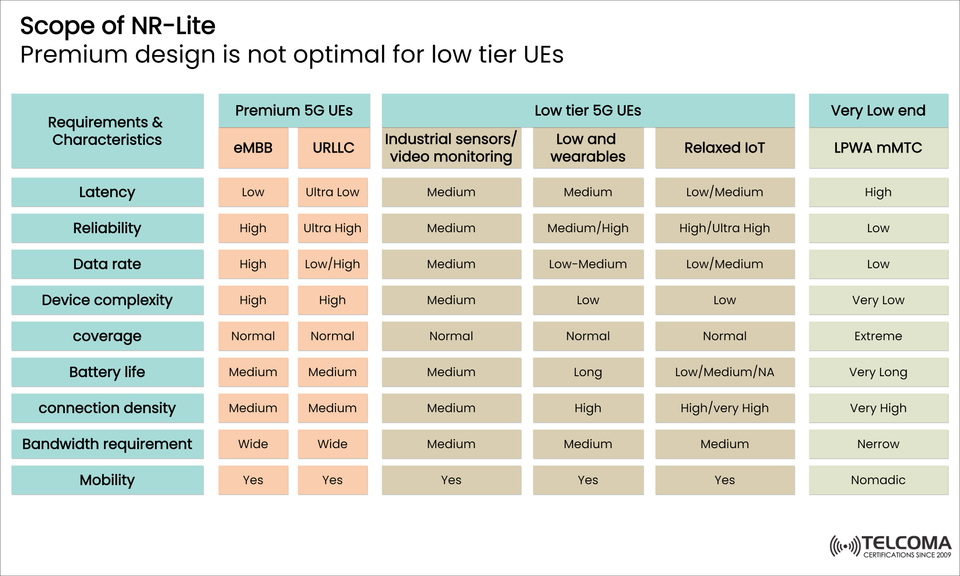

📶 Scope of NR-Lite in 5G: Single Purpose Design for Low Tier Devices
As 5G networks come online, the requirement to connect many lightweight, low complexity devices will substantially grow. NR-Lite is a 3GPP-defined tentative version of the 5G NR standard used to design low tier user equipment (UE) that includes devices such as IoT sensors, wearables, and mMTC devices that will not benefit from higher-end 5G devices, through the provision of lightweight, low complexity, low-cost wireless connectivity.
The graph above illustrates how NR-Lite will serve these devices by providing cost efficiency, battery life and extended coverage, while discounting the unnecessary functionalities of eMBB or URLLC UEs.
📊 NR-Lite vs Premium 5G UEs: Feature Comparison Table
Requirement Premium 5G (eMBB/URLLC) Low Tier 5G UEs (e.g. wearables, industrial IoT) Very Low-End (e.g. LPWA, mMTC)
Latency Low / Ultra Low Medium to Low/Medium High
Reliability High / Ultra High Medium to High / Ultra High Low
Data Rate High Medium to Low/Medium Low
Device Complexity High Medium to Low Very Low
Coverage Normal Normal Extreme
Battery Life Medium Medium to Long Very Long
Connection Density Medium Medium to Very High Very High
Bandwidth Requirement Wide Medium Narrow
Mobility Yes Yes Nomadic
🔍 Why Premium 5G Design Is Not Ideal for Low-tier UEs
Premium user equipment (UE) like smartphones and AR/VR headsets were designed for high data rates, ultra-low-latency, and mobility. A few examples of lower-tier devices include those that:
- are fixed (e.g., sensors) or semi-fixed;
- require battery longevity months or preferably years;
- are only using moderate or low bandwidth; and
- are low-complexity and low-cost;
Because of this disconnect, the extensive 5G NR designs for premium devices may be overly complicated and unnecessarily consume valuable resources for low-tier devices. This is precisely why there is NR-lite.
📡 Use Cases for NR-lite
NR-lite will be instrumental by enabling a plethora of seemingly unlimited 5G applications:
- Industrial IoT and Monitoring
Real-time video surveillance and sensor networks in manufacturing will use moderate reliability and latency with predictable coverage. - Wearables and Health Technology
Smartwatches, fitness bands and biomechanical sensor and connected remote health monitors need low complexity, modest coverage, as well as longer battery life. - Relaxed IoT Situations
Smart homes, agriculture and environmental monitoring typically involve low-cost, (relatively) immobile devices that function utilizing intermittent connectivity. - All LPWA and mMTC applications
These situations involve deploying millions of endpoints (e.g., smart meters) at some future time for large-scale purposes, utilizing extremely low bandwidth and power consumption levels.
🧠 Main Characteristics of NR-Lite
Simplified Physical Layer: Simplified modulation schemes and channel coding.
Less Bandwidth: Operates in smaller slices of spectrum to save battery.
Optimized Protocol Stack: Lightweight signaling produces lean communication patterns.
Extended DRX Cycles: Extended sleep duration to enhance battery life in battery-powered devices.
Mobility Support: NR-Lite doesn't inherently support high mobility UEs; however, it does support nomadic or semi-stationary UEs.
💡 Conclusion: NR-Lite is the Infrastructure of Scalable 5G IoT
As 5G moves into verticals that they have never entered before, "one-size-fits-all" approaches will no longer be the most effective option. NR-Lite is a critical enabler of the massive IoT ecosystem and it specifically meets the cost-sensitive, low-power, and dense deployment needs.
NR-Lite allows for a shift away from the performance-centric design for premium UEs by allowing wide-scale adoption of 5G at the edge, which is the building block for smart cities, agriculture, healthcare and industry 4.0.
🌍 Strategic Value of NR-Lite to the 5G ecosystem
Even though Enhanced Mobile Broadband (eMBB) and Ultra-Reliable Low Latency Communications (URLLC) tends to attract the most media attention in the 5G world, it will really be massive Machine-Type Communication (mMTC) and the IoT that will give 5G its scale and universality.
Why Operators Are Confident About NR-Lite:
Economy of scales - billions of IoT endpoints are forecasted in the next decade.
Cost efficiencies - NR-Lite UEs will be less expensive hardware without many of the other network requirements.
Flexibility of the Network - MNOs can more efficiently assign spectrum for different types of use cases.
Regulatory aspects - Certain applications such as smart metering and public infrastructure monitoring, must meet strict power and security expectations.
NR-Lite and Legacy Technologies: Complement or substitute?
NR-Lite is viewed as a replacement of LTE-M and NB-IoT, primarily because:
- Allows customers and service providers higher spectral efficiency in IoT.
- NR-Lite is compatible with a high degree of use, that is, arrives from a 5G-native architecture.
- NR-Lite supports the IoT-specific features that 5G offers such as network slicing to dedicate network resources to IoT traffic individually
Its important to note that legacy IoT technologies will remain part of the entire IoT landscape for years, particularly in developing broadband markets where 5G rollout is still developing.
Technology Peak Data Rate Battery Life Latency Spectrum Use 5G Core Support
NB-IoT Very Low Very Long High Narrowband No
LTE-M Low Long Medium Medium Partial
NR-Lite Medium Long Medium Medium Yes
NR-Lite Security
Benefits primarily from the 5G security framework but some simplifications are made to mitigate processing demands.
- Lightweight encryption protocols
- Reducing signaling procedures to limit points of attack.
📅 What to Expect: What's Next for NR-Lite
With advancing 3GPP specifications under Release 17 and ever more further, NR-Lite will be even more adaptable. We can expect to see new features around:
Multi-cast/broadcast for efficient firmware updates
Energy-harvesting integration for ultra-long-life sensors
AI-supported management of connectivity in IoT-evidence environments
Who Are the Players?
Qualcomm, MediaTek (chipsets)
Ericsson, Nokia, Huawei (infrastructure)
Telcos: AT&T, Verizon, Vodafone, Reliance Jio (pilot provider)
✅ Final Thoughts
NR-Lite is a valuable technical option but nonetheless a layer of the strategic 5G ecosystem. You have a job to do as a network architect, firmware maker or service provider. Understanding NR-Lite and implementing it in the right way, NR-Lite also allows for the establishment of new revenue streams and service models.