
Understanding NR Slot Length and Numerology in 5G NR: Complete Guide for Telecom Professionals

NR Slot Length and Numerology in 5G NR Explained
The 5G New Radio (NR) system brings in a flexible time-domain structure called numerology, which allows for various subcarrier spacings and slot lengths. This makes it possible for 5G networks to cater to a range of applications—from enhanced mobile broadband (eMBB) to ultra-reliable low-latency communication (URLLC)—with exceptional precision and adaptability.
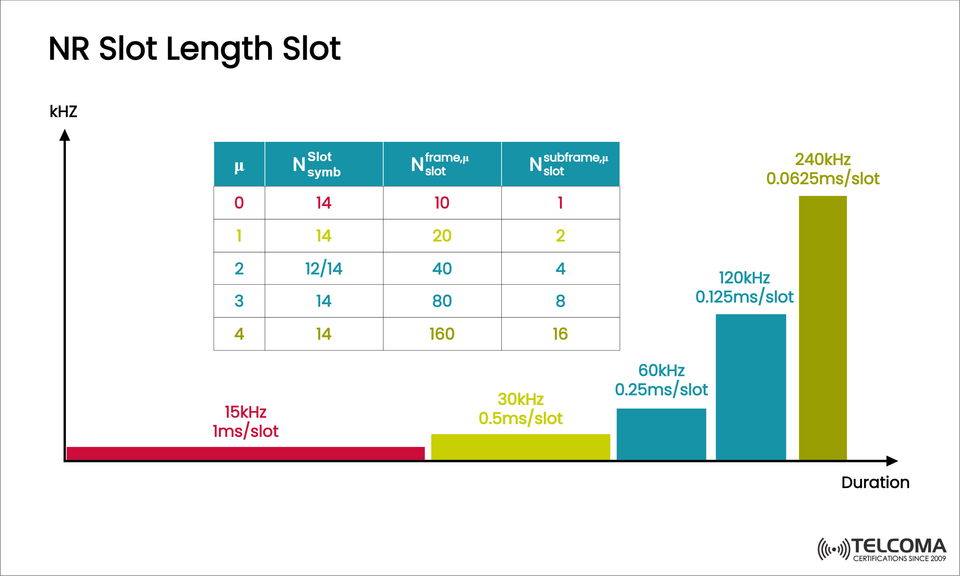
The image above shows how the slot duration varies with subcarrier spacing (SCS) and how several slots fit into a single radio frame. Let’s dive into the details.
What is a Slot in 5G NR?
In 5G NR, a slot is a specific time unit within a radio frame during which data transmission happens. Each slot contains a fixed number of OFDM symbols (usually 14 symbols for a normal cyclic prefix) and is associated with a specific subcarrier spacing (SCS).
As the subcarrier spacing increases, the slot duration gets shorter, giving 5G its unique flexibility in terms of latency and capacity.
Relationship Between Subcarrier Spacing and Slot Duration
The subcarrier spacing (Δf) dictates how closely the OFDM subcarriers are packed in frequency. 5G NR defines several numerologies (μ), each of which represents a doubling of the subcarrier spacing:
Numerology (μ)Subcarrier Spacing (Δf)Slot DurationSlots per 10 ms Frame015 kHz1 ms10130 kHz0.5 ms20260 kHz0.25 ms403120 kHz0.125 ms804240 kHz0.0625 ms160
Key formula:
Slot duration = 1 ms / (2^μ)
So, as μ increases, the subcarrier spacing doubles while the slot duration halves.
Understanding the Concept of Numerology (μ)
In LTE, there was only one numerology (15 kHz) available. With 5G NR, flexible numerology is introduced to cater to a wide variety of use cases:
μ = 0 (15 kHz): Suitable for wide-area coverage and high mobility (like rural eMBB).
μ = 1 (30 kHz): For urban macro deployments with moderate latency.
μ = 2 (60 kHz): Best for small cells and mid-band settings.
μ = 3 (120 kHz): Used in mmWave for ultra-low latency.
μ = 4 (240 kHz): Generally for synchronization and control signals in FR2 (mmWave bands).
This versatility allows a 5G base station to handle multiple numerologies at once, serving various users or services concurrently.
The Structure of a Radio Frame
A radio frame in 5G NR lasts 10 ms and is organized as follows:
10 subframes per frame (each lasting 1 ms)
Multiple slots within each subframe depending on μ
Each slot is made up of 14 OFDM symbols (or 12/14 for μ=2)
The table in the image summarizes these relationships:
μNSlot symbNframe, μ slotNsubframe, μ slot01410111142021212/1440433148081416160161
This setup allows 5G NR to adjust slot timing on the fly to meet different latency and throughput needs.
Slot Duration and Its Impact on Latency
Shorter slot durations mean that data can be sent more often, which significantly cuts down latency. This is super important for applications like:
Self-driving cars
Remote surgeries
Real-time gaming
Industrial automation
For instance:
At 15 kHz, slot duration = 1 ms → great for eMBB and coverage.
At 120 kHz, slot duration = 0.125 ms → perfect for URLLC and low-latency operations.
So, higher numerology equals lower latency, but it also means smaller cell coverage, as increased phase noise and propagation loss come into play at those higher frequencies.
Numerology and Frequency Range (FR1 vs FR2)
5G NR is designed to function over two key frequency ranges:
Frequency Range Spectrum Band Subcarrier Spacing Typical Numerology Use CaseFR1Below 6 GHz15–60 kHzμ = 0–2eMBB, coverageFR2Above 24 GHz (mmWave)60–240 kHzμ = 2–4URLLC, high-capacity
The higher frequency (FR2) allows for faster data, but covers a smaller area, which means you'll need to deploy more small cells to keep up.
Understanding Mini-Slots and Flexible Slot Scheduling
5G NR also brings in mini-slots, which are shorter than regular slots and can have 2, 4, or 7 OFDM symbols.
Mini-slots facilitate immediate data transmission without waiting for slot boundaries—this is crucial for low-latency and urgent communications.
For example:
A URLLC message can cut in on ongoing eMBB traffic using a mini-slot transmission.
This adaptability is a part of 5G NR’s self-contained slot structure, where uplink (UL), downlink (DL), and control data can coexist within the same slot.
Slot Configuration Types
In NR, slots can be arranged as:
Downlink (DL) slot: For data sent from gNB to UE
Uplink (UL) slot: For data sent from UE to gNB
Flexible (F) slot: Can be dynamically assigned to either DL or UL as needed
This setup supports dynamic TDD (Time Division Duplexing) operations, making spectrum usage more efficient based on traffic demand.
Visualizing Slot Length Scaling
From the image:
15 kHz → 1 ms per slot
30 kHz → 0.5 ms per slot
60 kHz → 0.25 ms per slot
120 kHz → 0.125 ms per slot
240 kHz → 0.0625 ms per slot
This exponential drop in duration with rising frequency gives 5G the flexibility it needs across various applications—from rural broadband to ultra-fast mmWave connections.
Advantages of Flexible Slot Structure in 5G NR
Low latency: Critical for mission-critical communications.
Scalability: Supports broad spectrum bands (FR1 & FR2).
Coexistence: Different services can work at the same time.
Efficient spectrum use: Dynamic slot allocation maximizes throughput.
Future-proof: Built to support the evolving needs of 5G and beyond (6G) applications.
Comparison: LTE vs 5G NR Slot Structure
FeatureLTE5G NR Subcarrier spacing15 kHz fixed15–240 kHz flexible Slot duration1 ms fixed1 ms to 0.0625 ms Numerology Single Multiple (μ = 0–4)Latency Higher Ultra-low possible Frequency range Up to 6 GHzUp to 52.6 GHz (FR2)Slot type Static Flexible / Mini-slots
Practical Implications for Telecom Engineers
For network designers and RF planners:
Higher numerologies should be favored in areas with high density or mmWave settings.
Lower numerologies offer better coverage and penetration in rural or suburban places.
Finding a balance between slot configurations for latency and coverage is vital for getting the best 5G performance.
Conclusion
The idea of NR slot length and numerology is central to the flexibility and effectiveness of 5G NR. By dynamically adjusting subcarrier spacing and slot duration, 5G can meet the needs of applications that require high throughput, ultra-low latency, or wide-ranging coverage.
This adaptable time-frequency structure is what sets 5G apart from just being an upgrade to LTE; it represents a huge leap in radio network design—allowing for seamless operation of a broad spectrum of services on a unified platform.