
Understanding O-RAN Architecture: Components, Interfaces & Functional Split Explained

O-RAN Architecture Explained: important components, interfaces, and the data model
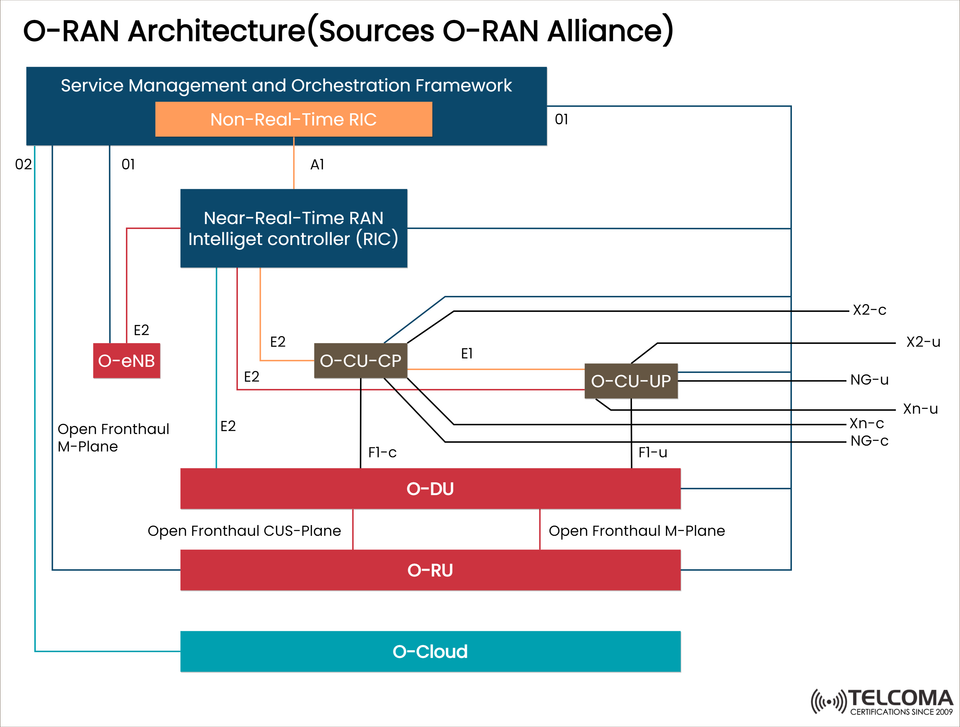
As the Telecom world transitions to 5G and beyond, Open RAN (O-RAN) is an innovative architecture designed to improve interoperability, reduce vendor lock-in, and embrace intelligent RAN operation. In this blog post we will overview the O-RAN architecture as identified by the O-RAN Alliance. Using the diagram below, I will identify and describe each of the main components, interfaces, and functional split in a straightforward, technically accurate manner.
What is O-RAN?
Open Radio Access Network, or O-RAN is a reference architecture, identified by the O-RAN Alliance, which standardizes and opens RAN interfaces. This architecture disaggregates hardware from software and integrates cloud-native software and intelligent controllers, enabling greater network automation and improved performance in 5G networks. The O-RAN architecture does assume that service providers will deploy physical RAN elements (such as cell towers), even if those open RAN interfaces and software are highly virtualized and cloud-native.
Main Components in the O-RAN Architecture
The O-RAN Architecture diagram includes many components and planes. The solid lines outline the three main logical nodes of O-RAN, and the dashed lines outline three additional functional components of the architecture.
- Service Management and Orchestration Framework
Orchestration (not included in the TMF models) responsible for the lifecycle management of RAN elements.
Connected to the Non-RT RIC through the O1 interface.
The O1 interface connects Non-RT RIC to the Service Management and Orchestration Framework (SMO), which is responsible for the orchestration of the lifecycle management of Radio Access Network (RAN) elements.
Using the O2 interface will expose infrastructure management for any cloud-native management to include the virtualized elements. - Non-real time RIC (Non-RT RIC)
This is where the long-term network optimization AI/ML models are executed.
The Non-RT RIC uses the A1 interface to communicate near real-time RIC.
islation and business layer. The Non-RT RIC utilizes standard interfaces, such as the A1 interface. - Near-Real-Time RIC
Near-Real-Time RIC is used for control and optimization in near-real-time.
It operates on the time scale range of 10 milliseconds to 1 second.
It interfaces via E2 with:
O-eNB (Open eNodeB)
Open version of eNodeB (LTE)
O-CU-CP (Centralized Unit - Control Plane)
O-DU (Distributed Unit)
Disaggregated RAN
The RAN functions are separated into cloud-native, virtualized components.
O-RAN has defined the following RAN components and generic interfaces:
Component Description Generic Interfaces
O-eNB Open Version of eNodeB (LTE) E2
O-CU-CP Centralized Unit – Control Plane E1 (to CU-UP), F1-c (to DU), E2
O-CU-UP Centralized Unit – User Plane E1 (to CU-CP), F1-u (to DU), NG-u, Xn-u, X2-u
O-DU Distributed Unit – handles MAC and part of PHY F1-c/u (to CU-CP/UP), E2
O-RU Radio Unit – handles RF and lower PHY Open Fronthaul (M-Plane and CUS-Plane)
O-Cloud Cloud platform hosting the virtual functions O2 interface to SMO
O-RAN Interfaces
The O-RAN architecture defines open and standardized interfaces so that the components can inter-operate; the interfaces are:
Practical Applications of O-RAN
Globally, O-RAN is being implemented. Here are a few use cases, showing how this architecture can provide a benefit to operators and businesses:
📶 Multi-Vendor 5G Deployments
Use Case: A mobile operator deploys O-RU from Vendor A; O-DU from Vendor B and O-CU from Vendor C.
Benefit: Avoid vendor lock-in and leverage best-of-breed.
🧠 AI Network Optimization
Use Case: Near-RT RIC dynamically changes power control and handover parameters based on real-time user mobility.
Benefit: Better spectral efficiency and reduced dropped calls.
🏭 Private 5G Networks.
Use Case: Companies deploy lightweight O-RAN units at their sites (factories, airports, etc).
Benefit: Custom slices with lower TCO of infrastructure to deploy.
☁️ RAN-as-a-Service
Use Case: The operator virtualizes O-CU and O-DU functions on the O-Cloud and delivers RAN services over the internet.
Benefit: Scalable and flexible RAN service while minimizing physical footprint.
The Biggest Challenges with O-RAN
While O-RAN has merit, there are a number of technical challenges and operational hurdles.
🔧 Integration Complexity
Interoperability is always a risk when mixing components from multiple vendors (even if they both leverage standardized interfaces).
⏱️ Latency sensitive
The near-RT RIC must operate within milliseconds; consistently getting this level of performance in the cloud is no easy task.
The Future of O-RAN
O-RAN is more than a concept, it's a blueprint for future network evolution. Here is a look ahead:
🔄 A closer coupling of AI / ML through RICs to achieve full Network automation.
☁️ Mass adoption of Cloud RAN (vRAN) provisioned on commercial of the shelf hardware (COTS).
🛰️ Globally standardized as more operators and vendors join O-RAN Alliance.
🔗 6G ready through flexible, software defined radio access control.
Final Thoughts
O-RAN is changing the way mobile networks are designed, deployed and operated. It gives Telecom Operators flexibility, it lowers operating costs, and it provides an opportunity for innovation through open ecosystems.
By knowing what the components like O-CU, O-DU, O-RU, RICs are, and their standardized interface references to connect them together, you are better positioned to shape and influence the future of wireless technologies.
Quick Reference Table: Key O-RAN Elements and Interfaces
Element Capability Interface(s)
O-eNB LTE base station element E2
O-CU-CP Central control logic for RAN E1, F1-c, E2
O-CU-UP User data plane processing E1, F1-u, NG-u, Xn-u, X2-u
O-DU Lower-layer control and MAC scheduling F1-c/u, E2
O-RU Radiating interface, beamforming.
Conclusions: The Future is Open
O-RAN is about more than just technology. It's about openness, flexibility, and innovation in the telecom industry. With this architecture, operators have freedom of choice, improved innovation cycles, and cost-effective scale.
No matter if you are an engineer, developer, operator, or decision maker, being informed and involved with O-RAN is right where to want to be for the next wireless revolution.