
Understanding O-RAN Architecture: Key Components, Interfaces, and Intelligent Control

O-RAN Architecture Explained: A Complete Guide for Telecommunications and 5G Professionals
As 5G networks develop, there is an increasing focus on the transition towards openness, interoperability, and intelligence. The Open RAN (O-RAN) architecture responds directly to this and addresses this by disaggregating the traditional RAN, and using open functional interfaces, virtualized functions, and intelligent control.
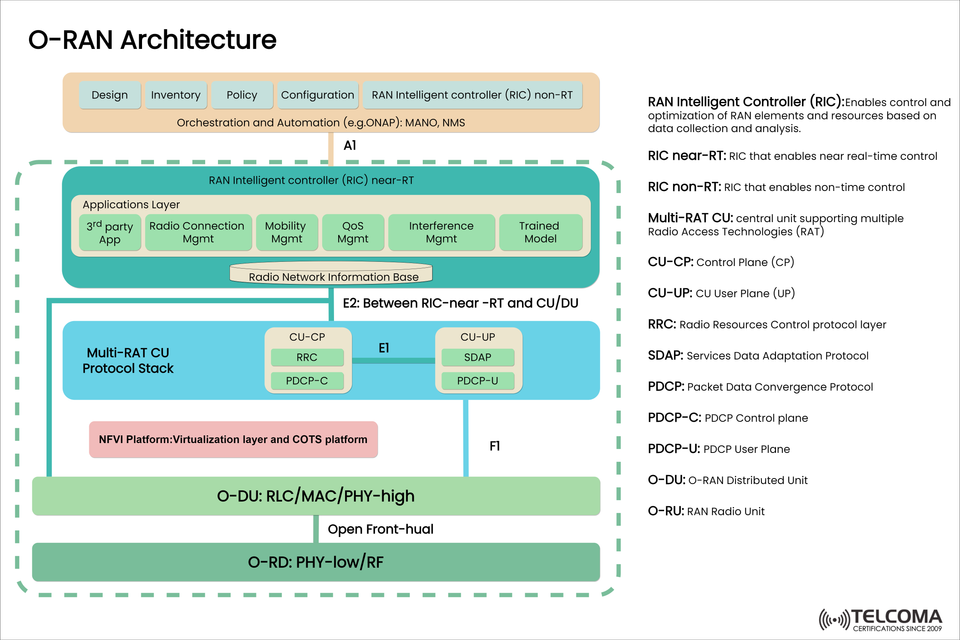
In this article, we describe O-RAN architecture based on the visual reference in the picture, including many of the important components, for example the RAN intelligent controller (RIC), Multi-RAT CU stack, DU/RU split, and the interfaces (A1, E2, F1) that tie it all together.
🧱 What Is O-RAN?
Open RAN (O-RAN) is a common open architecture which allows operators to procure and deploy RAN components from multiple vendors that interoperate using defined common open interfaces. This provides:
📐 O-RAN Architecture Overview
The architecture in the diagram depicts how O-RAN separates these network functions and facilitates the use of a number of intelligent controllers to dynamically optimize the RAN.
The key components of the architecture are below:
Component Description
RIC (RAN Intelligent Controller) Real time and non-real time control and optimization of RAN elements
CU (Centralize Unit) Handles protocol stack layers above, i.e. RRC, PDCP, and SDAP
DU (Distributed Unit) Handles protocol stack layers below.
🧠 RAN Intelligent Controller (RIC)
The RIC is the core innovation in O-RAN that enables a programmable control of the RAN, based on machine learning and enforcement of policies.
There are two categories of RIC:
RIC non-RT (non-Real-Time): Perform long-term optimization for structures around policies or intelligence to train AI models. Connected via A1 interface.
RIC near-RT (near-Real-Time): Perform short-term decisions related to quality of service (QoS), mobility, and interference control. Connected with trained models and via E2 interface.
Use cases of RIC will involve:
- Radio connection management
- Mobility management
- QoS configuration
- Interference mitigation
- Connecting to third-party apps
🧩 Central Unit (CU) and Planes
CU in O-RAN is divided into:
CU Type: Protocols: Plane
CU-CP: RRC, PDCP-C: Control Plane
CU-UP: SDAP, PDCP-U: User Plane.
The CU communicates with the DU through F1 interface. The CU is virtualized over an NFVI platform and can support multi-RAT architecture (e.g., LTE + 5G).
⚙️ O-DU and O-RU Roles
O-DU executes mid-layer protocol operations:
RLC (Radio Link Control)
MAC (Media Access Control)
PHY-high
O-RU (also known sometimes as O-RD):
Executes lower-layer PHY (PHY-low) and RF processing
Real device, connects to the antenna and transmits/receives radio signals.
Normally these will be deployed closer to the edge for low-latency applications.
📈 Benefits of O-RAN Architecture
Being an O-RAN provides benefits for operations and strategies.
✅ Interoperability:
Open interfaces (E2, F1, A1) allow vendor plug and play for a mix of components.
✅ Flexibility:
Virtualized components can be scaled independently and support multiradio access networks (i.e., 4G/5G).
✅ Intelligent RAN Optimization:
RIC is intended to provide dynamic control with AI/ML model that can optimize real-time.
✅ Cost Effectiveness:
CAPEX/OPEX are lower because of commodity hardware and open software options.
✅ Speed to Innovation:
Building a new RIC app or xApp can be introduced quickly by typically a different developer.
🔍 Quick Reference Table: O-RAN Layers and Control Points
Layer Component Control Process
App Layer 3rd Party, Mobility, QoS, Interference Mgmt Optimization logic
RIC non-RT Policy, Training, Model Exchange Non-time-sensitive control
RIC near-RT Real-Time Optimization Near-time control
CU-CP RRC, PDCP-C Control Plane
CU-UP SDAP, PDCP-U User Plane
This is a conclusion.
The O-RAN architecture is a major paradigm shift in how telecom networks are created and managed. O-RAN provides operators with the platforms to build smart, cost-effective, and vendor-neutral RAN solutions by providing access to open interfaces, containerized and virtualized environments and AI territories in the RAN architecture.
For telecoms professionals (whether engineers, systems integrators, or planners), knowing the functional architecture structure (from RIC to DU/RU) will help them design RAN systems that are future-oriented, software-defined networks.
Here are a few real-world use cases of O-RAN, promoting O-RAN's modularity and design ethos, which lend themselves to many deployable formats:
Multiple Vendor RAN Deployments
Operators could deploy RUs from Vendor A and DUs/CUs from Vendor B.
We’re promoting vendor diversity and don't have vendor lock-in.
Urban Network Densification
O-DUs exist at the edge and manage a massive amount of user density and traffic loads.
The near-RT RIC helps to dynamically introduce interference mitigation.
Private 5G Networks
Enterprises deploying localized O-RAN stacks as isolated O-RANs for smart factories, campuses or port locations.
The RIC allows for real time policy enforcement and AI enhanced optimizations.
Low Latency Applications
Edge processing with real-time RIC control exist for virtual reality, autonomous vehicles, industrial robotics.
🌐 Multi-RAT Configuration
Operators can manage their 4G and 5G RANs using the Multi-RAT CU in a simultaneous manner and under one management umbrella.
⚙️ O-RAN Deployment Considerations
O-RAN does open the door to flexibility and intelligence, but the level of complexity involved in decoupling and openness creates issues. Here are some technical issues:
Infrastructure Requirements:
A high-performing NFVI (NFV Infrastructure). For example, the NFVI must also support DU functionality in real-time and support applications that would require very low latency.
Synchronization. It is important to have the same notion of time for the DU-RU coordination (for example, IEEE 1588 or GPS).
High capacity fronthaul. Open fronthaul technology must meet the requirements for bandwidth and possible jitter.
Software Integration:
RIC app lifecycle: The system must support onboarding xApps/rApps, updating xApps/rApps, and retiring xApps/rApps.
Kubernetes orchestration. Most of the O-RAN components will be deployed as CNFs (Cloud native functions). Kubernetes provides a lot of other debugging, reporting, monitoring and management capabilities, which may be difficult to achieve without the benefit of cloud native technology.
Security. Many of the O-RAN deployments are multi-vendor with multi-vendor support, thus requiring strong API authentication/authorization and data protection be afforded.