
Understanding OFDM Symbols in LTE and 5G: How Subcarriers Transmit Data Efficiently

Understanding OFDM Symbols in LTE and 5G Networks
Orthogonal Frequency Division Multiplexing (OFDM) is a key technology that drives LTE, 5G NR, and Wi-Fi. It helps utilize the spectrum efficiently, achieves high data rates, and maintains strong performance even in tough radio conditions.
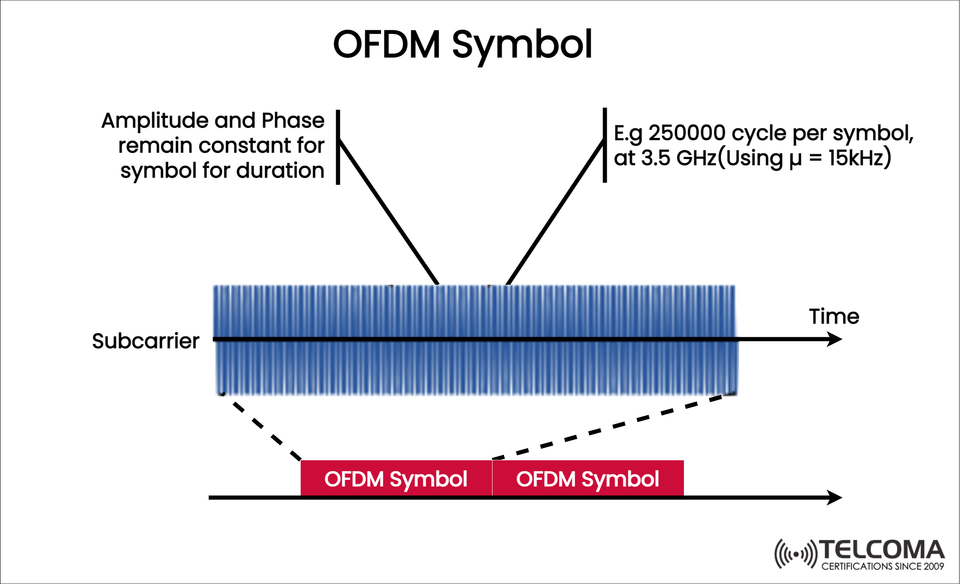
The image above illustrates the structure of an OFDM symbol, showing how a subcarrier keeps a steady amplitude and phase throughout the symbol duration, with multiple OFDM symbols sent one after the other.
What Is OFDM?
OFDM (Orthogonal Frequency Division Multiplexing) is a multi-carrier modulation technique where the available spectrum is split into several closely spaced subcarriers. Each of these subcarriers carries a part of the user data independently.
Key Characteristics of OFDM:
It uses multiple orthogonal subcarriers to send data in parallel.
Each subcarrier is modulated using QPSK, 16QAM, 64QAM, or 256QAM.
The subcarriers are orthogonal, which means they won’t interfere with one another, even when they overlap in frequency.
This technology significantly boosts spectral efficiency and enhances resilience against multipath fading.
Applications:
4G LTE
5G NR (New Radio)
Wi-Fi (IEEE 802.11a/g/n/ac/ax)
Digital Video Broadcasting (DVB)
Understanding the OFDM Symbol
The OFDM symbol serves as the basic unit of transmission in an OFDM system. It represents the period where the amplitude and phase of each subcarrier remain unchanged.
What the Image Shows:
The blue waveform stands for a single subcarrier in the frequency domain.
The horizontal axis (time) indicates that during one OFDM symbol period, the amplitude and phase stay consistent.
The OFDM symbols (in red blocks) repeat one after another over time, forming a continuous time stream of modulated data.
Example:
At a carrier frequency of 3.5 GHz and a subcarrier spacing (Δf) of 15 kHz, the subcarrier completes roughly 250,000 cycles per symbol period. This rapid oscillation carries the data encoded in the symbol’s phase and amplitude.
- The Concept of Subcarriers
Each subcarrier in OFDM is a sinusoidal wave operating at a distinct frequency within the overall transmission bandwidth.
Key Features of Subcarriers:
They are equally spaced in frequency based on the subcarrier spacing (Δf).
Each carries a symbol — a specific combination of amplitude and phase.
Orthogonality ensures that even with overlapping subcarriers, they can still be separated at the receiver without interference.
Mathematical Expression:
Each subcarrier can be defined as:
sk(t)=Akej(2πfkt+φk)s ext_k(t) = A ext_k e^{j(2πf ext_k t + φ ext_k)}
Where:
AkA ext_k = amplitude of subcarrier k
φkφ ext_k = phase of subcarrier k
fkf ext_k = frequency of subcarrier k
During each OFDM symbol period, both Ak and φk remain steady.
Symbol Duration and Subcarrier Spacing
A crucial relationship in OFDM is between subcarrier spacing (Δf) and symbol duration (Ts):
Ts=1ΔfT ext_s = rac{1}{Δf}
This means that as the subcarrier spacing grows, the symbol duration shrinks.
Example Configurations:
Numerology (μ)Subcarrier Spacing (Δf)Symbol Duration (without CP)Typical Use Case015 kHz66.7 µsLTE, 5G low-band130 kHz33.3 µs5G mid-band260 kHz16.7 µs5G high-band3120 kHz8.33 µsmmWave4240 kHz4.17 µsVery high-frequency 5G
This flexibility introduced by 5G numerology allows the system to adapt to different frequency ranges and latency needs.
- Amplitude and Phase: The Data Carriers
During each OFDM symbol period:
The amplitude and phase of every subcarrier are adjusted according to the modulation scheme.
These settings represent binary data bits based on constellation points.
Example:
For QPSK (Quadrature Phase Shift Keying):
Each symbol stands for 2 bits of data (4 phase states).
For 16QAM (Quadrature Amplitude Modulation):
Each symbol signifies 4 bits of data (16 distinct amplitude-phase combinations).
For 256QAM:
Each symbol conveys 8 bits of data.
So, increasing the modulation order raises data rates, but it also makes the system more sensitive to noise.
- Cyclic Prefix (CP): Guarding Against Interference
In actual wireless environments, signals bounce off buildings and other obstacles, creating multipath propagation. To reduce Inter-Symbol Interference (ISI), OFDM adds a Cyclic Prefix (CP).
Cyclic Prefix Explained:
A copy of the end portion of the OFDM symbol is added at the beginning.
The receiver discards the CP during decoding but gains from better synchronization and reduced ISI.
CP Duration:
Typically, CP = 4.7 µs (Normal) or 16.7 µs (Extended) in LTE, based on cell size and propagation conditions.
- Orthogonality: The Core Principle
The “O” in OFDM stands for Orthogonal — a property ensuring that subcarriers don’t interfere with one another, even when their spectrums overlap.
Mathematically, this is shown because:
∫0Tssin(2πfmt)⋅sin(2πfnt) dt=0form≠n
the integral from 0 to T ext_s of sin(2πf ext_m t) times sin(2πf ext_n t) dt equals zero for m not equal to n.
This means that at the receiver, subcarriers can be separated easily using the Fast Fourier Transform (FFT).
Visualization of OFDM Symbol Transmission
The image shows:
Each subcarrier maintains constant amplitude and phase during a single OFDM symbol.
Many OFDM symbols follow one another over time.
The data is transmitted by adjusting these amplitude and phase settings during each symbol period.
This setup makes OFDM super efficient, combining frequency diversity (many subcarriers) with time-domain flexibility (adjustable symbol durations).
Advantages of OFDM in Modern Networks
Key Benefits:
High Spectral Efficiency: Subcarriers overlap without causing interference.
Resilience to Multipath Fading: The cyclic prefix helps minimize ISI.
Simplified Equalization: Frequency-domain processing is easy on computation.
Scalability: Subcarrier spacing can adapt to different environments.
Compatibility with MIMO: OFDM works well with multiple-input multiple-output systems to enhance throughput.
- OFDM in 5G: A Step Beyond LTE
While LTE has a fixed subcarrier spacing of 15 kHz, 5G NR brings in scalable numerology — enabling subcarrier spacing up to 240 kHz.
Benefits in 5G:
Reduced latency (thanks to shorter symbol durations).
Adaptability across low-, mid-, and high-frequency bands.
Improved synchronization and flexibility in bandwidth parts (BWPs).
This scalability makes 5G OFDM great for both low-latency IoT applications and high-speed eMBB scenarios.
Conclusion
The OFDM symbol is at the heart of modern wireless communication. By dividing the spectrum into several orthogonal subcarriers — each carrying data through fixed amplitude and phase during a symbol period — OFDM guarantees reliable and efficient data transmission even in complex situations.
From LTE to 5G NR, the advancement of OFDM has allowed for:
Greater spectral efficiency,
Robust performance under interference,
Flexibility across a wide spectrum of frequencies and applications.
Grasping how an OFDM symbol behaves — as shown in the image — offers telecom professionals valuable insights into how data gets modulated, transmitted, and decoded in next-gen networks.