
Understanding ONAP Functionality: Design, Runtime, and 5G Automation Framework

📡 What is ONAP and Why is it Important for 5G?
The Open Network Automation Platform (ONAP) is a widely used open source project to automate the lifecycle of network services. It is important to 5G deployments and enables zero-touch orchestration, real-time policy enforcement, and closed-loop automation.
ONAP enables telecom operators to efficiently manage, orchestrate, and optimize physical and virtual network functions (VNFs/CNFs) in hybrid, multi-vendor environments.
🧱 An Overview of ONAP Architecture: Functional Blocks
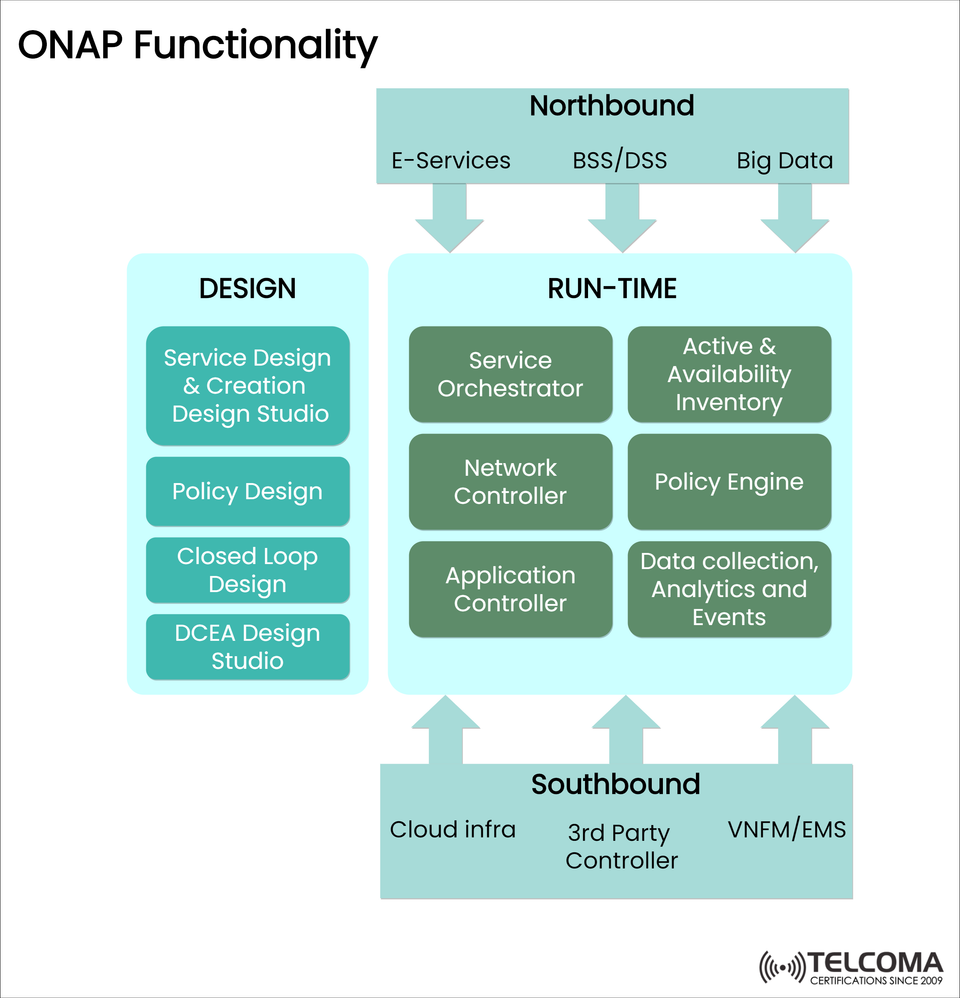
The image illustrates ONAP in terms of architecture by dissecting what it does between Design Time and Runtime, and how it interacts with Northbound business systems and Southbound infrastructure elements.
✍️ Design-Time Functional Blocks
Functional Block Definition
Service Design & Creation Studio Models new services and defines VNFs, policies and workflows.
Policy Design Designs condition-action policies that will be used by the Policy Engine at runtime.
Closed Loop Design Allows for creating automation loops to heal, scale or optimize operational network services.
DCEA Design Studio Allows for analytics based, event-based workflows for closed-loop assurance to be designed.
🏃️ Runtime Functional Blocks
Functional Block Definition
Service Orchestrator Orchestrates the lifecycle of end-to-end services across the various domains of core, RAN, and edge.
Network Controller Generated control plane communication towards the SDN controllers and the infrastructure for resource provisioning.
Application Controller Controls application logic such as traffic routing or security.
🧰 ONAP in Real World Scenarios
The key to ONAP's value is when put into practice in real-time, complex telecom environments. Here are some examples of use cases that ONAP can provide significant value in:
- Dynamic Network Slicing in 5G
Problem: Meeting SLAs across different services (e.g., IoT, AR/VR, autonomous vehicles).
ONAP Action: automate the design, provisioning, and modification of slices according to user behavior and real-time analytics
- Closed-loop Fault Management
Problem: System downtime from hardware failures or misconfigurations
ONAP Action: use analytics to find anomalies, and then policy engine to initiate self-healing (e.g., rerouting traffic, restarting an VNF)
- Zero-touch VNF/CNF Onboarding
Problem: long provisioning cycle for new services.
ONAP Action: automate the onboarding, instantiation, and configuration of VNFs and CNFs, dramatically reduce time to market.
- Multi-cloud orchestration
Problem: provisioning and managing services across OpenStack, Kubernetes and bare metal.
ONAP Action: abstract out the underlying platforms and be able to programmably orchestrate across multiple cloud infrastructures.
🔗 Relationships with Other Telecom Frameworks
ONAP cannot operate alone. It becomes more valuable when linked to a larger set of telecom ecosystems:
Framework How it integrates with ONAP
O-RAN Interacts with RAN Intelligent Controllers (RICs) via A1 and E2 for real-time optimization of the RAN
ETSI NFV MANO Complements ETSI MANO
🏗️ Example Deployment: 5G Smart City ONAP
Scenario: A telecom operator is deploying 5G in a smart city, supporting connected transport, public safety, and real-time surveillance.
ONAP in Action:
The Design Studio creates templates for service slices of low-latency transport, high-throughput surveillance, and massive IoT sensors.
Then the Service Orchestrator deploys VNFs/CNFs to the edge and core clouds.
The Policy Engine establishes QoS policies specific to application (healing), and applies dynamic auto-scaling during periods of peak load.
The Analytics & Events monitors performance of video feeds and heals the application (restores performance) if video packet loss percent exceeds a predetermined limit.
Result: Service reliability improved by 30 percent, and operational cost reduced as a result of lessened human intervention through automation.
📚 Takeaways
ONAP serves as a beacon for the telco industry's future of intelligent, open, programmable networks. When operators support applications enabled by new technologies such as 5G, edge, and AI, ONAP acts as a powerful control plane which can orchestrate and optimize services end-to-end.
Regardless of whether your role is as a network architect, Dev ops engineer or service designer, having a working knowledge of ONAP will help you facilitate the transition toward autonomous, intent-based networks.
📎 Summary Table: ONAP at a Glance
Category Functions
Design Time Service design, policy modeling, closed-loop blueprinting
Run Time Service orchestration, analytics, inventory, network/application control
Northbound BSS, OSS, analytics, e-services integration
Southbound Cloud interfacing
📈 Benefits of Using ONAP for Contemporary Telecom Networks
By leveraging ONAP, telecom operators can evolve from traditional manual and static operations into intelligent, automated, and agile delivery of services. Here are the principal benefits:
✅ Main Benefits
Service Agility: Accelerated design and deployment of new network services without vendor lock-in.
Operational Efficiency: Closed-loop automation leads to lower human involvement, as well as fewer errors and downtime.
Cost Savings: Streamlined service life cycle governance reduces CAPEX and OPEX.
Scalability: Provides seamless service management across multi-cloud and/or hybrid environments.
Flexibility: Supports VNFs (Virtual Network Functions) and CNFs (Cloud-Native Network Functions).
Open Ecosystem: Built in the LF Networking space and will involve and innovate in the Open ecosystem that is telecom.
🛠️ Getting Started with ONAP
If you are a telecom or network engineer interested in getting hands-on experience with ONAP, here is the proposed path:
🔍 Getting Started step-by-step guide
Understand the Architecture
Understand the high-level architecture components of ONAP (Design, Run-time, Northbound/Southbound interfaces).
Create an Environment Lab
Follow the ONAP official installation guide, or leverage an install image such as ONAP Amsterdam VM.
Try out the Use Cases
Try out basic use cases such as VNF onboarding or service chaining.
🧭 Closing Thoughts
Telco providers are striving toward 5G, cloud-native, AI-enabled automation, and ONAP is establishing itself as the market leader for network management and orchestration.
As an open-source, modular platform, ONAP allows CSPs the ability to innovate faster and reduce operational overhead to deliver services in a timely and reliable manner. ONAP drives better transition between design-time intent and run-time autonomy and is behind the next evolution in networks that are dynamic and intelligent.
🌐 ONAP Use Cases in the Real World
ONAP provides an open-source framework for building many advanced telecom capabilities. Below are some examples: