
Understanding Online Charging and Policy Control in LTE/EPC Networks

Online Charging and Policy Control in LTE: Enabling Smart Monetization for Networks
In today’s LTE and 5G networks, monetizing services in real-time and ensuring policy-based Quality of Service (QoS) are absolutely essential. Operators need to find the right balance between providing a great experience for subscribers, prioritizing data, and ensuring accurate billing.
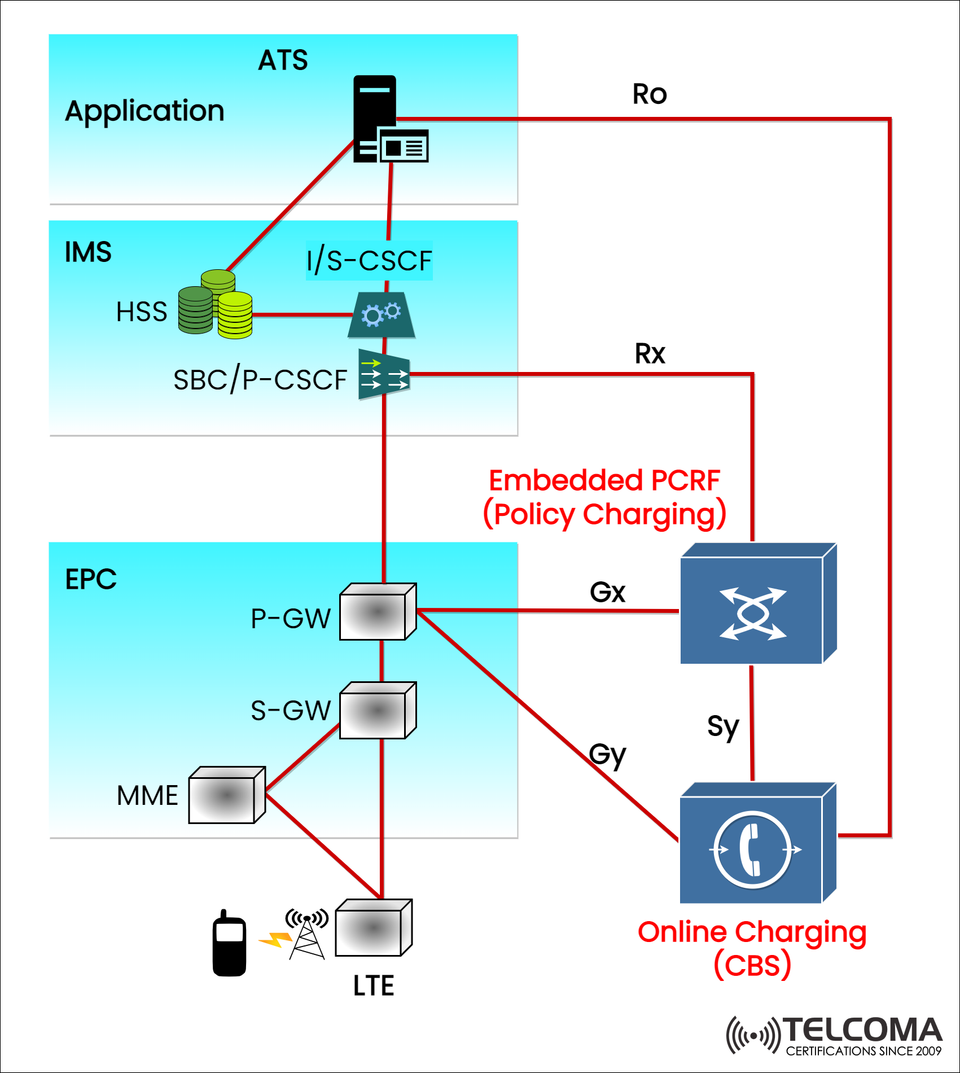
The diagram from Telcoma Global illustrates how the Policy and Charging Control (PCC) framework works alongside the Online Charging System (OCS) to enable dynamic data session control and billing within LTE's Evolved Packet Core (EPC).
Overview of LTE Policy and Charging Control (PCC)
The PCC architecture outlines how policies—like access control, bandwidth limits, and QoS—are set, along with how charging works, whether it's prepaid or postpaid.
At its core is the Policy and Charging Rules Function (PCRF), which makes sure service policies are enforced across the network. The PCRF talks to key components such as the Packet Gateway (P-GW) and the Online Charging System (OCS), ensuring that data usage stays within user entitlements and adapts to network conditions.
Key Goals of PCC
Dynamic QoS Management: Adjusts network performance based on individual subscribers or applications.
Real-time Charging Control: Facilitates charging for both prepaid and postpaid accounts.
Policy Enforcement: Controls access, throttling, and prioritization.
Service Differentiation: Supports various data plans, premium offerings, and network slicing.
Components Within the PCC Architecture
The diagram highlights how different network parts interact through reference points. Let’s take a closer look:
Component | Function
PCRF (Policy and Charging Rules Function) | Central hub for PCC; establishes and enforces policies and charging rules.
PCEF (Policy and Charging Enforcement Function) | Part of the P-GW, implementing policies laid out by the PCRF.
OCS (Online Charging System) | Responsible for real-time credit control, managing accounts for prepaid and data quotas.
OFCS (Offline Charging System) | Manages postpaid billing through Call Detail Records (CDRs).
SPR (Subscriber Profile Repository) | Holds subscriber information, policy rules, and QoS entitlements.
AF (Application Function) | Interacts with the PCRF to request specific QoS for services like VoLTE.
Explanation of Reference Points
The diagram labels several interfaces (or "reference points") that connect different network elements, each with its own role:
Rx Interface: Links the Application Function (AF) to the PCRF, allowing apps (like IMS VoLTE) to ask for certain QoS or policy treatments.
Gx Interface: Connects the PCRF to the PCEF in the P-GW, used for real-time policy enforcement and flow-based charging.
Gy Interface: Connects the PCEF to the OCS, facilitating online charging based on user balance and consumption.
Sy Interface: Connects PCRF and OCS to synchronize quota information.
Ro Interface: Direct link between application servers and OCS for application-level charging (such as video or messaging).
These interfaces allow full real-time control from the application request to user session billing.
How Online Charging Functions
The Online Charging System (OCS) is key for real-time credit control, especially for prepaid services. It uses the Diameter protocol for signaling and can handle two main types of charging:
A. Event-Based Charging
Used for one-off transactions like sending an SMS or starting a VoIP call.
The OCS instantly deducts a fixed amount from the user's balance.
B. Session-Based Charging
Applies to continuous services such as data sessions or video streaming.
The OCS tracks data usage during a session and deducts credits at intervals.
Online Charging Flow (In a Nutshell)
A user starts a data session.
The P-GW checks with the PCRF for policy and charging rules via Gx.
The PCRF verifies user data from SPR and sends policy info to the P-GW.
The P-GW interacts with the OCS through Gy for real-time charging.
The OCS approves service if the user has enough credit.
Usage data is sent back for billing.
This back-and-forth communication makes sure no session goes on without enough balance and that QoS rules are applied correctly for each service type.
IMS and Policy Integration's Role
In IP Multimedia Subsystem (IMS) networks, services like VoLTE, video calls, and RCS messaging rely on PCC coordination for maintaining service quality and billing.
The P-CSCF (Proxy Call Session Control Function) uses the Rx interface to inform the PCRF about service requests.
The PCRF then applies QoS parameters to the appropriate bearer in the EPC.
For example, a VoLTE call might get higher priority and guaranteed bit rate, ensuring clear voice quality.
So, the integration between IMS and EPC via PCRF helps make sure the user experience meets service-level agreements (SLAs).
Embedded PCRF and Policy Charging
The image highlights Embedded PCRF (Policy Charging), which means PCRF functions can be integrated within either EPC or IMS layers to cut down on latency and simplify signaling.
This is especially useful for:
Private LTE networks
Edge computing setups
Network slicing in 5G
By placing PCRF functions closer to the data flow, operators can achieve ultra-low latency and localized policy enforcement, which is crucial for industrial IoT and critical services.
Online Charging (CBS) and Real-time Monetization
The Charging and Billing System (CBS), illustrated in the image, is a key part of the OCS ecosystem, making sure every user action is tracked and billed accurately.
CBS Core Functions
Monitors prepaid balances in real time.
Manages charging for multiple services (voice, data, SMS).
Supports cross-service promotions and discounts.
Integrates with CRM and BSS platforms for streamlined billing.
This system allows telecom operators to implement dynamic pricing models—like pay-per-use, time-based plans, and zero-rated content.
Advantages of PCC and Online Charging Integration
Feature | Benefit
Real-time Credit Control | Stops revenue loss and ensures accurate prepaid billing.
Dynamic Policy Enforcement | Adjusts QoS based on network demands and user plans.
Subscriber Personalization | Provides tailored plans and offers for each user.
Application-aware Charging | Allows differentiated charging for apps like YouTube or WhatsApp.
Regulatory Compliance | Ensures lawful interception and accounting transparency.
PCC in the 5G Era and Network Slicing
As 5G develops, PCC transitions to Policy Control Function (PCF) in the 5G Core (5GC). While the fundamental principles remain the same, they adapt to network slicing, edge deployment, and cloud-native orchestration.
Conclusion
The Online Charging and Policy Control architecture is the backbone of LTE networks, providing the financial and operational foundation. By integrating PCRF, PCEF, and OCS, operators are able to deliver high-quality, policy-driven services while keeping tight control over monetization.
As we move toward 5G, this architecture will evolve, but the core ideas of real-time control, QoS enforcement, and flexible charging will always be key to innovation in telecommunications.