
Understanding OpenRAN Reference Architecture: Components, Interfaces & Future of 5G
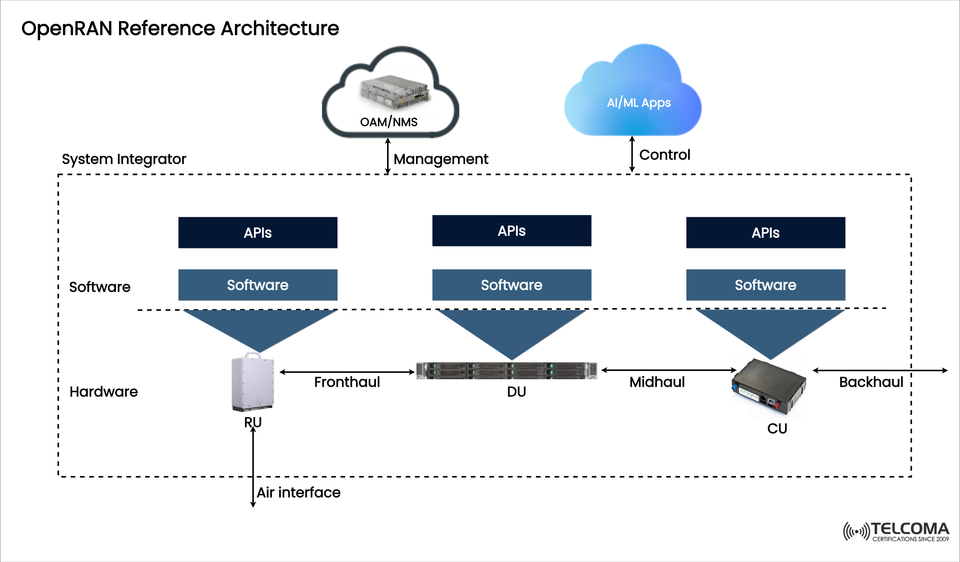

OpenRAN, which is gaining traction in mobile networks transitioning to 5G and beyond, is fundamentally changing how telecom operators build and scale their networks. OpenRAN replaces the proprietary hardware and software bundles of traditional RAN architecture, with a more modular and interoperable ecosystem built upon open standards and vendor-agnostic solutions.
The diagram above is a reference architecture for OpenRAN, illustrating the conceptual separation of hardware, software, and APIs operationalized by intelligent management and control.
OpenRAN Reference Architecture - Key Functional Components
The OpenRAN architecture decomposes the RAN into three major functional units - RU, DU, and CU - with well-defined functions and interfaces:
Unit Full Form Function
RU Radio Unit Radio transmission and reception (air interface).
DU Distributed Unit Time-sensitive Layer 1 and Layer 2 processing, like MAC, RLC, and parts of physical layer.
CU Centralized Unit Layer 3 functions including PDCP, SDAP, and a connection to the 5G Core network.
OpenRAN Interfaces
Each unit connects directly and employs standardized interfaces:
Fronthaul (RU ↔ DU): The use of high-bandwidth, low-latency signals (usually the O-RAN fronthaul interface).
Midhaul (DU ↔ CU): The transport of data between DU to CU (this is usually the F1 interface).
Backhaul (CU ↔ Core Network): The connection between the RAN to 5G Core.
🧠 Software and API layers
Each hardware element (RU, DU, CU) is decoupled from the software stack, which permits:
Vendor-neutral hardware: open sourcing supports interoperability.
Custom software: operators can adapt software functions to particular use cases or performance objectives.
API(s): Exposed APIs provide programmability, orchestration, and analytics access to applications.
These aspects provide the foundation for cloud-native RAN deployments, with performance and automation gaining primacy.
☁️ Intelligence & Control layers
Above the hardware and software stack is a control and management plane that consists of:
AI/ML Apps: for predictive analytics, anomaly detection, and dynamic RAN optimization.
OAM/NMS (Operations, Administration, and Maintenance / Network Management System): provides fault, configuration, performance, and security management.
These elements ensure closed-loop automation and zero-touch provisioning necessary for future-ready networks.
🔄 Advantages of OpenRAN architecture
Multi-vendor interoperability
Lower total cost of ownership (TCO)
Accelerated innovation through disaggregation
Better network agility and automation
Vendor independence and reduced lock-in
📊 OpenRAN Architecture Stack Summary
Layer Elements
Control AI/ML Apps
Management OAM / NMS
Integration System Integrator
API Layer Northbound APIs for orchestration
Software Virtualized RAN functions
Hardware RU, DU, CU connected via open interfaces
✅ Conclusion
The OpenRAN Reference Architecture represents a paradigm shift in mobile network development and operation. By separating hardware and software, utilizing open APIs, and employing AI-enabled orchestration, OpenRAN provides an opportunity for operators to develop networks that are more agile, cost-effective, and ready for change in the future.
🧩 OpenRAN Implementation Considerations
Before deploying OpenRAN, telecom operators, and system integrators should carefully consider the following:
- Interoperability Testing
Validate vendor conformity to O-RAN Alliance specifications.
Verify that handover to other RU/DU/CU vendor components is successful. - Network Synchronisation
Utilize timing protocols such as PTP (IEEE 1588v2) for fronthaul latencies.
For deployed fleet, you may need a GPS or grand master clock to maintain appropriate timing. - Hardware Acceleration
Some high-performance real-time workloads (like beamforming, FFT) may need FPGA, or ASIC acceleration at DU.
Depending on your latency and capacity objectives, there may be a vRAN or Cloud-RAN alternative to consider. - Security, & Compliance
The introduction of open interfaces may create a broader attack surface.
Secure APIs and be sure to introduce zero-trust architectures, particularly with respect to northbound interfaces, and management layers.
📡 Integration with RIC and SMO
The RAN Intelligent Controller (RIC) is a foundational component of OpenRAN and offers programmable, intelligent control of the RAN by providing:
🧠 Real World Use Cases for OpenRAN
Rural Connectivity: Affordable deployment options with flexible backhaul solutions.
Private 5G Networks: Modular and customized networks to suit enterprises and factories.
Edge Intelligence: Contextual network changes driven by AI algorithm side dependencies based on user behavior and mobility.
Disaster Recovery: Portable OpenRAN nodes that can be rapidly deployed for emergency communications.
📘 Glossary of Important Terms
Term Definition
RU Radio Unit: Connects to antennas; performs radio frequency and physical layer processing.
DU Distributed Unit: Performs protocol stack tasks lower in the stack (e.g., Media Access Control (MAC) and Radio Link Control (RLC)).
CU Centralized Unit: Contains the upper layer tasks (Packet Data Convergence Protocol (PDCP), and connects to the core).
OAM/NMS Operations and Network Management: For provisioning, fault management, and maintenance.
RIC RAN Intelligent Controller: Provides dynamic policy driven real-time RAN control using xApps/rApps.
SMO Service Management and Orchestration: Provides life cycle management for all network functions: deployment, scaling, healing, and upgrading.
📣 Conclusion
OpenRAN is not only a ubiquitous evolution in terms of needing flexibility, it is the use of more open modeling philosophy for networks for open, flexible networks designed to be intelligent systems. For telecom, system integration, and enterprise, OpenRAN represents new opportunities to innovate faster, do it for less, and have scale.
With the maturation of 5G networks and accelerating 6G research, OpenRAN will serve as the enabler for hyper-agile, AI-native, and cloud-optimized networks.
🔧OpenRAN Deployment Models
- Fully Disaggregated Deployment
A different vendor for every RU, DU, and CU.
Allows for the most flexibility and innovation.
Best for operators looking to have many vendors to choose from. - Integrated (Hybrid) Deployment
A vendor sells multiple components (e.g. DU + CU), but the interfaces are still open.
Provides a good balance between performance and interoperability.
Easiest way to reduce the complexity of integration while maintaining openness. - Cloud-Native OpenRAN
DUs and CUs are run as VNF or CNF on common hardware.
Can scale dynamically using Kubernetes.
Increase the potential of edge compute where latency can be reduced.
🚀 Benefits of OpenRAN
Benefit Definition
Vendor Agility Allows operator to build a multi-vendor ecosystem reducing lock-in.
Cost-Effective Uses white-box hardware with open interfaces.
Scalable Can go from a rural small cell to an urban macro site.
Innovate Ready Can use AI/ML to provide intelligent automation.
Faster to Market Opens the door for quicker service launches using modular deployment.