
Understanding Paging Early Indication (PEI) in RRC Idle State: Optimizing UE Power Efficiency in 5G NR
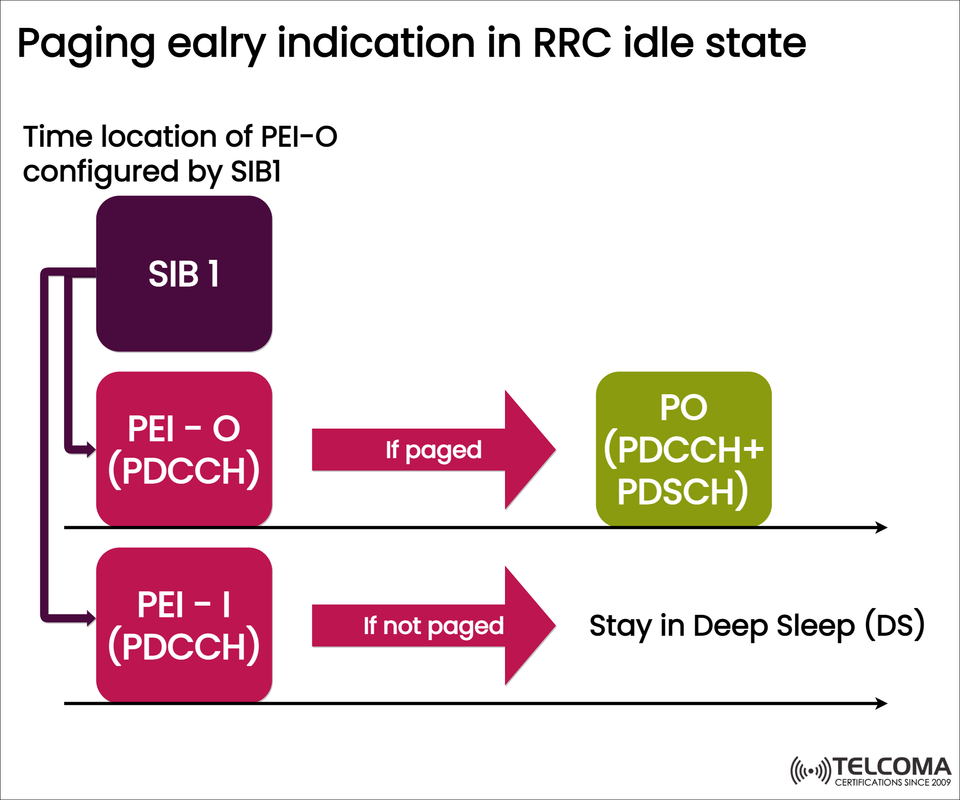

Understanding Paging Early Indication in RRC Idle State
Managing paging effectively is crucial in 5G and LTE networks, as it strikes a balance between low-latency communication and power-saving methods for user equipment (UE). One effective way to achieve this is through Paging Early Indication (PEI), which optimizes UE energy use while ensuring that essential network messages are delivered promptly.
In this article, we’ll dive into how PEI functions in the RRC Idle state, its impact on cutting down UE wake-up cycles, and the flow of the process as shown in the diagram above.
What Is Paging in 5G NR and LTE?
Paging serves as a signaling method used by the core network to alert the UE (User Equipment) about:
Incoming calls
Mobile-terminated data (like messages, push notifications)
System information updates
When a UE is in the RRC Idle state, it periodically wakes up to look for paging messages instead of maintaining a constant connection to the base station. This waking happens during a Paging Occasion (PO) within a Paging Frame (PF).
Challenge: Balancing Power Efficiency and Responsiveness
In 5G and LTE networks, the challenge lies in finding the right balance between:
Power efficiency (for longer battery life)
Responsiveness (for quick reactions to paging)
If the UE wakes up too often, it drains too much power. But if it stays asleep too long, it could lead to delays in paging. To help with this balance, Paging Early Indication (PEI) was introduced.
Paging Early Indication (PEI): The Concept
Paging Early Indication is a signaling feature that helps the UE figure out early if it should stay awake to receive a paging message or just go back to sleep.
Purpose of PEI
To prevent unnecessary wake-ups for UEs that aren’t being paged.
To shorten paging monitoring time.
To boost power-saving in RRC Idle state.
This early indication is sent over the PDCCH (Physical Downlink Control Channel), allowing the UE to quickly determine whether to decode the full paging message on PDSCH (Physical Downlink Shared Channel) or return to sleep.
Understanding the Diagram: Paging Early Indication Process
The diagram from Tel coma shows the step-by-step behavior of PEI operation while in the RRC Idle state.
Let’s break it down:
Step Component Description
1 SIB1 (System Information Block 1)
Defines the configuration for PEI-O (Outer PEI). The UE reads SIB1 to know when to check for PEI indications.
2 PEI-O (Outer Paging Early Indication)
A brief control signal on the PDCCH that tells the UE if it should prepare for an incoming paging message.
3 If paged (Positive Indication)
The UE keeps monitoring the Paging Occasion (PO) to receive the paging message (PDCCH + PDSCH).
4 PEI-I (Inner Paging Early Indication)
If there's no paging message indicated, the UE gets PEI-I to confirm it is not paged.
5 If not paged (Negative Indication)
The UE can head back to Deep Sleep (DS) mode right away, thus conserving power.
Key Components Explained
SIB1 (System Information Block Type 1)
SIB1 broadcasts critical system parameters. Among various configurations, it defines:
PEI timing locations (when the UE should check for PEI)
Paging cycle and DRX parameters
Cell identity and scheduling information
This helps the UE know when and how to watch for paging early indications.
PEI-O (Outer Paging Early Indication)
Sent over PDCCH.
Configured by SIB1.
Indicates whether a UE is likely to be paged.
If the indication is positive, the UE moves on to the Paging Occasion (PO).
This minimizes the monitoring time the UE spends on downlink channels unnecessarily.
Paging Occasion (PO)
A combination of PDCCH + PDSCH where the actual paging message is delivered.
Contains details like IMSI-based paging identity.
Triggered only if the UE received a positive indication during the PEI phase.
PEI-I (Inner Paging Early Indication)
Also transmitted on PDCCH.
Indicates that the UE is not paged.
Upon receiving this, the UE can skip PO monitoring and return to Deep Sleep (DS).
This greatly boosts battery life without compromising service availability.
Deep Sleep (DS) Mode)
A low-power state where the UE shuts down most of its radio functions.
The UE can enter sleep mode right away if it gets PEI-I.
This ensures efficient power use during idle times.
Advantages of Paging Early Indication
Paging Early Indication is vital for improving network efficiency and enhancing user experience. Here are some key benefits:
Power Savings
Cuts down unnecessary active time for UE in RRC Idle.
Greatly extends battery life for IoT devices and smartphones.
Reduced Signaling Load
Lowers the need for paging message decoding for UEs that aren’t paged.
Frees up downlink resources in the network.
Faster UE Response
When paged, the UE is already primed for the PO timing, allowing for quicker reactions and less latency.
Network Efficiency
Improves radio resource usage.
Ensures only the relevant UEs stay active during paging cycles.
Practical Use Case: PEI in 5G IoT Devices
IoT devices often stay idle for long periods, only communicating with the network occasionally. With PEI, these devices can:
Briefly wake up for PEI-O,
Return to Deep Sleep if they aren’t paged,
Or continue to PO for data reception if they are paged.
This supports massive IoT scalability without draining device batteries or overwhelming the paging system.
Technical Notes for Implementation
Parameter Defined By Function
pe i-Config SIB1
Defines PEI timing offset and period.
pe i Offset RRC Signaling
Indicates the relative position of PEI within the paging frame.
pe i Cycle RRC or SIB1
Defines how often PEI monitoring repeats.
UE manufacturers and network operators set these parameters to achieve optimal performance based on:
UE type (smartphone, IoT, etc.)
Network load conditions
Power-saving goals
Comparison: Traditional Paging vs. PEI Paging
Aspect
Traditional Paging | Paging with PEI
---|---
Wake-up Frequency | UE wakes at every paging cycle | UE wakes briefly for PEI first
Power Consumption | Higher | Lower
Paging Delay | Normal | Negligible impact
Network Load | Moderate | Reduced (fewer unnecessary page checks)
Efficiency | Standard | Optimized
Conclusion
Paging Early Indication (PEI) in the RRC Idle state is an advanced mechanism that helps strike a fine balance between network responsiveness and UE power efficiency.
By using SIB1 configuration to establish PEI timing and implementing PEI-O and PEI-I for early decision-making, the network can ensure that only UEs with pending paging messages stay awake. This greatly lowers power consumption, reduces signaling overhead, and boosts overall 5G system efficiency.
In a world where countless IoT devices often remain idle, PEI proves to be essential for sustainable and energy-efficient network operation.