
Understanding PCF Interactions During 5G Standalone Access Registration
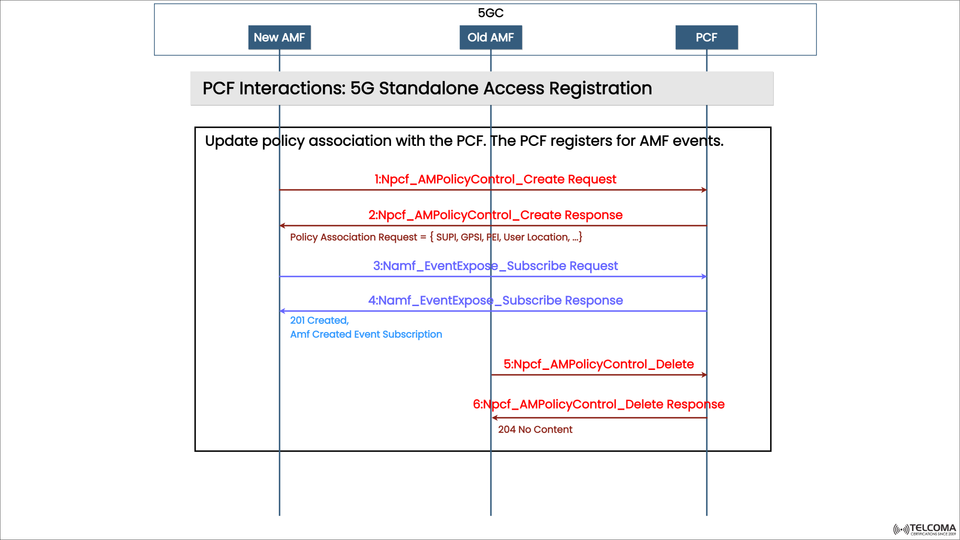

PCF Interactions in 5G Standalone Access Registration
In a 5G Standalone (SA) network, the Policy Control Function (PCF) is essential for making sure that every registered device (UE) follows the right network policies, slices, and QoS (Quality of Service) parameters.
This post will outline the message sequence between the Access and Mobility Management Function (AMF) and the PCF during 5G standalone access registration, as shown in the accompanying diagram. Each step illustrates how the PCF actively manages policies and event subscriptions to ensure that mobility and access control work efficiently in the 5G Core (5GC).
Understanding the Role of PCF in 5G Core
Before we dive into the message flow, it’s important to grasp where the PCF fits within the 5G Core architecture.
PCF Overview
The Policy Control Function (PCF) has several responsibilities:
It manages and enforces network policies for UE sessions.
It provides policy decisions to the AMF and SMF (Session Management Function).
It deals with subscription-based and context-aware QoS and mobility rules.
In 5G SA, every UE’s registration requires establishing a policy association between the AMF and PCF. This ensures all mobility and access decisions align with the operator's policy framework.
PCF Interaction Flow During 5G Registration
The message flow depicted in the image includes six key steps (1–6) that show how the AMF and PCF work together during UEs' registration. Let’s take a closer look at each one.
Step 1: Npcf_AMPolicyControl_Create Request
Direction: AMF → PCF
When a new UE registers, the AMF sends an Npcf_AMPolicyControl_Create Request to the PCF.
Purpose:
To create a new Access and Mobility Policy Association for the UE.
Key Parameters Included:
SUPI (Subscription Permanent Identifier) – Uniquely identifies the subscriber.
GPSI (Generic Public Subscription Identifier) – Links to public user identifiers (like MSISDN).
PEI (Permanent Equipment Identifier) – Denotes device identity (IMEI).
User Location Information – Shows the UE’s current location.
Access Type – Specifies 3GPP access (NR) or non-3GPP (Wi-Fi).
The PCF uses this info to identify applicable mobility policies, such as:
Access restrictions,
Mobility area restrictions,
Preferred or allowed network slices, and
QoS parameters for mobility signaling.
Step 2: Npcf_AMPolicyControl_Create Response
Direction: PCF → AMF
After the policy association request is received, the PCF processes it and replies with a Create Response, confirming that the association has been successfully created.
Response Includes:
Policy Association ID – A unique ID for this association.
Applicable Policies – Rules governing UE registration, slicing, and mobility.
Triggers – Conditions that may require updates to the policy (like location change or AMF relocation).
This message confirms that the AMF and PCF are now policy-synchronized, enabling the AMF to enforce network-level decisions consistent with the operator's policy framework.
Step 3: Namf_EventExpose_Subscribe Request
Direction: PCF → AMF
Once the policy is created, the PCF subscribes to certain AMF events with the Namf_EventExpose_Subscribe Request.
Purpose:
To let the PCF receive updates about AMF-managed events that could affect policy decisions.
Examples of Subscribed Events:
Changes in location (when UE moves to a new cell or TA).
Changes in registration status (UE deregisters or re-registers).
Access type updates (switching between 3GPP and non-3GPP access).
Loss of connectivity or service continuity events.
Step 4: Namf_EventExpose_Subscribe Response
Direction: AMF → PCF
The AMF confirms the subscription with a 201 Created response, indicating that the event exposure was successfully established.
Response Includes:
Subscription ID – Unique ID for the event subscription.
Acknowledgment Message: “AMF Created Event Subscription.”
This means that the PCF is now actively monitoring AMF notifications, allowing it to adjust policy rules as needed when the UE’s status or location changes.
Step 5: Npcf_AMPolicyControl_Delete
Direction: AMF → PCF
If the policy association is no longer necessary—like during UE deregistration or AMF relocation—the AMF sends a Npcf_AMPolicyControl_Delete request.
Purpose:
To delete the existing policy association and free up PCF resources.
Scenarios Triggering This Request:
UE deregisters from the network.
UE moves to a different AMF (inter-AMF mobility).
Session termination or abnormal failure conditions.
Step 6: Npcf_AMPolicyControl_Delete Response
Direction: PCF → AMF
The PCF acknowledges the deletion with a 204 No Content response, confirming that the policy association has been successfully removed.
At this point:
All related event subscriptions are canceled.
The PCF will no longer track the UE through this AMF.
Network resources tied to this UE’s policy control are released.
Technical Insights: Why These Interactions Matter
The PCF–AMF interface ensures that policy enforcement remains context-aware and dynamic. Here’s why this exchange is so crucial for modern 5G networks:
A. Context-Aware Policy Enforcement
By utilizing parameters like SUPI, GPSI, PEI, and location, the PCF delivers tailored policies for each UE. This enables operators to:
Prioritize enterprise users,
Impose access restrictions, or
Provide specific services for each slice or location.
B. Event-Driven Automation
Event subscriptions allow the PCF to adapt policies in real-time. For instance, if a UE enters a restricted area, the PCF can notify the AMF right away to trigger access restrictions or adjust services.
C. Resource Efficiency
Deleting policy associations during deregistration prevents policy buildup in the PCF, helping to keep network operations efficient and scalable.
D. Seamless Mobility
In cases of AMF relocation, these interactions help the new AMF recreate or transition policy associations smoothly, maintaining uninterrupted service continuity.
Real-World Use Case: Dynamic Policy Updates
Picture a subscriber moving between network slices, like from a consumer slice to an enterprise slice.
The AMF notifies the PCF about the location and slice change using event exposure.
The PCF recalculates the relevant QoS and mobility policies.
The AMF then dynamically enforces the updated rules — ensuring a smooth handover and continued service.
This kind of dynamic adaptability is a core innovation of 5G's Service-Based Architecture (SBA).
Benefits for Operators and Developers
Scalable Policy Control: Each UE’s policy can be managed separately.
Enhanced Automation: Event subscriptions minimize the need for manual intervention.
Faster Decision Making: RESTful APIs allow for quick, stateless communication.
Reduced Latency: Direct service-based interactions enhance performance during registration.
Conclusion
The PCF interactions during 5G standalone access registration lay the groundwork for smart policy management within the 5G Core. By establishing, subscribing, and deleting policy associations through standardized APIs, the AMF and PCF guarantee that every UE session is optimized, secure, and context-aware.
For telecom professionals, getting a handle on this signaling sequence is critical for understanding how 5G achieves its flexibility — making way for differentiated services, network slicing, and real-time policy updates that define next-generation mobile connectivity.