
Understanding PCF – Policy Control Function Interactions in 5G Core (5GC)
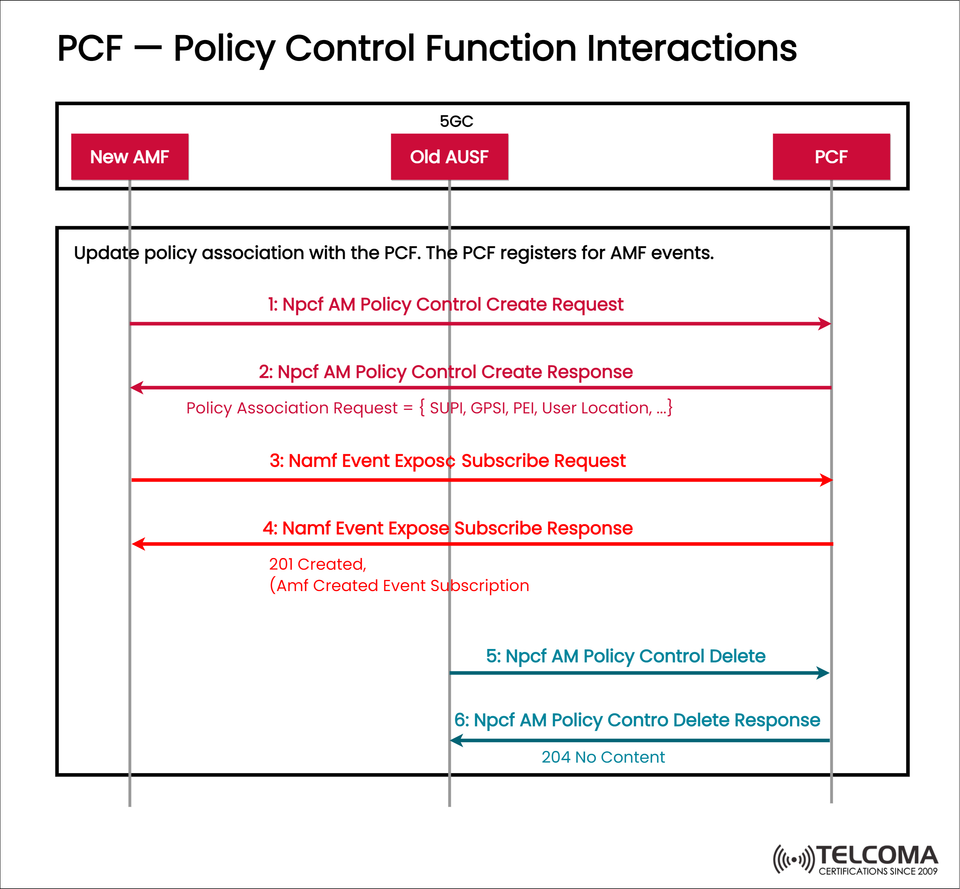

PCF — Understanding Policy Control Function Interactions
The Policy Control Function (PCF) is a crucial part of the 5G Core (5GC), making decisions about network policies. Its role is to make sure subscribers get the best services, while also keeping the network running efficiently, fairly, and in line with service-level agreements (SLAs).
In this post, we’re going to break down the PCF interaction flow using the sequence shown in the image — explaining each signaling step, the functions of AMF and AUSF, and how the PCF actively manages network policy.
Digging into the 5G Policy Control Framework
The 5G Core network is built on a service-based architecture (SBA), where each function provides its services through standardized APIs. Among these, the Policy Control Function (PCF) serves as the central hub for policy decisions across various services like QoS (Quality of Service), charging rules, and mobility policies.
Key Players in This Interaction:
Function Full Name Role PCF Policy Control Function Makes policy decisions, enforces network behavior, and interacts with other NFs through APIs. AMF Access and Mobility Management Function Manages mobility, registration, and connection for UE (User Equipment).AUSF Authentication Server Function Authenticates users and provides authentication vectors to other network functions.
The interaction flow shown in the image illustrates how the PCF updates its policy association with a new AMF and subscribes to events that the AMF exposes. This ensures consistent policy enforcement even when the UE moves or when there are changes in network elements.
Step-by-Step Guide to PCF Interaction Flow
The signaling sequence consists of six key steps between the New AMF, Old AUSF, and PCF. Let’s take a closer look at each step and what it means.
- Npcf AM Policy Control Create Request
Sender: New AMF
Receiver: PCF
Purpose: To create a new policy control association for a user session.
When a UE (User Equipment) registers or transitions to a new AMF, that AMF needs to notify the PCF. The Npcf ext{ }AM Policy Control ext{ }Create request includes important identifiers and parameters, such as:
SUPI (Subscription Permanent Identifier)
GPSI (Generic Public Subscription Identifier)
PEI (Permanent Equipment Identifier)
User Location Information
This message alerts the PCF that a new AMF is now in charge of mobility management for the subscriber.
- Npcf AM Policy Control Create Response
Sender: PCF
Receiver: New AMF
Purpose: To confirm the creation of the policy control association.
The PCF processes the request, sets up the policy association, and replies with the Npcf ext{ }AM Policy Control ext{ }Create Response.
This response includes:
The Policy Association ID
Policy rules or default settings
Any optional parameters needed for AMF operations
At this stage, a new policy session is now established between the AMF and the PCF.
- Namf Event Exposure Subscribe Request
Sender: PCF
Receiver: New AMF
Purpose: To subscribe to AMF events about the UE.
The Event Exposure Service in AMF allows other network functions (like PCF) to get updates on specific UE-related events, such as:
Changes in UE mobility status
Updates to registration area
Changes in connectivity or reachability
By signing up for these events, the PCF can dynamically modify policy decisions as the UE’s context shifts.
- Namf Event Exposure Subscribe Response
Sender: New AMF
Receiver: PCF
Purpose: To confirm successful event subscription.
The AMF replies with a 201 Created status, indicating that the event subscription has been registered successfully. From now on, the PCF will receive notifications whenever those subscribed events happen, allowing for real-time policy updates without the need for manual reconfiguration.
- Npcf AM Policy Control Delete Request
Sender: New AMF
Receiver: PCF
Purpose: To delete an existing policy control association.
This step takes place when:
A UE deregisters from the network,
A session finishes, or
The AMF is being changed or reset.
The AMF sends a Npcf ext{ }AMPolicyControl ext{ }DeleteRequest message to the PCF, asking it to remove the previously created policy association.
- Npcf AM Policy Control Delete Response
Sender: PCF
Receiver: New AMF
Purpose: To confirm the deletion of the policy association.
The PCF responds with a “204 No Content”, indicating that the policy association has been successfully deleted. This step is crucial for resource cleanup and to prevent outdated policies from causing issues in future sessions.
Key Takeaways from PCF–AMF Interaction
- Smooth Policy Updates
This interaction keeps policy control in sync when a UE switches between AMFs, which is vital for mobility management and service continuity.
- Event-Driven Architecture
By subscribing to AMF events, the PCF takes a proactive stance — responding instantly to network changes instead of just relying on periodic checks.
- Resource Efficiency
Removing policy associations when they’re no longer necessary helps to conserve resources and boosts system performance.
Streamlined Network Automation
The entire interaction is driven by APIs, in line with the Service-Based Architecture (SBA) model of the 5G Core. This approach fosters automation, scalability, and compatibility between different vendors.
Why PCF Interactions Are Important in 5G Networks
In older networks (like 4G LTE), policy control was mainly managed by the PCRF (Policy and Charging Rules Function), which was less flexible and more session-oriented.
But in 5G, the PCF brings in:
Context-aware decisions: Tailored to UE behavior, location, and subscription profile.
Network slicing awareness: Allowing for specific policies per slice or service.
Integration with AI and analytics: Facilitating adaptive policy control using insights from machine learning.
These interactions ensure that network policies stay agile, resources are utilized efficiently, and the user experience is enhanced through intelligent automation.
Use Cases of PCF in 5G
- QoS Enforcement
PCF makes sure that QoS policies are applied dynamically, reflecting real-time network conditions or user movements.
- Network Slicing
Different slices might need their unique policy sets. PCF helps nail down these slice-specific rules for latency, throughput, or reliability.
- Data Charging and Usage Policies
PCF works with the Charging Function (CHF) to set usage limits, prioritize services, or send notifications based on data consumption.
Wrapping Up
The Policy Control Function (PCF) is pivotal in the 5G Core network, enabling smart, dynamic, and real-time policy management. Its interactions with AMF and AUSF guarantee smooth mobility, consistent policies, and effective network utilization.
By leveraging standardized APIs and event-driven communication, the PCF empowers operators to deliver customized, high-performance 5G services while maintaining flexibility and automation throughout the network.