
Understanding PCI Collision in LTE Networks: Causes, Impact, and Solutions

PCI Collision in LTE Networks: A Comprehensive Summary
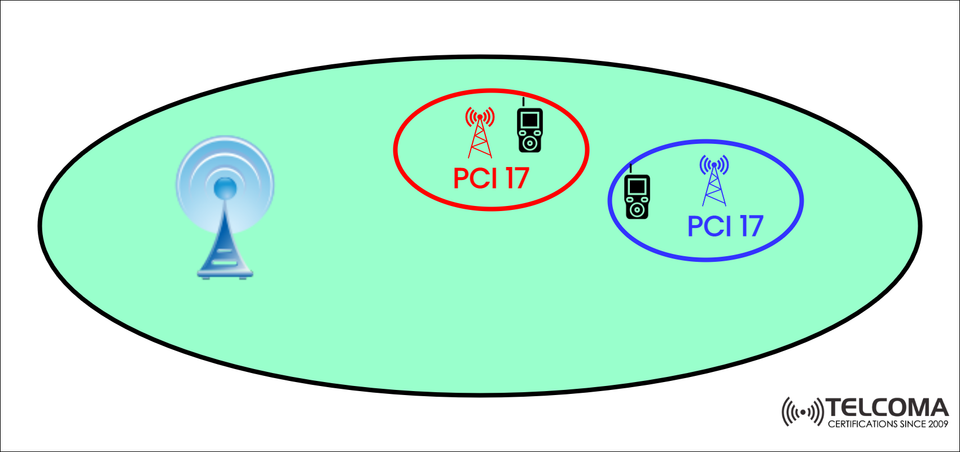
The picture shows a typical PCI Collision example occurring in an LTE network where two adjacent cells are assigned the same Physical Cell Identity (PCI 17). From my experience as a formal telecoms engineer and consultant, it is essential for telecom professionals and engineers to know what interference scenarios like this look like in order to manage mobility and network performance.
What Is PCI in LTE?
In LTE (Long-Term Evolution) networks, PCI stands for Physical Cell Identity which is a numeric identifier that falls between 0 and 503 to differentiate between neighboring cells while the UE (User Equipment) performs cell search, handover, or reselection.
What is PCI Collision?
A PCI Collision occurs when two or more neighboring cells are assigned the same PCI and are radio covered so that they interfere or are too close to each to make the UE's ability to track its serving cell uniquely identified.
In the picture provided,
There are two co-located cells in the same coverage area that are both using PCI 17.
User devices (UEs) can not distinguish between the two cells in the overlapping locations.
This causes mobility problems that include failed handovers and reselection failures.
Problems Caused by PCI Collision
Problem Impact on Network
UE confusion UEs find it impossible to uniquely identify the serving cell.
Handover failure the source eNodeB has no method to steer the UE correctly.
Reselection failure UEs in idle mode may select the wrong cells.
The difference between PCI collision and PCI confusion
PCI feature PCI collision PCI confusion
Geographic Area The same PCI in adjacent cells The same PCI in non-adjacent cells
Impact Confusion in the UE due to overlapping signals Confusion will still happen, particularly in mobility scenarios
Urgency to resolve High, it can lead to handover issues that are critical Medium/Lower, it is still something to resolve to improve the overall performance of the network
Best practices to avoid PCI collision
To avoid PCI collision, LTE networks conduct careful PCI Planning activities:
Follow PCI planning procedures and, if available, PCI planning tools that will allow you to assess where RF overlap zones exist.
Do not use the same PCI in adjacent cell.
Make sure to implement PCI reuse patterns which use reuse planning with either 3-sector use or 6-sector use.
Conduct continuous network audits and drive tests so that you can recognize when there are overlapping PCIs;
Utilize Self-Organizing Networks (SON) features such as Automatic PCI Allocation;
Conclusion
PCI collision is one of the main issues faced during LTE radio planning, and it directly impacts the experience of users, and the performance of mobility. Telecom engineers should understand the causes of, and how to avoid PCI collision using effective PCI planning practices, to greatly improve reliability in their networks and ensure that user handovers are optimized.
In a 5G future where seamless connectivity is assumed, the fundamentals of good PCI planning will always be important.
Real life examples of where PCI collisions occur
PCI collisions do not just happen in theory - they occur in live LTE deployments in particular, for:
For example, in an urban area of high rises and lots of traffic:
Two pico cells possibly in adjacent towers can have the same PCI due to planning mistakes.
When users move across the buildings, the handover requests could fail or unintentional re-directs could happen.
The performance KPIs (Key Performance Indicators) such as Call Setup Success Rate (CSSR) and Handover Success Rate (HSR) might drop off quickly.
Tools for PCI Collision Detection
To help them to detect and mitigate potential PCI collisions, operators use various tools
Drive Testing Tools [e.g. TEMS, Nemo Outdoor]: Measure real signal coverage and identify same PCI signals from different locations.
OSS Reports: Operations Support Systems can keep track of handover failures, and neighbor relations were not consistent.
PCI Planning Software: It also utilizes RF propagation models to determine interference scenarios.
SON (Self Organizing Networks): Automatically assigns and re-assigns PCIs to avoid collisions dynamically.
SON in PCI Management
SON (Self Organizing Network) capabilities in PCI management is important in PCI day to day management:
Automatic PCI Allocation (APA): ensures that new cells are assigned a unique PCI value within their interfernce domain.
Collision/Confusion Detection Modules: can also detect if cells operate in overlapping or confused PCI zones and raise alerts.
Closed Loop Optimization: This also allows for ongoing monitoring or mobility KPIs and automatically or indirectly configure.
PCI Planning in 5G Networks
While the concept of PCI originated in LTE, PCI will now carry over into 5G NR as well, and with more planning to consider:
5G NR is defined with PCI and will support a PCI in the PCI range from 0 to 1007, leveraging the planning space.
Dynamic spectrum sharing (DSS) and Carrier Aggregation (CA) contribute to this level of reuse.
Interworking between LTE and a 5G service will provide additional complexity for a multi-RAT (Radio Access Technology) PCI plan.
Transition Tip:
Operators moving from 4G to deploy 5G should seek a summary of prior LTE PCI allocations to avoid overlap in NSA (Non-Standalone) landscape where 5G NR reliance on LTE or LTE anchor.
Wrapping Up
Efficient PCI planning will require continuous effort on behalf of;
Collaboration between RF engineers and their optimization counterparts,
Continuous auditing and refreshing the planning registers,
Investing in smart planning tools and automation.
As networks continue to evolve toward 5G and beyond, avoiding basic mistakes such as PCI collision should be the primary focus in order to deliver high availability, frictionless mobility, and an overall extensive QoE (Quality of Experience).