
Understanding Primary Scanning Channels (PSC) in the 6 GHz Band for Wi-Fi 6E and Beyond

Understanding Primary Scanning Channels (PSC) in the 6 GHz Wi-Fi Band
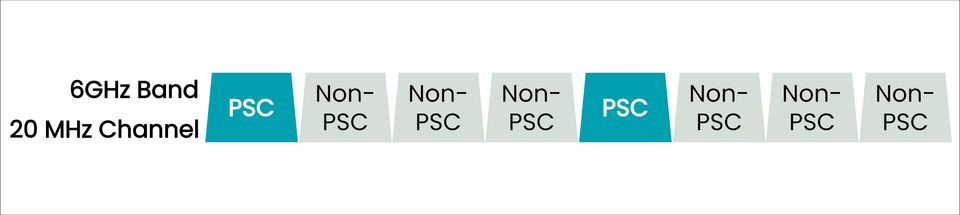
The 6 GHz band has advanced Wi-Fi technology, particularly in providing higher bandwidth and low-latency connectivity (Wi-Fi 6E and soon Wi-Fi 7). One important aspect of the 6 GHz spectrum is the Primary Scanning Channels (PSC). The image above shows how PSC and non-PSC channels are mapped in the 6 GHz band with 20 MHz channel widths.
The intent of this article is to explain what PSC are, why they are important, and how they help with device discovery and network efficiency.
What Are Primary Scanning Channels (PSC)?
PSC (Primary Scanning Channels) are assigned 20 MHz channels in the 6 GHz band that client devices scan first looking for access points (APs). There is one PSC per every four channels in the band so clients will scan channels using PSC to limit their scanning time and enhance performance once they have connected.
PSCs have specific and standard definitions (IEEE and Wi-fi Alliance).
Only a few of the 20 MHz channels defined in the 6 GHz band are PSCs.
Devices can scan the PSC channels to speed up their scanning rather than searching all channels in the spectrum.
Visual Overview:
As represented in the image:
The 6 GHz band is divided into a number of 20 MHz channels.
Some of these channels are designated as PSC (in blue).
Other, non-PSC channels exist in light grey.
This alternation helps in channel discovery because devices only need to scan specific channels without scanning the entire frequency range, therefore saving valuable time and energy.
Why PSC Are Important in Wi-Fi 6E and Wi-Fi 7
🔍 Speedier Access Point Discovery
Devices only discover PSC channels in order to find neighboring Access Points (APs), which greatly increases the speed of connection.
⚡ Power Efficiency
Less scanning = less battery = very important on devices like smartphones and IoT sensors that run on batter power.
📶 Decreased Spectrum Congestion
By allowing clients to search for discovery within the PSC ranges, PSCs themselves may help prevent unnecessary interference through non-PSC channels.
PSC vs Non-PSC: The Key Differences
Feature PSC Channels Non-PSC Channel
Scanned by default ✅ Yes ❌ No
Used for discovery beacons ✅ Yes ❌ No unless connected
How channels are filled in frequency range Spaced evenly in band Fill in remaining channels
How channels function when a device connects Scanning and joining Communication
How PSCs are allocated within the 6 GHz band
In a 20 MHz mode of operation:
Every fourth 20 MHz channel in the 6 GHz band is given to PSC.
We have 80 MHz intervals of PSCs.
Valuable Takeaways for Telecom and Network Engineers
Network Optimization: Deploy APs on PSC channels so user onboarding is faster.
Smart Planning: Limit beacon overhead to only discover broadcasts on PSC channels.
Better User Experience: Provides faster Wi-Fi connection times to the end user.
Primary Scanning Channels (PSC) is an innovative concept for the 6 GHz Wi-Fi band. It represents a major shift in the way a device discovers and connects to wireless networks. The simple idea of reducing the total number of channels a device needs to scan to allow for quicker Wi-Fi 6E, has made devices more efficient, faster, and intelligent.
For network architects and telecom professionals knowing what PSCs are and their inherent value is beneficial in optimizing modern wireless deployments and helps us prepare for the next motion of Wi-Fi.
🛠 Practical Deployment Considerations Using PSCs
For telecom professionals to implement Primary Scanning Channels (PSC) in real-world environments, deployment consideration should involve the following concepts:
📡 Best Practices for Access Point Deployments
Use PSCs for beaconing purposes: Configure APs to send back beacons frames only on PSC channels. This process aids a device's effort to discover networks.
Micro-manage SSID PSCs: If an AP is on a non-PSC channel, the AP can still advertise an SSID on the nearest PSC channel in an effort to help with discovery.
Plan PSC channel spacings: In potential high density environments plan for channel spacings on PSC.
CRAFTING THE FUTURE OF Wi-Fi SCANNING:
🔧 Configuration Recommendations for Device Manufacturers
Configure client device firmware to limit scanning to PSCs only.
Fast passive scanning may be implemented on PSCs, and active scanning should only be used as fallback if no beacon is detected.
Device manufacturers should also strive to limit wasted power consumption by disabling non-PSC scan sweeps, except when reauthentication determines scanning of all channels is necessary.
🌐 Regulatory Framework and Global Developments
IEEE 802.11ax and Wi-Fi Alliance:
The IEEE 802.11ax amendment for 6 GHz band identifies PSCs.
The Wi-Fi alliance has a mandated that any device that achieves Wi-Fi 6E certification must be able to perform scanning on PSCs to enhance the interoperability of the ecosystem of devices.
Regional Allocated Frequencies:
Although the governance of PSCs is globally standardized the usable part of the 6 GHz band varies:
USA (FCC): 5925–7125 MHz (full 6 GHz band).
EU (ETSI): 5945–6425 MHz.
Asia-Pacifica: Based variously from country-by-country basis many have adopted similar approaches to that of the FCC or ETSI.
This means PSC locations defined will vary slightly based upon local regulatory authority's definition, there remains a very clear concept of a fixed subset of 20 MHz channels used for expedient scanning purposes.
📈 The Future: PSCs in Wi-Fi 7 and Beyond
Wi-Fi 7 (802.11be) will provide enhanced operational ability in the 6 GHz band, and clearly PSCs will remain a fundamental method of channel discovery mechanisms.
🧠 Key Takeaways
PSC = Primary Scanning Channel: Equipped for fast and efficient Wi-Fi scanning.
Decreases the connection time, power consumption and overhead to the Wi-Fi network.
Deployed every 80 MHz across the entire 6 GHz band, in 20 MHz sizes.
Essential for Wi-Fi 6E, and will be the baseline for the upcoming innovations in Wi-Fi 7 and other 6 GHz wireless technologies.
Supported/enforced globally by regulatory and standards bodies.
🔍 Final Thoughts
For telecom professionals, system integrators, and wireless engineers, the understanding of Primary Scanning Channels (PSCs), their role and deployment is not just a best practice, it's a technical requirement. As we move Wi-Fi into the 6 GHz frequency world, understanding and deploying PSCs means we can help to ensure networks remain efficient, scalable, and ready for the next steps in the evolution of wireless communications.