
Understanding Programmable RAN and Unbundled eNodeB Architecture in Open RAN

How Programmable RAN and Unbundled eNodeB are Changing the Telecommunication Networks
The telecom industry is in a high-speed race towards 5G and beyond, which means traditional radio access network (RAN) architectures are evolving into Open RAN (O-RAN). The ability to develop software-defined RAN (SD-RAN) architectures, programmable control, and unbundled eNodeB components is redefining the structures of mobile networks to make it easier to create flexible, scalable, and economical mobile networks.
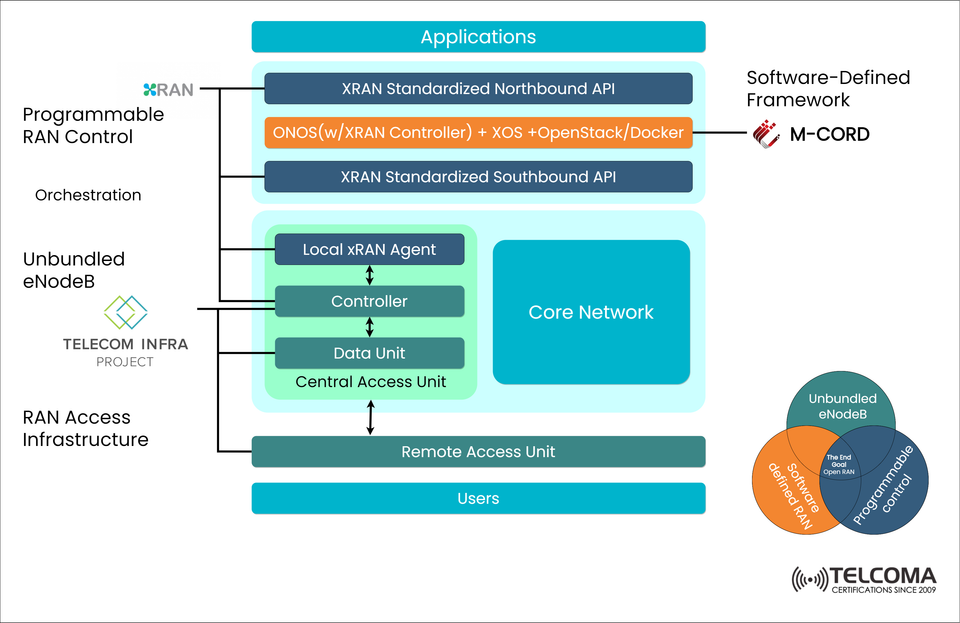
The image above depicts a modern Programmable RAN architecture that follows the principles of the Telecom Infra Project (TIP) and the M-CORD (Mobile Central Office Re-architected as a Datacenter) project, focused on open interfaces, virtualization and software control.
🔧 Important Components of Programmable RAN Architecture
The software-defined RAN stack can be broken down into four logical layers:
- Applications
Top of the architecture, interfaces with RAN components via XRAN standardized northbound APIs.
Allows service providers to dynamically control or orchestrate RAN behaviour based on policies or AI-based analytics. - Programmable RAN Control (M-CORD Layer)
Has software-defined orchestration.
Uses ONOS (Open Network Operating System) with XRAN Controller, XOS, and virtualization infrastructure such as OpenStack and Docker.
Supports automation and disaggregation, with a modular control layer. - Unbundled eNodeB and Centralized Access
This allows functional separation within the eNodeB:
Local xRAN Agent, to make local decisions
Controller, for RAN coordination
Data Unit for user data processing
This is together the Central Access Unit (CU) that connects to Remote Access Unit (RU).
- RAN Access Infrastructure
The RU provides RF functions and is closer to the user.
This is all connected to the Core Network, allowing complete end-to-end flow.
🔗 XRAN APIs: The Glue of Open RAN
The XRAN Standardized APIs (northbound and southbound) are important for the interoperability of the equipment of different vendors or OEMs.
Northbound API:
Link the control applications to RAN controller
Enable the dynamic RAN optimization.
Southbound API:
Link controller to RAN components like the CU and RU
Ensure there is a standard interface to enable interoperability.
📦 What is M-CORD and Why is it Important?
M-CORD is part of ONF (Open Networking Foundation) and TIP (Telecom Infra Project) ecosystems - we participate in both. A significant advantage of M-CORD is that it allows for the deployment of virtualized RAN, core, and edge services.
The advantage of M-CORD is as follows:
Containerisation and virtualisation (Docker/OpenStack)
Cloud-native orchestration
Disaggregated hardware and software infrastructure
This allows operators to deploy services rapidly, scale services with demand, and implement multi-vendor ecosystem.
🔄 Advantages of Open and Programmable RAN
Specifics Benefits
Unbundled eNodeB The vendor does not lock you in and provides much greater flexibility in the deployment.
xrAN APIs True interoperability is achieved between the software and hardware layers.
Software-Defined Control Centralized orchestration that is ready to take advantage of automation.
Cloud-native Platform (M-CORD) Accommodates Rapid innovation and DevOps adoption.
Centralized Plus Remote Units Effective utilization of resources and scalability.
📌 Key Takeaways from the Diagrams
It is clear that with a Local xRAN Agent, intelligent decisions can be made at the edge.
The ONOS and XOS orchestration capability is a powerful engine.
XRAN APIs unified the control and access units, which connects the applications to the infrastructure.
TIP and M-CORD are disruptors in the value chain since they intend to disaggregate traditional telecommunications infrastructure and their business models to accelerate innovation, flexibility, and openness.
🧭 The Journey to an Fully Open and Intelligent RAN
The diagram and supplementing descriptions suggest an ultimate goal of Open RAN, which is illustrated in the Venn diagram:
RAN Software-defined
E-NodeB unbundled
Programmable Control
At the intersection of these areas is a domain of fully disaggregated, open and intelligent networks that will have the directions to provide functionality for 5G, IIoT and all sorts of applications yet to come.
✅ Summary
The unbundled eNodeB and programmable RAN architecture that is portrayed in this report is a key milestone towards achieving the vision of open, software-defined, multi-vendor RAN. As we begin to decouple, since decoupling works coherently in switches/routers, we can create standardized interfaces through XRAN APIs for clearly defined and separable interface planes. By utilizing the orchestration capabilities of M-CORD as a cloud-native platform, operators can more effectively deploy all sorts of applications in their networks with greater agility and improved efficiencies by also removing duplication across network services.
🌍 Real-World Uses of Programmable RAN
- Private 5G Networks
Enterprises, like manufacturing plants, ports, and campuses, are establishing private 5G networks using programmable RAN for:
Customized network slicing
Real-time latency controls
Edge analytics with local decision-making capabilities
- Urban Network Densification
In dense urban environments, Open RAN enables:
Accelerated rollout of small cells
AI driven interference management
Dynamic load balancing on centralized control units (CUs)
- Connectivity in rural/remote regions
Open RAN's vendor-agnostic approach, along with a lower total cost of ownership (TCO), will aid in closing the digital divide by:
Reducing infrastructure costs
Facilitating deployments that are community-based
Using lightweight remote units in low-power environments
🏗 Implementation Considerations
Before migrating to a programmable and open RAN model, telecom operators should evaluate:
📌 Interoperability Testing
The ability for multi-vendor components (CU, DU, RU) to work together seamlessly
The XRAN API compliance at every layer
📌 Network Function Virtualization (NFV)
Using cloud-native VNFs to decouple hardware from software
Utilizing orchestration platforms, like OpenStack, Docker, and Kubernetes
📌 Security Frameworks
Protection of control plane APIs
Secure boot and runtime of software-defined components
Adopting zero-trust architecture
💬 Conclusion
Programmable RAN and unbundled eNodeB architectures promise a radical reconception of mobile networks. By embracing open standards like XRAN, orchestration frameworks like M-CORD, and proactive efforts like the Telecom infra project, operators can evade vendor lock-in and create more intelligent, adaptable networks.
This change isn't just about technology; it's strategic. It give telecom providers the power to:
Bring new services to market sooner.
Adopt a shorter pace of innovation similar what is seen in IT.
Enhance CAPEX/OPEX efficiency.
As the industry shifts toward open and intelligent networks, the organizations that invest early in Open RAN technologies expect to be the organizations that define the future of wireless connectivity.