
Understanding RAN Functional Split Options: A Guide for Telecom Professionals

Clarification of RAN Functional Split Options: A Research Paper for Telecommunications Professionals
As new architectural considerations for 5G and cloud-native architectures evolve, the understanding of the RAN functional split becomes a major part of the design decision. Each of the split options represent changes in how the RAN functions are split between vBBU (virtualized Baseband Unit) functions and the remote radio unit (RRU) functions, which will have varying potential for new network cost, performance, and scalability.
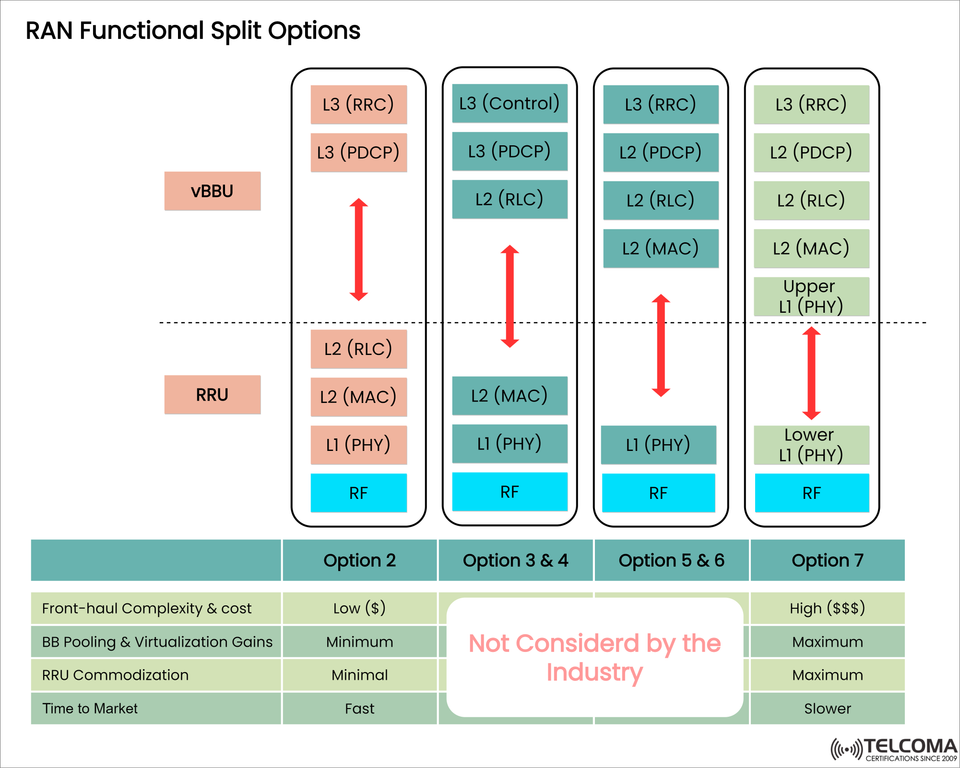
The above image from Telcoma represent the RAN functional split options - Option 2, 3, 4, 5, 6, and 7, where each of the RAN layers (L1, L2, and L3) is executed along with the trade-offs. So let's break it down.
What is RAN Functional Split?
The term RAN functional split refers to respectively splitting processing responsibilities between each of our:
vBBU (virtualized Baseband Unit): Cloud/centralized functions.
RRU (remote Radio Unit): Distributed functions that are at the edge and as close as possible to antennas.
This impact the means by which data can be transported over the front-haul (the section of connectivity between the virtualized BBU vBBU and the RRU.
Overview of RAN Split Options
🧩 Option 2: High RRU Responsibility
Split Point: Between PDCP and RLC layer.
vBBU: Layer 3 (RRC & PDCP)
RRU: Layer 2 (RLC, MAC) and Layer 1 (PHY)
Pros:
Front-haul complexity and cost is low.
Time to market is quicker.
Cons:
Limited benefits to virtualization.
Increased limitations on BB pooling flexibility.
🧩 Options 3 & 4: Not Commonly Adopted
Split Point: Between RLC and MAC (Option 3), or MAC and PHY (Option 4).
Not considered by most of the industry given little benefit, plus unknown value.
🧩 Options 5 & 6: Balanced Split
Split Point: Between MAC and PHY (Option 5) or while still in the PHY layer (Option 6).
vBBU: L3, PDCP, RLC, MAC.
RRU: Full L1 (PHY).
Pros:
Good balance of being culturalized vs. the front-haul.
Common throughout many 5G deployments.
Cons:
More complex than Option 2.
Needs a more capable front-haul than Option 2.
🧩 Option 7: Maximum Centralization
Split Point: Within PHY (upper vs. lower PHY).
vBBU: L3 to upper L1.
RRU: Lower L1 and RF.
Pros:
Maximum BB pooling and virtualization.
Facilitates lower cost RRU (aka RRU commoditization).
Cons:
A very high cost associated with front-haul complexity.
Time to market is slower due to implementation issues.
To quickly compare:
Feature Option 2 Option 3 & 4 Option 5 & 6 Option 7
Front-haul Complexity & Cost Low ($) Not Adopted Moderate ($$) High ($$$)
Virtualization Gains Minimal Not Adopted Good Maximum
RRU Commoditization Minimal Not Adopted Moderate Maximum
Time to Market Fast Not Adopted Balanced Slower
When deciding on a RAN Split Option
Choosing the Appropriate RAN Split Option
There are several factors that telecom operators and network architects should take into account when selecting a functional split:
Use case: Urban high-density scenarios versus rural coverage situations.
Transport Network: Availability of low-latency front-haul at high speed (e.g., fiber).
Deployment Strategy: Centralized versus distributed architectures.
Cost Constraints: CapEx versus OpEx balancing trade-offs.
Summary
The functional split in RAN will be instrumental in determining the performance, scalability, and economics of today's mobile networks. Option 2 may be the preferred option due to its simplicity and speed to market, while Option 7 will provide seemingly limitless virtualization potential- at a cost. Options 5 and 6 achieve a good balance where both are becoming increasingly popular in real-life 5G deployments.
Example: A mobile operator adding 5G coverage in remote areas may prefer to use Option 2 based on low front-haul requirements.
Front-haul requirement: Standard Ethernet or less.
Implementation of Option 7: Urban and Tower High-Density Considerations
Option 7 is generally preferred for high-density urban environments or indoor small cell deployments where you have high quality extremely low latency fiber access.
Example: When implementing, say, smart cities or professional sports stadiums, and the owner-example has its own, private, 5G networks, the maximum flexibility of a disaggregated RAN where real time processing can be moved out to the edge will appeal to planners.
Front-haul requirements: organizers will require high-capacity, low-latency fiber capabilities (e.g., eCPRI over 10Gbps front-haul links).
Pathway towards Cloud-Native RAN and Open RAN
The functional split options laid out in this guide are an essential part of both the Open RAN (O-RAN) movement as well as cloud-native, 5G networks came about.
🏗️ Open RAN Compatibility
Option 7.2x (it is subset of Option 7) has emerged as the de facto standard within the Open RAN community. The O-RAN Alliance supports the standard.
In this space, networks can provide multi-vendor and seamless interoperability between Distributed Units (DU) and Radio Units (RU).
☁️ Cloud-Native Enablement
Similar to Open RAN, Options 5 - 7 align with key principles of cloud-native, containerized and microservices-based CU/DU models.
Technical considerations
Latency tolerances between vBBU and RRU
Bandwidth capacities of the front-haul
The availability of edge computing capabilities.
Level of synchronization required (e.g., IEEE 1588v2 in Option 7 - if it's even required?)
Business Aspects:
CAPEX/OPEX trade-offs
The vendor ecosystem and interoperability
Regulatory compliance (e.g., in public safety networks)
Scalability for future upgrades
Future Perspectives
As 6G research advances and AI-powered RAN intelligence matures, it is possible that RAN functional splits will continue to evolve, possibly including:
Dynamic split options where the split point may change based on the needs for traffic or latency.
Orchestration with AI/ML that can optimize functional splits to dynamically steer traffic in real time between centralized and distributed functions.
Complete virtualization of the RAN, which means no hardware constraints regardless of where you are in the entire RAN.
Conclusion
RAN functional split options are what define the architecture of the mobile networks today and into the future. As with the simplified classic Option 2, or robust options such as Option 7 with high performance and virtualization, all of the splits represent trade-offs that need to fit the deployment objectives, regional requirements, and long-term vision.
All telecoms, networks planners, and vendors should work together to assess these options enable flexible, efficient, and future-enabled RAN infrastructures.