
Understanding RAN Functional Splits in 4G and 5G Networks

Understanding RAN Functional Splits in 4G and 5G Networks
As mobile networks transition from 4G/LTE to 5G and beyond, the architecture of the Radio Access Network (RAN) becomes crucial for performance, scalability, and efficiency. A key concept here is the functional split—which refers to how network functions are divided among the Central Unit (CU), Distributed Unit (DU), and Radio Unit (RU).
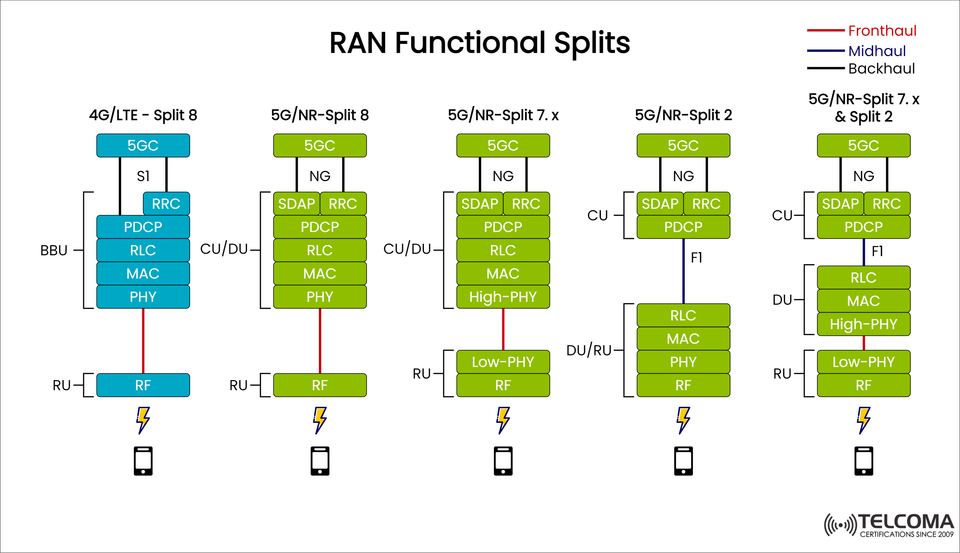
The diagram showing RAN Functional Splits illustrates how different functions like RRC, PDCP, RLC, MAC, and PHY layers are allocated in 4G and the various 5G split options, as well as the roles of fronthaul, midhaul, and backhaul.
In this blog, we’ll break down these functional splits, discuss their significance, and look at the trade-offs in latency, efficiency, and deployment flexibility.
What is RAN Functional Splitting?
In straightforward terms, functional splitting defines where specific protocol layers in the RAN are handled.
In 4G LTE, most functions were housed in the Baseband Unit (BBU), with just the RF component in the Remote Radio Head (RRH).
In 5G, due to the rise of cloud-native architectures and Open RAN (O-RAN) initiatives, functions can be split more flexibly between CU, DU, and RU.
This division affects network performance, costs, and scalability, making it vital for enabling virtualized and disaggregated RAN deployments.
Key RAN Components
Before diving into splits, let’s clarify the main components:
CU (Central Unit): Takes care of higher-layer processing like SDAP, RRC, PDCP. It's usually centralized and cloud-based.
DU (Distributed Unit): Manages lower-layer functions like RLC, MAC, High-PHY. It’s positioned closer to users to minimize latency.
RU (Radio Unit): Handles Low-PHY and RF functions. It’s usually found at cell sites alongside antennas.
The connectivity is set up by:
Backhaul: CU ↔ Core Network (5GC).
Midhaul: CU ↔ DU.
Fronthaul: DU ↔ RU.
Functional Splits in 4G and 5G
The diagram depicts different split options, ranging from 4G Split 8 to various 5G splits. Let’s break these down.
- 4G/LTE – Split 8
Architecture: The BBU centralized all operations (RRC, PDCP, RLC, MAC, PHY), while the RRH only managed RF.
Transport: Fronthaul (red line) transmitted digitized I/Q samples.
Challenge: This setup needed very high bandwidth and low latency (like CPRI links). It wasn’t scalable for widespread 5G deployments.
- 5G NR – Split 8
Similar to LTE Split 8, but tailored for 5G.
CU/DU functionalities (RRC, PDCP, RLC, MAC, PHY) are centralized; RU is responsible for RF.
Benefit: Provides a smoother transition from 4G.
Limitation: Still has demanding fronthaul needs.
- 5G NR – Split 7.x
High-PHY at DU, Low-PHY + RF at RU.
CU manages SDAP, RRC, PDCP, RLC, MAC.
Benefit: Reduces fronthaul bandwidth requirements by shifting some PHY functions closer to the RU.
Use Case: Ideal for densely populated urban small cells where fronthaul costs are a big concern.
- 5G NR – Split 2
Division between CU and DU.
CU oversees higher layers (SDAP, RRC, PDCP), while DU takes care of RLC, MAC, PHY, and RF.
Midhaul (blue line) connects CU and DU.
Benefit: Offers flexible CU centralization with less stringent latency than Split 7.
Use Case: Best for large-scale networks where one CU can efficiently serve multiple DUs.
- 5G NR – Hybrid Split (7.x + 2)
Combines Split 2 (CU ↔ DU) and Split 7 (DU ↔ RU).
CU handles RRC, SDAP, PDCP.
DU looks after RLC, MAC, High-PHY.
RU takes care of Low-PHY + RF.
Benefit: Balances latency, bandwidth, and cost issues effectively.
Use Case: Flexible setups in mixed environments (denser cities alongside rural areas).
Comparison of RAN Functional Splits
Split Option CU Functions DU Functions RU Functions Transport Benefits Challenges LTE Split 8RRC, PDCP, RLC, MAC, PHY–RF Front haul Simple migration path High fronthaul demand5G Split 8RRC, PDCP, RLC, MAC, PHY–RF Front haul LTE-like architecture Still bandwidth heavy5G Split 7.xRRC, PDCP, RLC, MAC, High-PHY–Low-PHY, RF Front haul Reduced bandwidth need Tight latency5G Split 2RRC, SDAP, PDCPRLC, MAC, PHYRF Mid haul Flexible CU centralization Higher DU cost Hybrid (7.x + 2)RRC, SDAP, PDCPRLC, MAC, High-PHY Low-PHY, RF Mi haul + Fronthaul Optimized balance Complexity in design
Fronthaul, Midhaul, and Backhaul Explained
The diagram also clarifies the roles of various transport links:
Fronthaul (Red): Connects DU ↔ RU. Demands high bandwidth and low latency. Technologies include CPRI, eCPRI.
Midhaul (Blue): Links CU ↔ DU. Less strict than fronthaul but still needs to be time-sensitive. Often utilizes Ethernet/IP.
Backhaul (Black): Connects CU ↔ Core (5GC). Typically fiber or microwave.
The choice of split largely hinges on the available transport network.
Why RAN Functional Splits Matter
Functional splits enable:
Network Flexibility: Operators have the ability to balance centralization versus distribution.
Cost Efficiency: Eases fronthaul bandwidth demands when necessary.
Cloud-Native Deployments: Supports virtualization and containerized RAN.
Support for Open RAN: Promotes multi-vendor interoperability.
Scalability for 5G: Aids in densification and heterogeneous networks.
Real-World Deployment Considerations
Latency Requirements: * Split 7.x needs <250 μs one-way latency. * Split 2 can manage up to 10 ms, making it more feasible for many setups.
Transport Network: * Dense urban areas may prefer Split 7.x if there's plenty of fiber. * Rural zones might opt for Split 2 for cost-effectiveness.
Virtualization and Cloud: * Split 2 is well-suited for vRAN and cloud-native CUs. * Split 7.x can still utilize cloud DUs but comes with stricter requirements.
Energy Efficiency: * Moving functions closer to RU can cut down backhaul traffic and save energy.
Future Outlook
As networks gear up for 6G, functional splits will likely become even more adaptable. AI-driven orchestration might let networks dynamically switch splits depending on traffic, latency, and energy needs.
Ongoing efforts from the O-RAN Alliance and 3GPP aim to ensure these splits stay compatible across vendors and regions, fostering open and flexible mobile networks.
Conclusion
RAN functional splits are fundamental to the flexibility and scalability of 5G. From LTE’s Split 8 to more sophisticated Split 7.x and Split 2 combinations, operators now have a range of options to build networks that strike a balance between latency, cost, and efficiency.
Grasping these splits—along with understanding the roles of fronthaul, midhaul, and backhaul—is essential for telecom professionals looking ahead to 5G and beyond. As networks continue to densify and adopt virtualization, functional splits will remain the cornerstone of efficient, future-ready RAN deployments.