
Understanding SBA in 5G: High-Level Architecture and IMS Integration
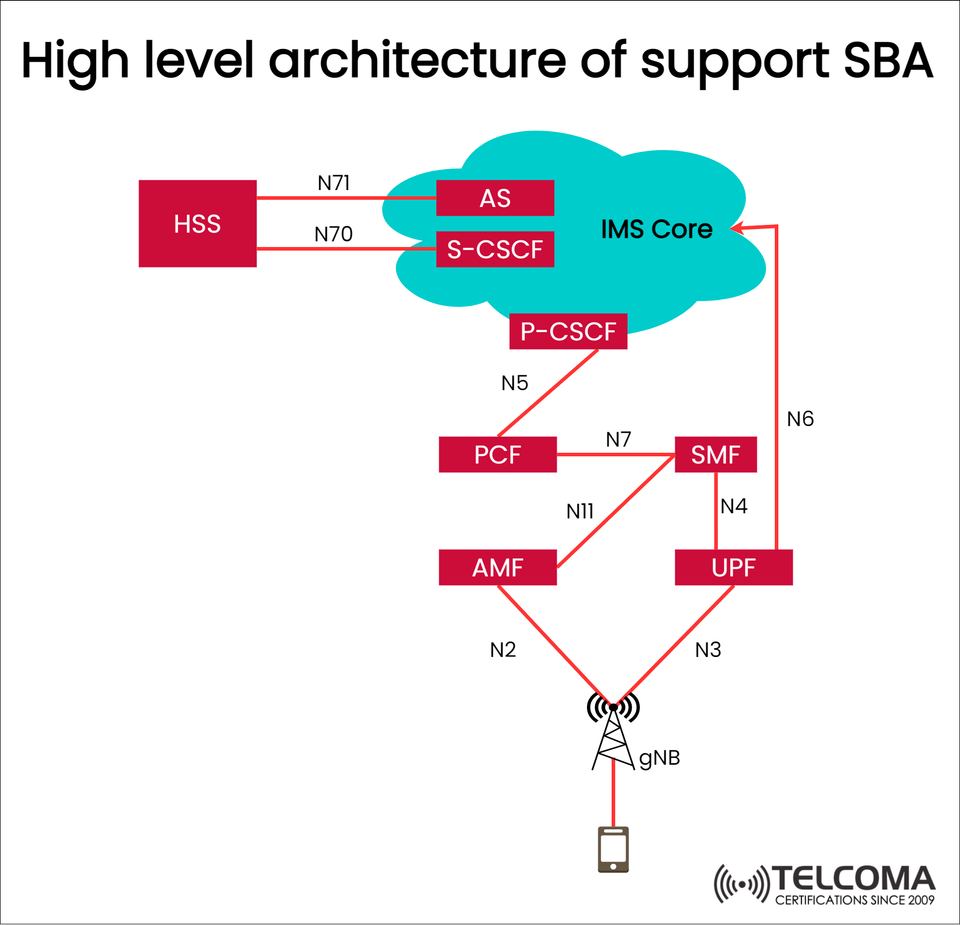

Overview of the Support Architecture for SBA in 5G
With the introduction of 5G Standalone (SA), we're seeing a significant change in how networks are designed, shifting from the old point-to-point styles of 4G to a more advanced Service-Based Architecture (SBA). This architecture is pivotal in the 5G Core (5GC), fostering a telecom ecosystem that's flexible, cloud-native, and service-oriented.
The diagram above depicts the high-level SBA architecture that supports IMS (IP Multimedia Subsystem), key for delivering voice (VoNR), video, and various IP-based multimedia services in 5G.
What’s Service-Based Architecture (SBA)?
In the 4G EPC framework, network functions primarily communicated through set interfaces, which was efficient back then but didn’t offer much flexibility. In 5G, SBA takes this rigid approach and replaces it with web-based APIs (often RESTful), allowing network functions (NFs) to interact in a more service-driven manner.
Here are some key features of SBA:
Cloud-Native: Designed for virtualization, containers, and orchestration.
Service-Oriented: Network functions can expose services for other NFs to use.
Scalable and Flexible: Operators can adjust the scale of functions on their own.
Interoperable: Makes it easier to integrate with third-party apps.
In essence, SBA turns the 5G Core into a modular, open, and programmable platform, setting the stage for innovations like network slicing and ultra-reliable low-latency communications (URLLC).
The Role of SBA in IMS and Voice Services
Even though 5G is groundbreaking for data, voice is still vital. IMS acts as the backbone for VoLTE (Voice over LTE) and VoNR (Voice over New Radio).
The 5G Core uses SBA to connect essential functions like:
Access and Mobility Management (AMF)
Session Management (SMF)
Policy Control (PCF)
User Plane Function (UPF)
Using SBA, these functions can interact with IMS components like P-CSCF, S-CSCF, and Application Servers (AS) in a more dynamic way.
Essential Parts of the SBA Support Architecture
The diagram outlines the main components involved in integrating SBA with IMS:
- UE (User Equipment)
The 5G device that connects to network services.
Connects to the gNB through the N2 (control plane) and N3 (user plane).
- gNB (Next-Generation NodeB)
The 5G base station.
Connects UE traffic to both the AMF and UPF.
- AMF (Access and Mobility Management Function)
Oversees registration, connection, and mobility management.
Connects with UE (via N2), SMF (via N11), and PCF.
- SMF (Session Management Function)
Manages the setup, modification, and release of sessions.
Controls UPF through N4.
- UPF (User Plane Function)
Responsible for forwarding data and routing to external networks (IMS Core via N6).
Anchors user traffic, ensuring low-latency.
- PCF (Policy Control Function)
Handles policy implementation and QoS enforcement.
Communicates with SMF (via N7) and IMS components.
- IMS Core Elements
P-CSCF (Proxy Call Session Control Function): The initial contact point for UE within IMS, connecting with PCF.
S-CSCF (Serving Call Session Control Function): Manages call/session control, interfaces with HSS via N70.
AS (Application Server): Provides services like voicemail and conferencing, connecting to HSS via N71.
HSS (Home Subscriber Server): Stores subscriber profiles and handles authentication.
Interfaces in SBA and IMS Support
The diagram demonstrates how SBA uses standardized interfaces to facilitate smooth communication:
N2: UE ↔ AMF (control signaling).
N3: UE ↔ UPF (user data).
N4: SMF ↔ UPF (session control).
N5: P-CSCF ↔ PCF (policy coordination).
N6: UPF ↔ IMS Core (voice/data traffic).
N7: SMF ↔ PCF (QoS and policy exchange).
N11: AMF ↔ SMF (control signaling).
N70/N71: HSS ↔ S-CSCF/AS (subscriber management).
These interfaces illustrate how SBA connects the control plane, user plane, and service plane to ensure effective delivery of IMS-based services.
How SBA Supports IMS Services: A Step-by-Step Flow
Here’s a breakdown of how SBA powers IMS voice service in 5G:
UE Registration * UE registers with 5GC through the gNB and AMF. * AMF takes care of mobility and authentication.
Session Establishment * SMF sets up session context, picking UPF for data management. * PCF implements policies and QoS rules.
IMS Registration * UE registers with IMS via P-CSCF. * S-CSCF gets subscriber data from HSS (via N70).
Service Invocation * When UE uses an app like voice calling or conferencing, AS may get activated (via N71).
Media Flow Routing * User plane traffic navigates through UPF (N3/N6) to the IMS Core. * This setup guarantees low-latency, QoS-assured voice/video communication.
Advantages of SBA in 5G IMS Support
SBA offers several benefits for telecom operators and their customers:
Flexibility: Separates network functions for independent scaling.
Speedier Innovation: Facilitates fast rollout of new IMS-based services.
Better Resource Utilization: Optimizes control and user plane separation.
Improved QoS: Real-time policy management through PCF.
Interoperability: Employs web-based APIs for simpler integration with third-party solutions.
SBA vs. Legacy Architecture
Feature Legacy (4G EPC)5G SBA Communication Model Point-to-Point Interfaces Service-Based APIs Flexibility Rigid Highly Modular Deployment Hardware-Centric Cloud-Native & Virtualized Policy Control Centralized, limited Dynamic, distributed Voice Support Vo LTE Vo NR + IMS Integration
Challenges in SBA Deployment
Even though SBA provides various advantages, operators face some hurdles:
Complexity: Transitioning from legacy EPC to SBA requires a significant redesign.
Security: API exposure necessitates stronger security measures.
Interoperability: Different vendors may interpret standards in varied ways.
Latency Sensitivity: Maintaining low latency for voice/video services needs careful optimization.
Future Outlook: SBA and Beyond
As networks continue to progress:
VoNR (Voice over New Radio) is set to be the standard voice solution in 5G SA, relying entirely on SBA-IMS integration.
Network slicing will utilize SBA to provide unique QoS for voice, IoT, and enterprise services.
Cloud-native orchestration will enable real-time scaling of IMS components.
This suggests that SBA won’t just support current IMS services; it will also pave the way for AI-driven automation, edge computing, and the developments of 6G.
Wrap-Up
The high-level SBA architecture is fundamental to the 5G Core, allowing for smooth integration with IMS for advanced voice and multimedia services. By moving away from inflexible point-to-point connections to adaptable, service-oriented APIs, SBA boosts scalability, efficiency, and innovation.
For telecom professionals, grasping SBA’s role in IMS support is crucial for designing, deploying, and optimizing future-proof 5G networks.
IMS services such as VoNR depend on SBA for adaptable control and user plane management.
Interfaces like N2, N3, N6, and N11 help maintain end-to-end service continuity.
SBA is more than just a technical upgrade; it's a strategic shift toward open, cloud-native networks.
As operators forge ahead, SBA will be the bedrock for dependable voice and multimedia services in 5G — and a pathway to the breakthroughs of 6G.