
Understanding SDN Architecture and Its Role in 5G Networks

🔍 Introduction: The Importance of SDN in 5G
As 5G networks become more complex and larger in scale, Software Defined Networking (SDN) is taking its rightful place as the architectural foundation for managing and orchestrating dynamic networks. The decoupling of control and data planes with SDN provides better network management, increased automation, and improved flexibility—all important characteristics that are very important for the agility associated with 5G.
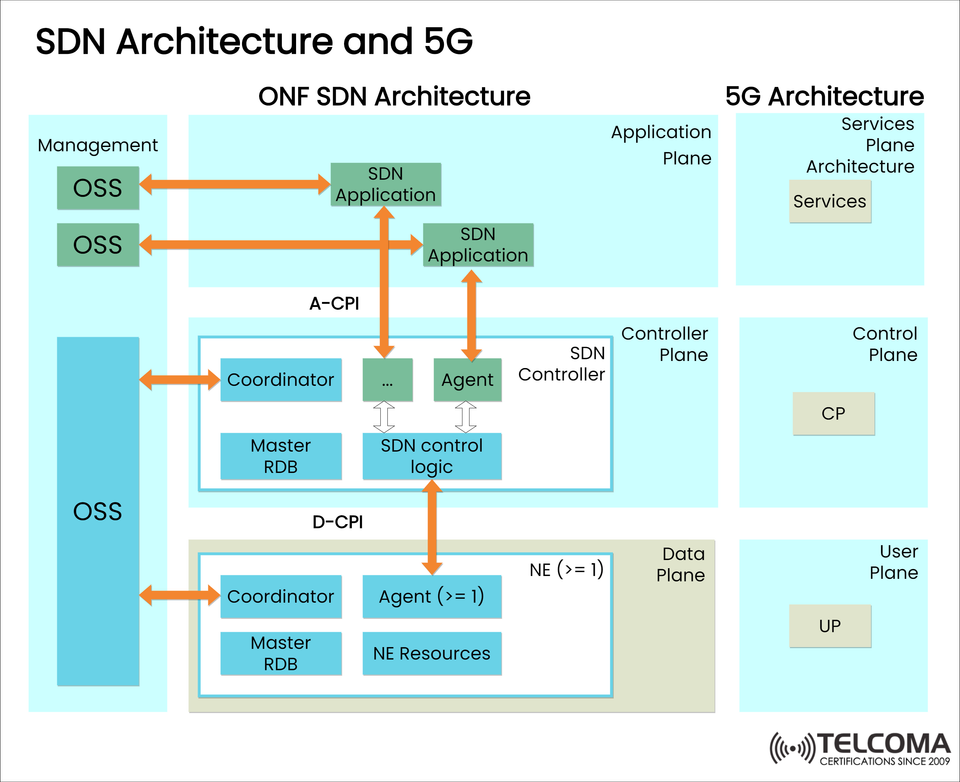
This blog, based on the image provided and uploaded, diagrammatically articulates the architecture and integration of ONF SDN models with 5G services, along with 5G control and user planes, for the telecom professional to consume an exposition that is visually stimulative.
🧠 What is SDN Architecture?
Software Defined Networking (SDN), is referred to as the abstraction of control from functions related to forwarding. This enables centralized, programmable network control of traffic and network behavior through software.
The architecture of ONF SDN, as illustrated in the image, contains:
Application Plane: Hosts SDN Applications that communicate with the controller.
Controller Plane: The Central brain of the network that manages policies, management applications and the interfaces to lower-level level infrastructure.
Data Plane: Where actual forwarding of traffic happens, along with interactions with network elements.
🧱 Key Components Described
- OSS (Operations Support Systems)
Also referred to as the interfaces between management systems and SDN abstraction.
Includes: management of policies, fault handling and service provisioning.
2. SDN Application Layer
Contains logic and business rules for automation.
The SDN Controller Plane consists of:
Coordinator - If you consider the work in multiple steps, then coordination is done between those steps.
Agent - The job of the Agent is to relay instructions to network elements and to transmit information back and forth to applications.
SDN Control Logic - This is the intelligence of the SDN architecture.
Master RDB - A shared database resource.
- D-CPI (Controller-Data Plane Interface)
This enables communication between SDN Controller and data plane resources. - Data Plane (NE = Network Elements)
Includes physical/virtual switches, routers, even radio base stations.
The instructions are relayed to the Agents and allow them to execute in real-time.
🧬 How SDN Fits into 5G Architecture
From the chart above, we can see how the ONF SDN architecture maps to the three planes of 5G:
5G Plane Mapped SDN Component
Service Plane SDN Applications / OSS
Control Plane SDN Controller Logic, CP Agent
User Plane (UP) Data Plane Network Elements (NE)
Take-Aways for 5G:
✅ Network Slicing: This will support multiple logical networks over a shared infrastructure.
✅ Dynamic QoS: User or Service based reconfiguration options can be performed in real-time.
✅ Multi-Vendor Interoperability: As the SDN standards emerge, common APIs will lessen reliance on a single vendor.
✅ Increased Automation: OSS + SDN Applications can enable service lifecycle to be automated.
📊Benefits of SDN Enabled 5G Networks
Advantage Impact on 5G
Centralized control Consistent orchestration and across RAN, transport and core
Programmability Network behavior customized to each use-case of network slice
Real-time monitoring Adaptive and informed decisions make ultra low latency and high reliability operationally feasible.
Simplified operations Less dependence on manual intervention for decision making and fault resolution tasks.
🏁 Conclusion: SDN Is Central to the Agility of 5G
Software Defined Networking is not just a complementary technology, it is the foundation of the success of 5G. SDN enables telecom operators to meet the needs of scale, ultra-low latency and slicing by adding a layer of abstraction and a centralized point of intelligence to telecom networks.
As 5G deployments ultimately transition to standalone, virtualized and cloud-native environments, SDN will serve as the architectural glue that provides interoperability, flexibility and operational efficiency.
🔧 Real-World Examples of SDN in 5G Networks
The arrival of SDN in 5G architecture has already yielded several use cases across a number of verticals. Here are a few examples of how different industries are leveraging this collective benefit:
🌐 1. Smart Cities
Dynamic bandwidth allocation for smart signage/traffic systems.
Integrated connection for smart public Wi-Fi, 5G and IoT networks.
Seamless automated failover to fault-tolerance connection for first responders/public safety.
🏥 2. Healthcare
Ultra-reliable low latency communications (URLLC) for remote surgery.
Dedicated network slices for medical IoT and diagnostics.
Stream real-time video for remote consultation.
🚗 3. Autonomous Vehicles & V2X
Latency-sensitive vehicle to everything (V2X) communications.
Prioritized vehicular data and application-aware traffic steering.
Direct orchestration of edge services for real-time response.
📡 Importance of SDN in Making 5G Features Possible
5G is more than just a faster data transmission experience; it represents a different way of interacting with networks. Many of the key features of the 5G Core (5GC) are made possible due to the origination of the operational functions being incorporated into SDN structures:
5GC Feature SDN Aspect
Control and User Plane Separation (CUPS) The function of each user/control is separated, allowing for a flexible scaling and isolation model.
Service-Based Architecture (SBA) SDN supports service communications of API-driven services.
Network Function Virtualization (NFV) SDN manages the flow of traffic and related capabilities between functions as they are virtualized.
Network Exposure Function (NEF) SDN provides an open API for third party apps/services
Policy Control Function (PCF) Integrates with an SDN controller to implement and manage dynamic policies.
🔄 Comparison of Traditional vs SDN-enabled 5G Networks
Feature Traditional Network SDN-enabled 5G Network
Control & Data Plane Coupled to each other Taken apart from each other and centralized.
Traffic Engineering Static/manual Dynamic; automated
Multi vendor interop Difficult/Open APIs, standard interfaces
Resource Provisioning Defined; rigid; Fixed Elastic with policy driven provisioning
Service Deployment Time Weeks, months Minutes, orchestrated.
🔮 Tomorrow: SDN and Beyond in 6G
As we move from 5G to 6G, we forecast more intelligent and intent-based networking systems will develop, and continue to include SDN. Some trends include:
🤖 AI-Driven SDN Controllers: Autonomous operators and predictive analytics.
🌐 Intent-Based Networking (IBN): User-driven desired outcomes.
📣 Conclusion
The image we discussed above has illustrated how ONF’s SDN architecture can easily map into the multi-plane structure of 5G networks, and also provides a way to think about:
Scalability
Flexibility
Service delivery
Operational efficiency