
Understanding Signal Interference in Cellular Networks: Strong, Weak, and Interfering Signals Explained

Signal Interference in Cellular Networks: Strong vs Weak vs Interfering Signals
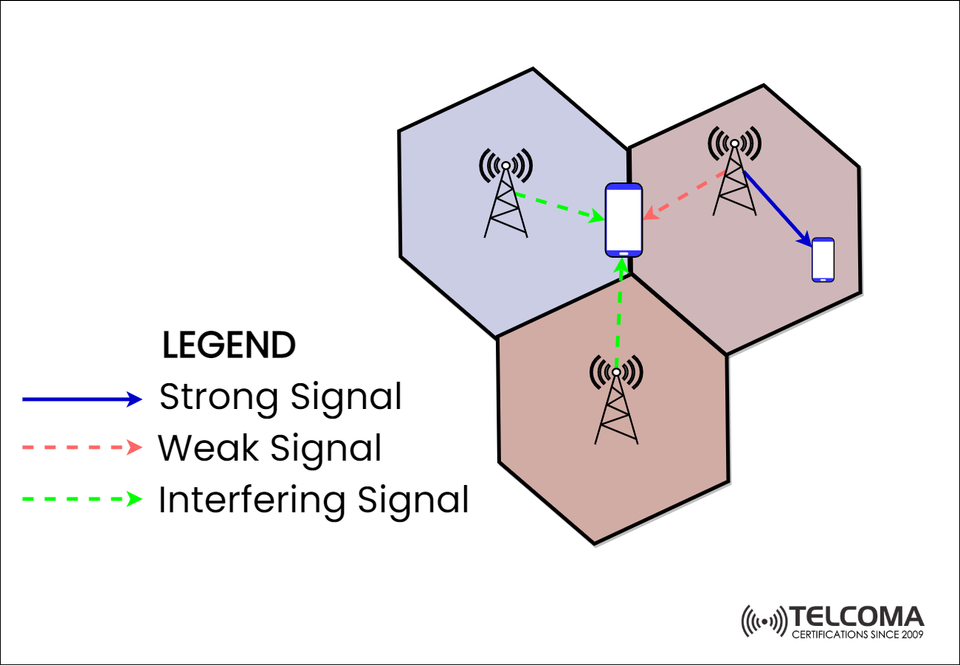
In modern 4G and 5G networks, signal interference can be a paramount concern for how it impacts network performance, user experience, and mobility management. The image you just uploaded clearly illustrates the interactions of strong, weak, and interfering signals between adjacent cells within a standard cellular deployment.
This blog will touch on the implications of each of the different signal types, and how telecom networks cope with interference to ensure coverage and service quality.
📊 What the Image Shows
The image shows three adjacent hexagonal cells with base stations serving each cell, and a visual representation of two user devices: one connected with a strong signal, and a second user at the intersection of a border between multiple cells.
Signal Types and Diploma Color/Line Representation:
Signal Type Color/Line Representation Signification
Strong Signal Solid Blue Preferred connections with optimal quality
Weak Signal Dashed Red Signal from nearby base station, but degraded
Interfering Signal Dashed Green Signal at area of overlapping neighboring cell Signal
📶 Effect of Interfering Signals
Mobile devices "at the border" between multiple cells can experience the following:
⚠️ Signal Interference Issues
Co-Channel Interference (CCI): or co-channel use of frequency bands- more than one cell, using same frequency band leading to degraded quality of signal.
🧭 Mobility Behaviors in Overlapping Zones
In the example presented, the user is connected to a weak signal (red) that is impacted by interfering signals (green) from two surrounding towers. Here, a signal from one of the towers (blue) is strong, but a handover won't take place unless:
The difference between the two tower signals meet (exceed) a defined threshold.
The handover algorithm developed by the network (using RSRP, RSRQ, SINR) determines that a handover will occur.
We have an example of a zone to consider for handover, and the fine tuning for mobility will be critical.
🔧 How Networks Handle Signal Interference
Telecommunications operators will use a variety of optimization methods to reduce interference:
🛠 Optimization Techniques for Interference Reduction
ICIC (Inter-Cell interference Coordination): Frequency reuse and power coordination across multiple cells.
eICIC (enhanced ICIC): LTE implementation designed for macro-small cell coordination.
Coordinated multipoint (CoMP): 5G feature that enables collaborative use of multiple base stations for their edge users.
Antenna down tilt: Steers reduction of signals into neighboring cells.
Beam-> Beamforming (in 5G): Channel specific transmission with beams to limit expansion of signals.
🗺 Real World Network Planning Considerations
optimization area action needed
cell overlap zone minimize overlapping coverage with tilt
frequency planning Use different channels for cells and their adjacent cells
load balancing Ensure users transition to neighbouring cell which has less congestion
Handover thresholds Calibrate on real world propagation
signal monitoring Use KPIs (SINR, CQI, RSRP)
🧠 Signal Metric Definitions
Metric Definition Consequence
RSRP Reference Signal Received Power For cell selection
RSRQ Reference Signal Received Quality Measure of interference
SINR Signal-to-Interference + Noise Ratio Unique to throughput
CQI Channel Quality Indicator Provisioning for link adaptation
🧬 Connection to 5G NR and Next
5G also creates denser cell deployments, including:
Small cells
Massive MIMO
Network slicing
Edge computing
The increased density leads to greater interference possibilities, which means more importance on the ability to analyze and optimize signals in near real time.
🏁 Summary
Understanding the relationships of strong, weak and interfered signals is a main component for network planners, RF engineers, and telecom architects. The adjacent image clearly depicts a situation that can frequently occur in denser deployments where the interference can negatively impact user experience.
With new technologies and increasingly denser 5G rollouts, avoiding and managing interference if you want to provide asfast, low latency and high-reliability wireless capabilities.
⚙️ Advanced Interference Management in LTE and 5G
- Dynamic Spectrum Sharing (DSS)
Allows concurrent use of LTE and 5G at the same time on the same carrier.
Reduces interference by dynamically allocating spectrum according to traffic demand.
Common to low-band spectrum to improve 5G deployment with DSS.
- Time Based Interference Management
eICIC introduces “Almost Blank Subframes (ABS)” to mitigate - 📍 Real Life Use Cases and Examples
Context Challenge Interference Solution
Urban Highrise Deployment Reflections causing Multibpath Loss Beamforming & TDD Guard intervals
Dense Small cell networks Overlapping cells causing CCI ICIC, Frequency planning, CoMP
Railway Network Coverage High mobility handovers Predictive handover, SINR mobility
Stadium/Arena Events User congestion and interference Dynamic beam steering, slicing, Edge UPFs
Rural Macro cell deployment Signal spillover into adjacent cells Antenna downtilt and power control
🔍 Tools used for Interference Analysis
Telecom professionals utilize tools for monitoring, providing measures to intervene with signal issues.
These include:
Drive Test software (e.g. TEMS, Nemo Outdoor)
Post-processing software (e.g. Actix, Atoll)
5G Planning tools (e.g. iBwave, Planet)
Network Optimization suites (e.g. NetAct, SON)
These tools enable the generation of:
Interference heatmaps
Coverage overlap analysis
Neighbor relation auditing
Handover success/failure KPIs
🧬 Preparing for Change: 6G and AI-Driven Signal Optimization
As we move closer to 6G, user interference will require more automation and intelligence. Here are future tactics:
🔮 AI-Driven RAN Optimization:
Self-optimizing networks (SONs), sustainably using Machine Learning (ML) to optimize tilt, power, and frequency on-demand
Pre emptory, proactive handover decisions based on user travelling trajectory and predicted signal.
🌍 Digital Twins of Cellular Networks
Modeling network performance under dummy signal interference
Enable "what if" assessment of deployment and network changes
✅ Summary Table: Implementation of Signal types and Network impacts and then Mitigation
Signal Type Network Impact Mitigation Approach
Strong Signal Best performance Maintain with qaulity coverage planning
Weak Signal Poor qaulity - requiring more retries Build more with small cells, should consider CA, beamforming
Interfering Signal SINR can be worse, can cause handover issues Use ICIC, CoMP, adjust handover dynamics
🏁 Outcome
Interference signal management in mobile communication networks is complex but manageable. In the photo shown, a single device at a cell edge can be impacted by numerous conflicting signals. It is not just about strong signals but also signal quality, mitigating interference, and mobility intelligence.
Using advanced techniques with RAN including but not limited too CoMP, beamforming and AI-supported RAN optimization, operator's can sustain continued high speed connectivity even in the presence of signal interference.
The impact of strong, weak, and interfering signals can help telecom professionals better develop smart and efficient networks; now and even into the future.