
Understanding SMF Interactions in 5G Standalone Access Registration
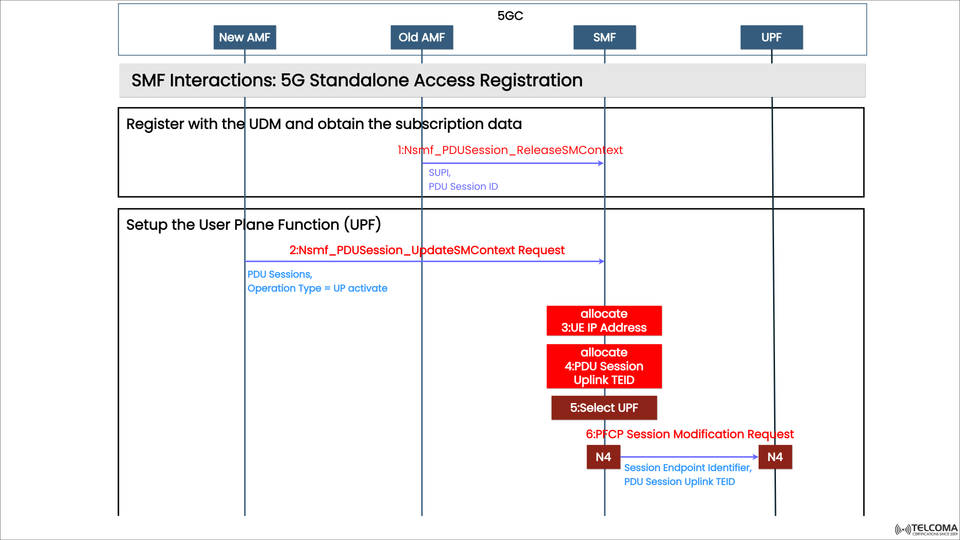

SMF Interactions: 5G Standalone Access Registration
In the 5G Core (5GC) architecture, the Session Management Function (SMF) is crucial for managing user data sessions and ensuring smooth connectivity. During the 5G Standalone (SA) access registration, the SMF works closely with the Access and Mobility Management Function (AMF) and the User Plane Function (UPF) to efficiently establish, update, and release data paths.
The image above shows the step-by-step signaling sequence of SMF interactions in the 5G standalone registration process. Let's dive into each step for a better technical understanding.
Overview of SMF’s Role in 5G Core
The SMF is in charge of establishing, modifying, and releasing sessions in the 5G Core. Its responsibilities include:
PDU Session Management
IP address allocation for UEs
User Plane Function (UPF) selection
Policy and QoS enforcement
Interfacing with PCF, AMF, and UPF
In simpler terms, the SMF ensures that the data session between the user device (UE) and the network is correctly set up and maintained, in line with the user’s subscription and network policies.
Signaling Flow in SMF Interactions
During 5G standalone access registration, several key steps happen among the New AMF, Old AMF, SMF, and UPF.
Step 1: Ns mf_ PDU Session_ Release M Context
Message Direction: From New AMF → SMF
Purpose: To release the existing Session Management (SM) context linked to the UE in the old AMF.
Parameters: SUPI (Subscriber Permanent Identifier) and PDU Session ID.
When a UE registers with a new AMF—say, because of mobility or AMF reassignment—the new AMF sends a Release SM Context request to the SMF. This notifies the SMF that the UE’s session management context tied to the previous AMF is no longer valid.
Outcome: The SMF starts updating the context information to sync with the new AMF.
Step 2: Ns mf_ PDU Session_ Update SM Context Request
Message Direction: From New AMF → SMF
Purpose: To either establish or update the session context after registration with the new AMF.
Contents: PDU Session details and Operation Type (like UP activate).
This step prompts the SMF to begin reconfiguring the User Plane setup for the UE. Essentially, this request tells the SMF that the UE is ready to keep its PDU session going with the new AMF.
Setting Up the User Plane Function (UPF)
Once the SMF gets the update request, it moves on to configure the User Plane for data transfer. This involves various internal and external tasks between the SMF and UPF through the N4 interface.
Let’s break down the sub-steps:
Step 3: Allocate UE IP Address
Function: The SMF assigns a unique IP address to the User Equipment (UE).
Purpose: This IP will be used for the UE’s data session, ensuring proper routing of user data packets in the network.
Each PDU session is linked to a specific UE IP address, making sure the UE’s identity is clear in the data plane.
Step 4: Allocate PDU Session Uplink TEID
Function: SMF allocates a Tunnel Endpoint Identifier (TEID) for the uplink PDU session.
Purpose: TEIDs are vital for GTP-U tunnels between the UPF and gNB, identifying the specific data flow for a PDU session.
This allocation makes sure that any uplink data from the UE is accurately mapped and sent through the UPF.
Step 5: Select UPF
Function: SMF chooses the right User Plane Function (UPF) for this session.
Selection Criteria:
UE location
Network slice
QoS requirements
Operator policies
Selecting the UPF is a key optimization step. Depending on where the user is and the service they’re using (like streaming or gaming), the SMF dynamically picks a UPF to reduce latency and boost efficiency.
Step 6: PFCP Session Modification Request (N4 Interface)
Message Direction: SMF → UPF
Purpose: Modify or set up PFCP (Packet Forwarding Control Protocol) sessions for user data.
This request includes:
Session Endpoint Identifiers
PDU Session Uplink TEID
QoS enforcement rules
Through the PFCP Session Modification, the SMF directs the UPF to establish the necessary forwarding rules for the UE’s traffic flow. This ensures packets are routed properly from the UE to the data network and vice versa.
Interfaces Involved in the SMF Interaction
Interface Between Function
N11 AMF ↔ SMF Control plane interface for PDU session management
N4 SMF ↔ UPF User plane control, PFCP-based session setup
N10 SMF ↔ UDM Retrieves subscription and policy data
N7 SMF ↔ PCF Retrieves policy and QoS rules
These interfaces ensure smooth coordination between the control plane (AMF, SMF, PCF) and user plane (UPF).
Key Concepts in SMF Interactions
a. PDU Session Management
Each UE can have multiple PDU sessions, each identified by a PDU Session ID. The SMF manages the lifecycle of these sessions—covering everything from creation and modification to release—ensuring reliable data connectivity.
b. UPF Configuration
The SMF instructs the UPF on how to forward packets for each PDU session. This includes:
Allocating IP addresses
Establishing GTP-U tunnels
Applying QoS and traffic steering policies
c. Context Transfer
When the UE shifts from one AMF to another, the session context needs to be updated to reflect that change. The SMF works to keep the user’s data session uninterrupted, even during mobility or AMF swap.
Why These Interactions Matter
Efficient coordination among SMF, AMF, and UPF is vital for:
Low latency and high throughput in 5G SA networks
Seamless user mobility between AMFs
Dynamic session management based on network policies
Optimal resource utilization in the user plane
The SMF essentially acts like the brain of session management, making smart choices that influence user experience and network efficiency.
Summary of Message Sequence
Step Message/Action Description
1 Ns mf _PDU Session _ Release SM Context Release old session context
2 Ns mf _PDU Session _ Update SM Context Update or re-establish SM context
3 Allocate UE IP Address Assign unique IP to UE
4 Allocate PDU Session TEID Define tunnel identifiers
5 Select UPF Choose optimal UPF for user session
6 PFCP Session Modification Establish or modify PFCP session in UPF
Conclusion
The SMF interactions during 5G standalone access registration are a fundamental part of how modern 5G networks handle data sessions. By effectively coordinating with the AMF and UPF, the SMF guarantees:
Stable and secure session continuity
Optimal routing through dynamically selected UPFs
Policy-compliant data handling for each subscriber
Grasping these message flows and interactions is crucial for telecom professionals who want to design, optimize, or troubleshoot 5G Core networks. In a world driven by data and mobility, the SMF serves as the smart control entity ensuring 5G networks fulfill their promise of ultra-reliable, high-speed connectivity.