
Understanding SON Architecture in LTE: How Self-Organizing Networks Enhance Optimization
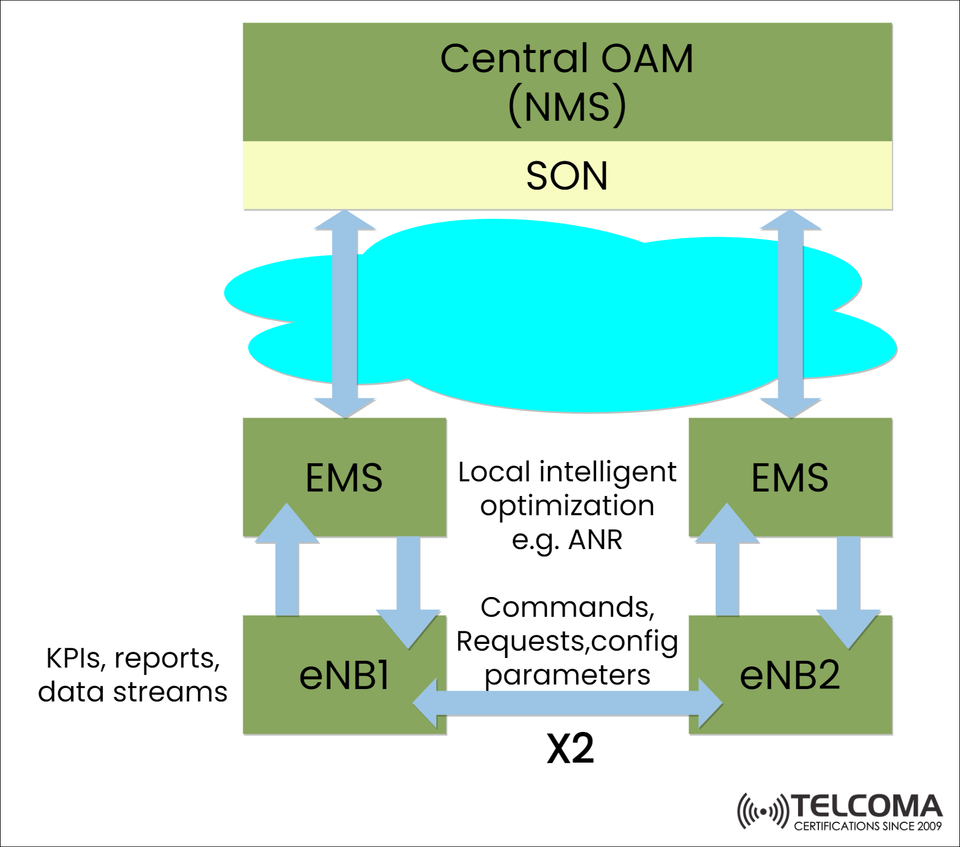

SON Architecture in LTE Networks: Centralized , Distributed, and Hybrid Optimization Further Describing with the expanding complexity of LTE networks, manual management and optimization of the networks is no longer a sustainable option. This is where Self-Organizing Networks (SON) come in; SON is an intelligent framework that incorporates automation for configuration, optimization, and healing of the network.
The following image shows the functional architecture of a SON in an LTE network, and it depicts the relationship among Central OAM (NMS) and EMS, eNodeBs (eNB), management via the X2 interface among eNBs.
What Is SON (Self-Organizing Network)?
SON is a vital component in LTE/5G networks that automates key network functionalities, thus eliminating operational complexity, improving performance, and reducing the need for human involvement.
SON Functions Include:
Self-Configuration: Auto-setup of cells.
Self-Optimization: Automatic adjustments based on KPIs.
Self-Healing: Automatic detection and correction of faults.
Understanding the SON Architecture
- Central OAM (NMS) - Operations, Administration, and Maintenance
- Central controller
- Hosts SON Applications like ANR, Load Balancing, PCI Optimization.
- Take data from EMS and UEs and make decision across the network.
- SON Module- Sits between Central OAM and EMS, enables automatic functions (PCI planning, RACH optimization, handover tuning), it can operate as Centralized, Distributed.
- SON Module
Located between the Central OAM and EMSAutomates other functions such as PCI planning, RACH optimization, and handover tuning.Can work in Centralized, Distributed, and Hybrid SON modes. - EMS (Element Management System)
A single point of contact for the eNodeBsUsed for control and configuration specific to each network element.Allows for the KPIs and performance data from the eNBs to be collected. - eNodeB (eNB1 and eNB2)
The RAN NodesUtilize local optimizations, such as e.g. ANR and handover.Communicates via the X2 Interface to understand handover, load balancing, and interference management.
SON Optimization Use Case: ANR (Automatic Neighbor Relation)
The diagram's labels "Local intelligent optimization e.g. ANR", provides an example of the benefits of SON;
Feature Overview
ANR Function Automatically discovers and maintains neighbor cell relations
Benefits Reduces the number of handover failures, leading to improved mobility
Deployment Level Assumed at the eNB level or via the EMS level - regional level deployment is a future state, typical case
How SON improves network intelligence.
Benefits Overview
Reduced OPEX Reduced manual effort and drive testing
Faster Time-to-Market Automated cell deployments with self-configured
Improved User Experience Real-time optimization of properties such as mobility and interference
Proactive Fault Management Self-healing modules, monitor and react to outages and performance degradation
Central + Local Intelligence Functionality that layers global NMS data with local cell-based tuning.
Centralized or Distributed SON
Centralized SON Distributed SON
Location Central OAM/NMS eNodeB/EMS
Scope Optimizes Network-wide Only optimize local real-time decisions
Latency Higher (due to data aggregation) Less (local processing)
Use case PCI planning; parameter tuning ANR; handover adjustment
Conclusion
The advent of SON in the LTE architecture is revolutionary in terms of how operators will manage mobile networks. With technology used for intelligent automation through Central OAM, EMS and eNodeBs, operators can downsize deployment time, improve coverage footprint, and increase efficiency. OSON not only narrows the execution of the same tasks, it will be a basic building block vehicle in the apparatus of self-driving, or autonomous, 5G networks and beyond.
Advanced SON (self-organization networks) Functions in LTE Networks
Although ANR is the basic SON capability, many modern LTE and intermediate 5G networks have begun deploying advanced capabilities or self-optimizing functions. Some of these capabilities include:
- Mobility Load Balancing (MLB)
Dynamically reallocates user traffic across overloaded or under-loaded cells. Users benefit from better service and consumes acceptable resources. - Mobility Robustness Optimization (MRO)
Optimizes handover procedures by changing optimum handover parameters (e.g. time to trigger, hysteresis).
Drop calls are minimized, no ping pong handovers occur. - Inter-Cell Interference Coordination (ICIC)
Focuses on reducing interference in neighboring cells, particularly at edges of the coverage area. It can be performed with the co-figured eNodeBs via the X2 interface, or centrally from the SON function. - Coverage and Capacity Optimization
Self-Optimizing Networks use measurement reports from the UE, KPIs with analysis and either automates processes, or provides operator with the suggestion to optimize cells in terms of coverage and capacity.
SON Architecture in the 5G Evolution
As networks migrate from LTE to 5G, SON is an integral part of the evolution, though it must adapt to the challenges of network densification, network slicing, and the deployment of massive IoT.
SON Enhancements for 5G
5G SON Capability Definition
Multi-RAT Coordination Management of legacy technologies and LTE or 5G NR in parallel.
Network Slicing Support Management of multiple slices whereby each slice is optimized in isolation, based on SLA.
RAN Intelligence SON functionality enhanced with AI or ML allowing predictive analytics and decision-making.
Cloud-Native SON SON functions as VNFs or CNFs deployed in a telco cloud, supporting horizontal scalability.
SON Deployment Best Practices in Live Networks
If you are going to implement SON in your production LTE or 5G networks, you have to consider the following.
✅ Do a Network Baseline Audit
Make sure to collect pre-SON KPIs for comparison purposes to demonstrate SON improvements upon deployment.
✅ Identify SON Deployment Option
Centralized as a tool for strategic planning (e.g., PCI planning)
Distributed to deal with real-time operations (e.g., handovers)
Mixed to do both
✅ Enable Partial SON Functions
It is better not to automate your SON function all at once - start by enabling monitoring or semi-automated RAD or application functions, and go from there.
✅ Customize Algorithms by Region
If deploying both urban and rural sites, the algorithm optimization logic may not be applicable across a vast diversity of sites.
✅ Monitor and Tune
This can be accomplished by the KPIs and reports generated from the EMS or eNBs comparing fault logs rather than implementing SON and forgetting.
Conclusion:
The Importance of SON in Autonomous Networks
SON's inclusion into LTE and transition to 5G-ready self-intelligent networks is disrupting the whole telecommunications industry. Networks can now utilize centralized management (OAM/NMS) and intelligent distributed control (EMS and eNBs).