
Understanding SON in Mobile Networks: Self-Configuration, Self-Optimization, and Self-Healing

Understanding SON in Mobile Networks: Self-Configuration, Self-Optimization, and Self-Healing
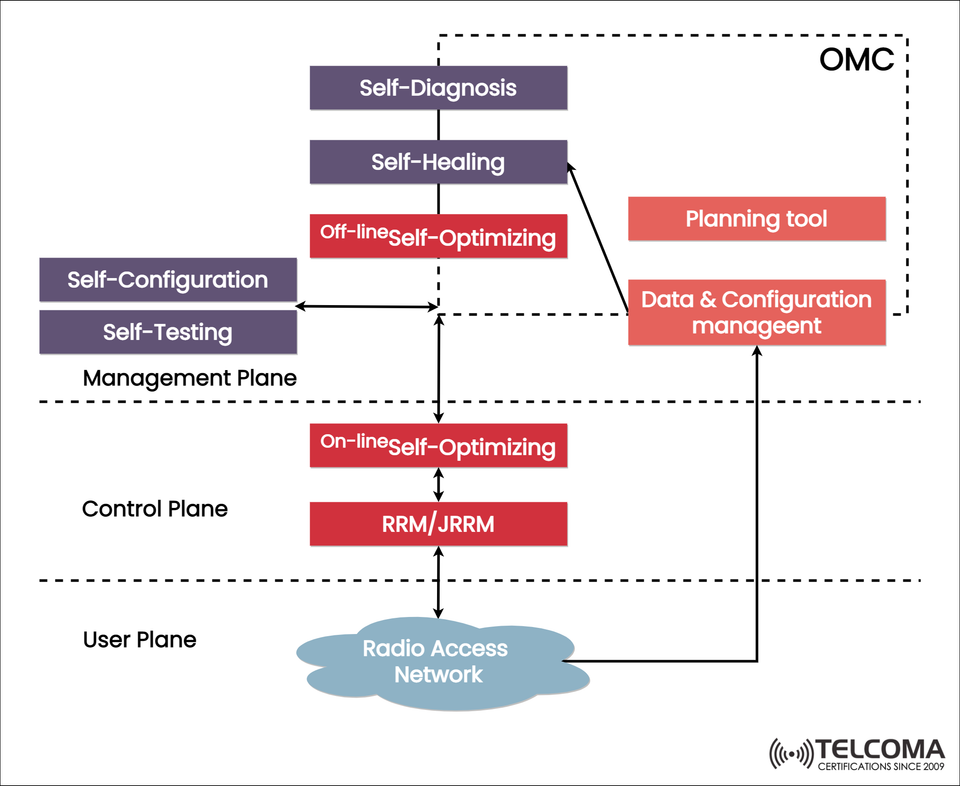
As mobile networks get more complex with the emergence of 5G and beyond, automation has become essential to keep performance up, cut costs, and reduce human errors. Self-Organizing Networks (SON) tackle this issue by bringing smart automation into the Radio Access Network (RAN). The image above outlines the main components of SON and how they interact across the management plane, control plane, and user plane.
In this blog, we’ll dive into the SON architecture, go over its key functions—self-configuration, self-optimization, and self-healing—and discuss the benefits it offers to operators and telecom professionals.
Introduction to Self-Organizing Networks (SON)
SON is an automation framework aimed at streamlining the planning, configuration, management, optimization, and healing of mobile networks. It works across several planes:
User Plane – This plane carries user traffic data.
Control Plane – It manages signaling and control protocols.
Management Plane – This oversees tasks related to network management, monitoring, and optimization.
By automating repetitive tasks, SON helps cut down on manual work, speeds up network rollouts, and enhances user experience.
SON Functions and Architecture Explained
The uploaded image showcases three main functionalities of SON along with additional support tools:
- Self-Configuration (Automated Setup)
Self-configuration automates the initial setup of network elements like eNodeBs (for LTE) or gNodeBs (for 5G). This function is vital during rollouts or when new sites are added.
Key features include:
Plug-and-Play Deployment: New RAN elements can set themselves up automatically when connected.
IP Address and Neighbor List Setup: This ensures easy integration with existing network nodes.
Reduced Commissioning Time: Saves engineering resources and speeds up time-to-market.
- Self-Testing (Verification & Validation)
Before a newly set up network element goes live, it undergoes self-testing to validate things like:
Hardware and software integrity
Connections to the core network
Important performance metrics like latency and throughput
This step helps ensure reliability and prevents service disruptions before activation.
- Self-Optimization (Performance Tuning)
Self-optimization is one of the most crucial SON functions, which is depicted in two formats in the image:
Offline Self-Optimization: This uses historical data and planning tools to fine-tune parameters.
Online Self-Optimization: This operates in real-time within the control plane, using Radio Resource Management (RRM/JRRM) for dynamic adjustments.
Optimization goals include:
Balancing load across cells
Managing mobility (optimizing handovers)
Reducing interference
Improving energy efficiency (by managing sleep/wake cycles of cells)
By constantly fine-tuning these parameters, networks can maintain optimal performance, even when traffic varies.
- Self-Diagnosis and Self-Healing
Self-diagnosis identifies network faults by checking alarms, logs, and performance metrics. Once a fault is spotted, the self-healing function steps in to take automated actions like:
Restarting malfunctioning network elements
Rerouting traffic to functional nodes
Isolating damaged components for maintenance
This keeps downtime to a minimum and boosts network availability, which is critical for applications like autonomous vehicles or IoT.
- Planning Tools and Data Management
The image also highlights planning tools and data & configuration management components linked to SON. These tools help with:
Long-term capacity forecasts (like anticipating traffic growth and proactively adding resources)
Centralized data storage to keep configurations consistent
Integration with Operations & Maintenance Center (OMC) for streamlined network operations
This interconnectedness enables SON to merge real-time optimization with strategic planning.
SON Workflow Across Network Planes
Here’s how SON functions across various planes of the network:
Plane SON Role Management Plane Handles self-configuration, self-testing, and offline self-optimization. Control Plane Manages online self-optimization and RRM/JRRM functions. User Plane Supplies real-world traffic data for optimization and troubleshooting.
This multi-plane design ensures SON can respond to immediate events and long-term trends alike.
Benefits of SON for Mobile Networks
The adoption of SON offers numerous advantages for telecom operators:
Lower OPEX and CAPEX – Less manual work and fewer site visits mean reduced operational costs.
Faster Network Deployment – Automated setups speed up site rollouts.
Better Quality of Experience (QoE) – Dynamic optimization ensures users have a consistent experience.
Increased Reliability – Self-healing capabilities minimize downtime and avoid service degradation.
Scalability for 5G – SON can handle the complexities of 5G networks, like network slicing and massive IoT connections.
Challenges in SON Implementation
Even though SON is powerful, there are challenges operators face during its deployment:
Interoperability Issues – Working in multi-vendor setups can complicate things.
Algorithm Conflicts – If multiple optimizations run at once without proper coordination, they might clash.
Security Concerns – Automation brings new vulnerabilities that need to be addressed.
Tackling these issues requires thoughtful design, collaboration among vendors, and strong security policies.
Conclusion
Self-Organizing Networks (SON) are no longer just a nice-to-have; they’re essential for today’s mobile networks. By enabling self-configuration, self-optimization, and self-healing, SON boosts network efficiency, cuts operational costs, and enhances user experience.
As we usher in 5G and prepare for upcoming 6G technologies, SON will continue to advance, leveraging AI and machine learning for more sophisticated network automation. For telecom professionals, getting a grasp on SON is key to staying ahead in this fast-evolving wireless environment.