
Understanding Supplementary Downlink (SDL) in 5G and LTE Networks
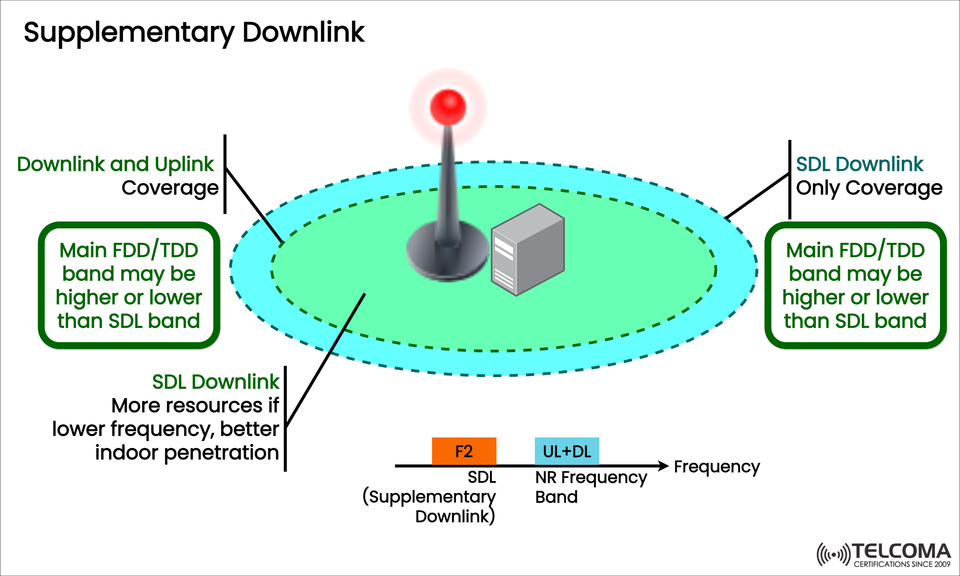

Supplementary Downlink (SDL) Overview: Improving Coverage and Capacity
As wireless data consumption continues to skyrocket in today's mobile networks, the increased demand for downlink capacity is needed as users are streaming video, playing games online, and accessing applications in the cloud. One of the ways that operators can help with this is through Supplementary Downlink (SDL), which allows another downlink carrier(s) to be added without being paired with uplink spectrum.
The following diagram will show you how Supplementary Downlink works in an LTE or 5G system and how it extends network coverage and capacity in high-usage situations.
Supplementary Downlink (SDL) is a configuration in FDD (Frequency Division Duplex) or TDD (Time Division Duplex) that says there is an added only downlink spectrum block that can be used. SDL is not defined in a normal paired frequency band where spectrum blocks are used for both uplink and downlink, but rather it is used in unpaired spectrum blocks that can only be used for downlink only.
This allows:
The user equipment (UE) to receive downlink data on multiple downlink carriers.
The user equipment (UE) to only use the main frequency for uplink communication.
The added carrier will increase downlink throughput.
In 3GPP language, SDL is an additional downlink carrier that is aggregated with the downlink of the primary cell when in Carrier Aggregation (CA). The main FDD/TDD band is what handles both uplink (UL) and downlink (DL) .
The Importance of Supplementary Downlink
An essential feature of modern networks is the asymmetric nature of data traffic, with users downloading significantly more data than they are uploading. Whether it's watching videos, visiting social media platforms, or downloading apps, the downlink is the heavier load.
Supplementary downlink (SDL) addresses the increased demand by providing additional downlink resources in an environment where they are needed most.
Reasons to Deploy Supplementary Downlink
Optimizing traffic that is predominantly downlink-heavy
Utilizing underused blocks of spectrum to improve spectral efficiency
Enhancing the user experience in urban and indoor dense environments
Maximizing unpaired spectrum use with downlink-only carriers to provide better performance
How Supplementary Downlink Works
The graphic below shows two relevant areas of coverage surrounding a cell site/base station:
- The inner green zone represents the primary FDD/TDD coverage area where both uplink (UL) and downlink (DL) traffic are served.
- The outer blue zone represents the area from which the downlink-only signal is transmitted.
Description of the Graphic
Main FDD/TDD Band
Serves both uplink and downlink traffic.
Enables normal two-way communication.
The operating frequency may be above or below
The operating frequency may be above or below the SDL frequency depending upon operator business case.
SDL Downlink Band (F2)
Provides additional downlink-only capacity.
There is no uplink associated with the SDL sector on the F2 band.
Increases downlink coverage and adds increased DL throughputs.
Layered Coverage
The inner area serves both uplink and downlink service.
The outer area serves downlink service only.
Frequency Connection
As mentioned in the figure:
F2 = SDL Frequency Band (Downlink-only)
UL + DL = NR or LTE main frequency band
Depending on the band pair and spectrum available, SDL may be higher or lower than the main carrier's frequency.
Benefits of Supplementary Downlink
Aspect Benefit
Increased Downlink Capacity Adds lower download spectrum to increase user data rates
Efficient Spectrum Use Allows unpaired bands to be used that otherwise would be unused.
Improved Indoor Coverage If SDL is at a lower frequency it will penetrate walls easier.
Enhanced User Experience Facilitate faster downloads and better experience in streaming.
Flexible Network Design Operators can dynamically implement SDL in places with more download demand.
Deployment Use Cases - SDL
In LTE-Advanced (LTE-A) and 5G-NR systems, SDL is used in both LTE-A systems and NR systems.
LTE-A Systems
In LTE-A, SDL was introduced as part of Carrier Aggregation (CA).
Example: Band 32 (SDL) can be aggregated with Band 3 (FDD).
Thus, it allows more throughput without requiring additional uplink spectrum.
5G-NR Systems
In 5G, SDL facilitates greater downlink in both FR1 (sub-6GHz) and FR2 (mmWave) bands.
SDL bands can be used to increase eMBB (enhanced Mobile Broadband).
Utilizing SDL is particularly advantageous in dense urban areas and when user devices are indoors.
SDL and Enhancement Coverage
The image illustrates one important point: SDL, in fact, extends coverage for downlink transmissions.
If a user moves toward the cell edge:
Uplink power diminishes due to the device's capabilities.
But the base station is still able to deliver a strong downlink signal because SDL is used.
So, even if uplink communication gets worse, the user can still receive the content and updates they want in a timely manner.
If the SDL is Operating at a Lower Frequency:
Improved indoor penetration (good for buildings or tunnels).
Wider coverage area due to less path loss.
If the SDL is Operating at a Higher Frequency:
Greater capacity with additional bandwidth.
Greater capacity in hotspot areas such as stadiums or shopping malls.
Challenges of SDL Implementation
While SDL has clear benefits and advantages, it also presents technical challenges to network operators.
- Device Compatibility
Not all user equipment (UE) will support supplemental downlink bands. It must possess carrier aggregation capabilities.
- Spectrum Licensing
Using SDL entails having dedicated unpaired spectrum, which is not always available or affordable.
- Synchronization and Interference
A downlink carrier from SDL can lead to increased interference if it is delayed and not synchronized with neighboring cells.
- Network Planning Complexity
Engineers will have to plan for SDL, as well as how the 3GPP defines and specifies the interaction with existing FDD/TDD cells, while still maintaining the true purpose of SDL to achieve load balancing.
Conclusion
Supplementary Downlink (SDL) is an important new technology that helps LTE and 5G networks accommodate significant downlink data loads.
By leveraging excess unpaired spectrum for downlink-only transmissions, SDL increases:
Data throughput,
Coverage, and
Spectrum flexibility.
Whether used as an FDD or TDD solution, SDL enables the network to provide faster, more reliable data services, and stays close to the cell edge.