
Understanding Telecom Network Architecture: Core, Transport, and Access Layers Explained

Introduction to Telecom Network Architecture: Core, Transport, and Access Layers
Telecommunication networks are the unseen backbone that keeps us connected—everything from making mobile calls and streaming videos to powering the Internet of Things (IoT) and rolling out 5G.
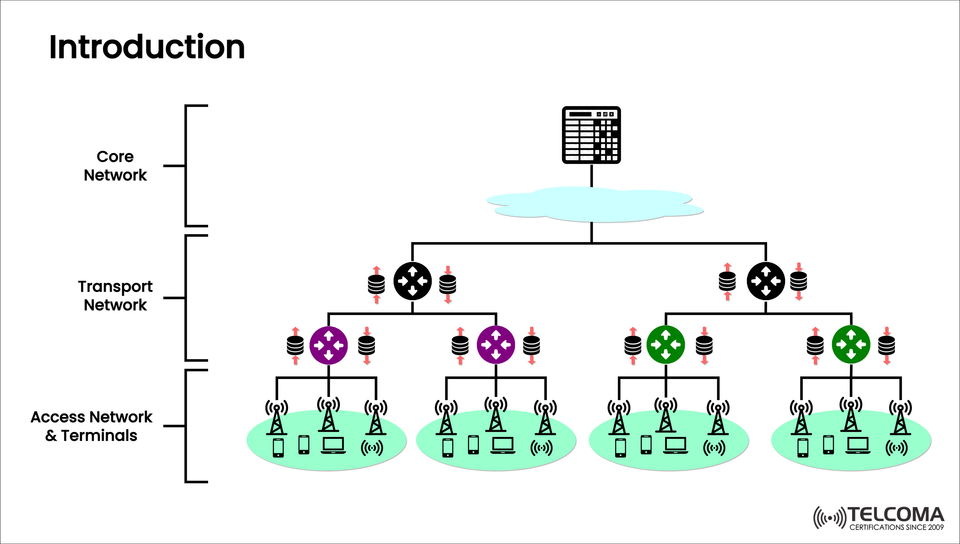
Every message sent or video viewed goes through a detailed, multi-layered framework that ensures smooth communication, reliability, and speed. The Telcoma diagram included here shows a clear breakdown of this architecture, which consists of three main layers: the Core Network, Transport Network, and Access Network & Terminals.
In this blog, we’ll take a closer look at each layer, dive into their functions, and see how modern telecom systems utilize this design to provide top-notch services.
Overview of Telecom Network Architecture
Telecommunication networks have a layered structure that allows for scalability, efficiency, and modularity. Each layer plays a vital role in delivering communication services from start to finish.
The diagram above shows this setup:
At the top, we have the Core Network, which is responsible for data routing, switching, and managing services.
Next, the Transport Network is tasked with moving data between various network domains.
Finally, the Access Network & Terminals connect users' devices to the network.
The Access Network & Terminals – The User Entry Point
The Access Network is the layer that’s closest to the end user, providing both physical and wireless connections between devices and the telecom network.
In the diagram, this includes smartphones, laptops, IoT devices, and wireless towers linked to routers and base stations.
Key Components:
User Terminals: Mobile phones, IoT sensors, tablets, and laptops.
Radio Access Networks (RAN): Comprising 4G LTE, 5G NR (New Radio), and Wi-Fi systems that connect user devices to base stations.
Base Stations and Antennas: These use licensed or unlicensed frequencies to communicate over the air.
Technologies Involved:
4G/5G Cellular Networks for broadband access.
Fiber-to-the-Home (FTTH) and DSL for users on fixed lines.
Wi-Fi 6/6E and satellite access for users in rural or hard-to-reach areas.
Functions:
Establishes the first connection for user data and voice services.
Handles authentication, encryption, and resource allocation.
Converts wireless signals into digital data for the transport network.
Example: When someone streams a video on their phone, that request goes from the base station to the transport layer, which then forwards it to the core network for processing and delivery.
The Transport Network – The Data Highway
The Transport Network serves as the backbone of the telecom system, moving huge amounts of data between access nodes and the core network.
It ensures high-speed, reliable, and low-latency data transmission. In the provided diagram, this is depicted with routers and switches that connect to storage or data management systems.
Key Characteristics:
Operates using optical fiber infrastructure.
Employs packet and circuit-based technologies such as MPLS, DWDM, and Ethernet.
Contains aggregation points that gather traffic from multiple base stations.
Main Components:
Aggregation Routers/Switches: These combine data from various sources before sending it to the core.
Optical Transport Systems: Technologies like SDH/SONET, OTN, or WDM enable long-distance connectivity.
Edge Routers: They serve as the link between access and core layers.
The Core Network – The Intelligence Hub
At the top of the architecture lies the Core Network, the central brain of the telecom setup. It oversees control functions, routing, session management, and policy enforcement.
This layer connects directly to data centers and cloud services, representing the network's centralized intelligence.
Core Network Functions:
Data Routing and Switching: Determines the best path for data packets.
User Authentication and Billing: Validates subscribers and tracks usage for billing.
Mobility Management: Monitors user location as they move through cells.
Service Delivery: Supports services like VoLTE, video calls, and IoT applications.
Security and Policy Control: Manages firewalls, encryption, and access rules.
Key Technologies:
The Evolved Packet Core (EPC) used in 4G networks.
The 5G Core (5GC) architecture featuring Service-Based Architecture (SBA).
Network Functions Virtualization (NFV) and Software-Defined Networking (SDN) for more flexible scaling.
How These Layers Work Together
Each layer has a unique role, but they all work together smoothly to enable communication across broad networks.
End-to-End Process Flow:
User Initiation (Access Layer): A mobile device sends a request through a base station nearby.
Data Aggregation (Transport Layer): The data then goes through routers and switches to reach the core.
Processing & Service Delivery (Core Layer): The core network processes the request, handling routing, authentication, and responses.
Return Path: The data (like video, voice, or messages) returns through the same layers to the end user.
This layered teamwork guarantees reliable connectivity and a good user experience, even when network activity spikes or congestion occurs.
The Role of Cloud and Virtualization in Modern Networks
The Telcoma diagram features a cloud infrastructure icon, emphasizing the move toward cloud-native and virtualized network functions.
Modern Trends:
Virtualized Network Functions (VNFs): These are replacing traditional hardware routers and switches with software-based equivalents.
Edge Computing: This brings computation closer to users, reducing latency.
Cloud-Native 5G Cores: They allow for flexible scaling and automated management.
These changes are reshaping traditional telecom frameworks into a dynamic, service-driven model, leading to quicker deployments, better resource use, and enhanced service delivery.
Benefits of Layered Network Architecture
Scalability: Each layer can be upgraded on its own.
Resilience: Issues in one part won’t bring down the whole system.
Security: A layered structure allows for multiple levels of security enforcement.
Operational Efficiency: It simplifies management and troubleshooting tasks.
Future-Proofing: It supports integration with 5G, IoT, and beyond.
Conclusion
The Core, Transport, and Access Network layers together form the very foundation of global telecommunications.
The Telcoma diagram captures this concept nicely, showing how user devices connect through radio and fiber networks into a centralized core that drives modern digital experiences.
For professionals in telecom, understanding this layered architecture is crucial for designing, optimizing, and evolving networks to meet the growing demand for speed, reliability, and connectivity.
As we head toward 6G, cloud-native architectures, and AI-driven automation, those same core principles—access, transport, and core—will continue to lay the groundwork for our connected future.