
Understanding the 5G Control Plane Between UE, 5G-AN, and AMF

Understanding the 5G Control Plane Between UE, 5G-AN, and AMF
The 5G Control Plane is crucial for the signaling system within the 5G network. It manages how user devices (UEs) connect, get authenticated, and keep communication sessions running through the 5G Access Network (5G-AN) and the Access and Mobility Management Function (AMF).
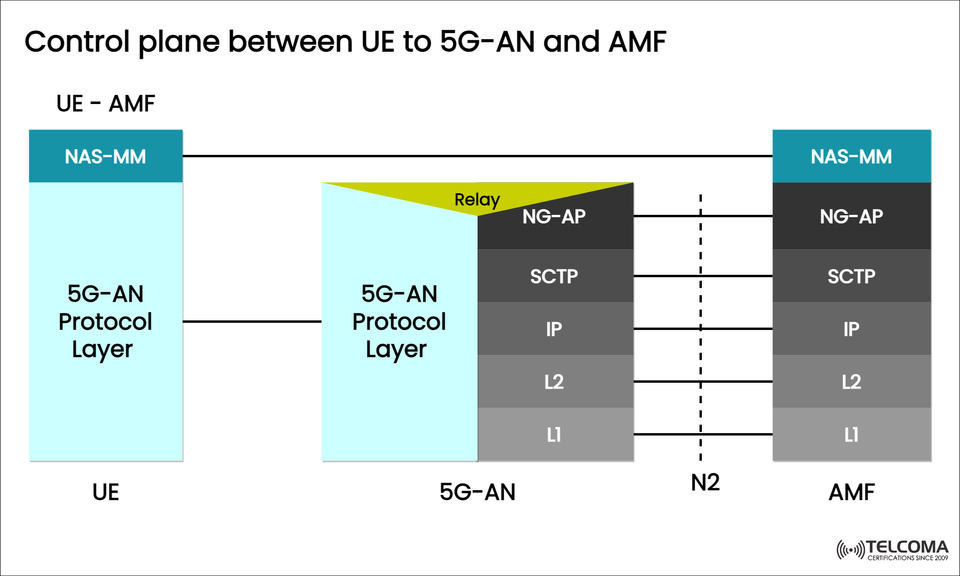
The image above gives a detailed view of how signaling flows between the UE, 5G-AN, and AMF using the N2 interface—a key component in 5G core architecture. This post will break down that interaction, step by step, showing how each protocol helps with smooth network control.
Overview of the 5G Control Plane
The control plane in 5G takes care of managing signaling and control information—basically, the messages that help set up connections, handle mobility, authenticate users, and manage sessions.
On the flip side, the user plane is all about the actual data users are sending (like video calls or voice chats). So really, the control plane acts like the “brain” of the network, making real-time choices about:
How users connect and move between cells
When to start or stop sessions
Authentication and policy enforcement
Resource allocation and handovers
The 5G Core (5GC) brings in a Service-Based Architecture (SBA) that divides functions like AMF, SMF, and UPF, making it easier to deploy in a modular, cloud-based way.
Key Entities in the Control Plane Path
The diagram highlights three main players:
Component Full Form Function UE User Equipment Starts the signaling for access and registration, sends NAS messages to the network.5G-AN5G Access Network (like gNB)Acts as a relay for NAS messages, controls radio resources, and communicates with AMF via NG-AP. AMF Access and Mobility Management Function Manages registration, connections, mobility, and ends NAS signaling.
These entities interact through specific protocols layered above physical and transport layers to ensure everything is reliable and secure.
The Control Plane Signaling Flow
a. UE to 5G-AN Communication
When a UE (User Equipment) tries to connect to the 5G network:
It sends NAS-MM (Non-Access Stratum - Mobility Management) messages to the 5G-AN.
The 5G-AN doesn’t interpret these NAS messages; it just relays them to the AMF over the N2 interface.
The 5G-AN Protocol Layer makes sure the communication with lower layers (RRC, MAC, PHY) goes smoothly, ensuring successful message delivery.
This setup keeps the access layer light while allowing central control in the 5G Core.
b. 5G-AN to AMF Communication via N2 Interface
The N2 interface serves as the vital connector between the 5G Access Network (gNB) and the AMF. It carries control-plane signaling essential for tasks like registration, connection setup, mobility management, and bearer modification.
Protocols Involved:
NG-AP (Next Generation Application Protocol): Sets the rules for signaling between gNB and AMF, covering procedures like UE context setup, handovers, and paging.
SCTP (Stream Control Transmission Protocol): Ensures reliable, message-oriented transport for NG-AP signaling.
IP / L2 / L1 Layers: Deal with routing, data link, and the physical transmission of packets.
The image shows these protocol layers stacked to demonstrate their role in sending control messages from the 5G-AN to the AMF.
c. AMF’s Role in the Control Plane
When the AMF gets NAS-MM messages from the 5G-AN:
It terminates the NAS layer, meaning it processes the mobility management messages directly.
It takes care of user authentication, registration, and connection management for the UE.
It sets up communication with the SMF (Session Management Function) over the N11 interface to handle session setups.
Basically, the AMF is the brain on the access side of the 5G core, ensuring that the UE gets authenticated and stays connected to the network properly.
Layers of the Control Plane (as per the diagram)
Each block in the image represents a layer in the control signaling stack. Here’s a quick rundown of each layer and what it does:
Layer Function NAS-MM (Non-Access Stratum – Mobility Management)Handles UE registration, authentication, and mobility signaling. Ends at AMF.5G-AN Protocol Layer Manages radio resource control (RRC), ensuring NAS messages reach AMF.NG-AP (Next Generation Application Protocol)Governs signaling between gNB (5G-AN) and AMF for connection setup and mobility. SCTP (Stream Control Transmission Protocol)Ensures reliable delivery of NG-AP messages. IP Provides network routing for SCTP packets.L2 (Data Link Layer)Frames data and deals with error detection/correction.L1 (Physical Layer)Transmits bits over the physical medium (radio or fiber).
The relay function in the image emphasizes how the 5G-AN passes on NAS messages unchanged, keeping the signaling intact between UE and AMF.
Benefits of the 5G Control Plane Architecture
The design shown in the diagram brings about several important advancements compared to 4G:
Separation of Control and User Planes: This allows for independent scaling and optimization.
Service-Based Architecture (SBA): Modular functions like AMF and SMF can be deployed as cloud-native microservices.
Enhanced Reliability: SCTP offers solid transport for crucial signaling.
Security: End-to-end NAS encryption and integrity protection.
Flexibility: The N2 interface accommodates various access technologies (NR, LTE, Wi-Fi).
These enhancements make 5G networks more flexible, resilient, and prepared for ultra-reliable communication requirements.
Practical Example: UE Registration Sequence
Here’s a look at how the control plane operates during a typical UE registration:
UE sends a NAS-MM Registration Request to 5G-AN (gNB).
5G-AN wraps the NAS message in NG-AP and sends it to AMF via SCTP.
AMF processes the NAS message, authenticates the UE, and sets up security.
AMF responds with a NAS Registration Accept, which gets relayed back through NG-AP and 5G-AN.
UE is now fully registered and ready for session establishment.
This sequence ensures the UE’s secure and controlled integration into the 5G network.
Conclusion
The 5G Control Plane linking UE, 5G-AN, and AMF is fundamental for the signaling structure of 5G networks. Through NAS-MM, NG-AP, and SCTP layered communication, it handles everything from initial registration to ongoing mobility control.
By dividing access (5G-AN) and core (AMF) functions via the N2 interface, 5G achieves a level of flexibility, scalability, and interoperability that’s never been seen before.
For telecom experts, grasping this flow is vital for optimizing network design, implementing mobility strategies, and ensuring reliable 5G connectivity for users.