
Understanding the 5G-R(AN) and AMF Control Plane Interface in 5G Core Networks

Understanding the 5G-R(AN) and AMF Control Plane in 5G Networks
The new 5G core architecture features a completely service-based, cloud-native design that allows for flexibility, scalability, and automation by decoupling network functions. A key aspect of this setup is how the 5G Radio Access Network (5G-RAN) interacts with the Access and Mobility Management Function (AMF) via the N2 interface.
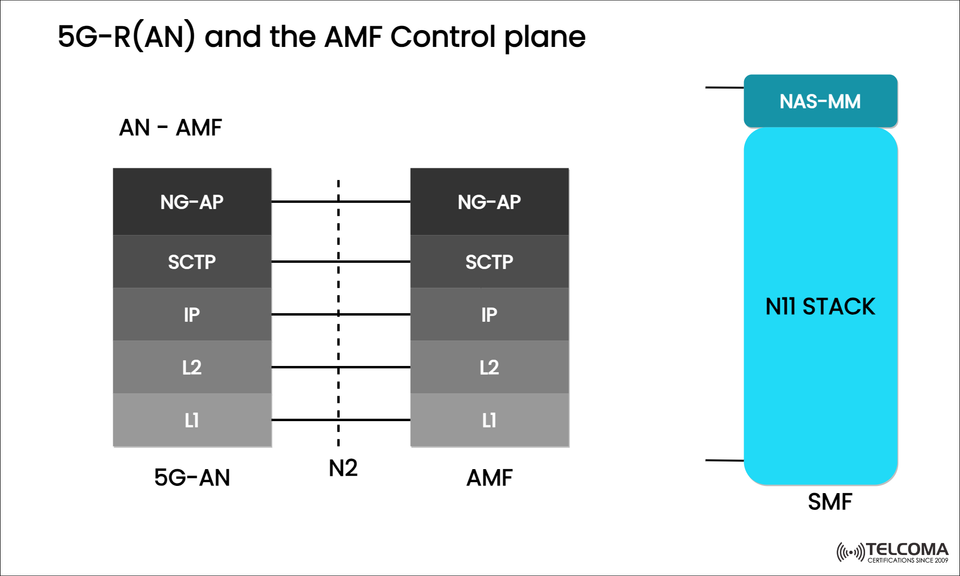
The diagram attached — “5G-R(AN) and the AMF Control Plane” — illustrates the protocol stack and the signaling relationships between these components. It offers a layered view of how control messages are exchanged, which is crucial for 5G session management, mobility handling, and access control.
Overview of the 5G-R(AN) and AMF Relationship
In 5G architecture, the Access Network (AN) — usually the gNB (Next Generation Node B) — connects user equipment (UE) to the 5G Core (5GC). The AMF (Access and Mobility Management Function) sits within the core network and takes care of:
UE registration and authentication
Mobility and connection management
Access control
Managing interfaces with other network functions (like SMF)
The N2 interface is the logical link between the 5G-RAN and AMF, carrying signaling messages tied to control and management.
The diagram clearly shows this relationship: the left block represents the 5G-AN layers, the right block shows the AMF layers, and they’re connected through N2. The AMF also links to the SMF (Session Management Function) via the N11 interface.
The 5G-R(AN) Protocol Stack Explained
The 5G-R(AN) or gNB has several protocol layers that allow communication with the AMF. These layers are part of the control plane stack and handle signaling, message delivery, and reliability.
- SCTP (Stream Control Transmission Protocol): Reliable Control Plane Transport
SCTP acts between the IP layer and NG-AP, providing transport for signaling messages. It’s often likened to TCP, but it’s tailored for signaling networks.
Key Features of SCTP in 5G:
Multi-homing support: Offers redundancy by enabling multiple IP addresses per endpoint.
Multi-streaming: Cuts down on head-of-line blocking by allowing the transmission of multiple message streams simultaneously.
Reliability: Guarantees in-sequence delivery and retransmission of lost packets.
In the context of 5G-R(AN), SCTP creates a stable and fault-tolerant transport layer for NG-AP signaling messages between the gNB and AMF.
NG-AP (Next Generation Application Protocol): The Heart of N2 Signaling
NG-AP is a protocol defined by 3GPP that manages signaling processes between the gNB and AMF over the N2 interface. It oversees operations related to the control plane, such as:
UE registration and authentication
PDU session establishment and release
Mobility management (handover, tracking area updates)
Connection setup and context management
Paging and service requests
How NG-AP Works:
NG-AP messages are sent over SCTP sessions and follow a two-level hierarchical structure:
Global procedures: Affect the whole system (like AMF configuration updates).
UE-specific procedures: Focus on managing individual UE connections (like initial context setup).
This protocol effectively serves as the “language” that links the RAN and the core to establish and control UE contexts.
AMF (Access and Mobility Management Function): The Control Plane Brain
The AMF is a crucial function within the 5G Core (5GC). It handles the control plane signaling tied to UE registration, authentication, and mobility management.
Key Responsibilities of AMF:
Manages NAS signaling from the UE via the gNB.
Coordinates with SMF over the N11 interface to establish data sessions.
Oversees mobility events, including handovers and location updates.
Maintains UE context and state across access networks.
In the diagram, you can see the AMF interacts with:
The 5G-AN via N2 (using the NG-AP/SCTP/IP stack)
The SMF via N11 (using the NAS-MM stack)
This dual connectivity enables the AMF to handle both access control and session management coordination.
N11 Interface and the NAS-MM Layer
The N11 interface connects the AMF and SMF (Session Management Function), making it a key bridge between control plane and session management.
The NAS-MM (Non-Access Stratum – Mobility Management) layer is situated on top of this interface. It deals with signaling directly related to the UE's mobility, authentication, and registration.
Functions of NAS-MM:
Procedures for UE registration and deregistration.
Mobility management and state transitions (Idle, Connected).
Security procedures (integrity and ciphering).
Communication with the SMF to handle session setup and modification.
How the N11 Stack Operates:
The AMF relays NAS messages from the UE (via RAN) to the SMF.
The SMF manages PDU sessions (user plane connectivity).
This structure ensures a clear division between mobility management (AMF) and session management (SMF) functions.
This separation of layers is a fundamental part of the Service-Based Architecture (SBA) introduced in 5G.
The N2 Interface: Core of 5G Control Plane Communication
The N2 interface is where all interaction between the 5G-RAN and AMF takes place. It’s exclusively a control-plane interface — user data is transmitted separately through the N3 interface (heading towards the UPF).
Functions of N2 Interface:
Transfers control plane signaling between RAN and AMF.
Establishes and manages UE contexts.
Supports mobility procedures like handovers.
Handles QoS (Quality of Service) configuration during session setup.
With NG-AP over SCTP, N2 signaling is both reliable and efficient, even in high-load, multi-cell situations typical of 5G deployments.
Advantages of This Layered Control Plane Design
This design offers several architectural and operational benefits:
Modularity: Each function (RAN, AMF, SMF) can evolve independently.
Scalability: Control and user planes can scale separately for better efficiency.
Resilience: SCTP’s multi-homing and multi-streaming characteristics enhance reliability.
Interoperability: Standardized interfaces (N2, N11) create a multi-vendor ecosystem.
Efficiency: NG-AP minimizes signaling overhead and boosts mobility response times.
These traits make 5G networks cloud-native, agile, and carrier-grade — perfect for supporting new features like network slicing, URLLC, and massive IoT.
Conclusion
The 5G-R(AN) and AMF Control Plane architecture represents the intelligence behind the 5G Core. Through the N2 interface, NG-AP signaling, and NAS-MM coordination with the SMF, this setup guarantees smooth UE registration, authentication, and mobility management.
By separating control, session, and user plane functions, 5G achieves a modular, flexible, and scalable architecture — crucial for meeting the diverse service needs of next-gen networks.
In short, this control plane design is at the heart of 5G automation, managing everything from device connection to service delivery with accuracy and resilience.