
Understanding the 5G Radio Protocol Stack: SDAP, PDCP, RLC, MAC, and PHY Explained

Grasping the 5G Radio Protocol Stack: Your Comprehensive Guide
The backbone of 5G networks is their promise of lightning-fast speeds, minimal delays, and massive connectivity. But all that relies on a well-organized communication system—that’s where the 5G Radio Protocol Stack steps in.
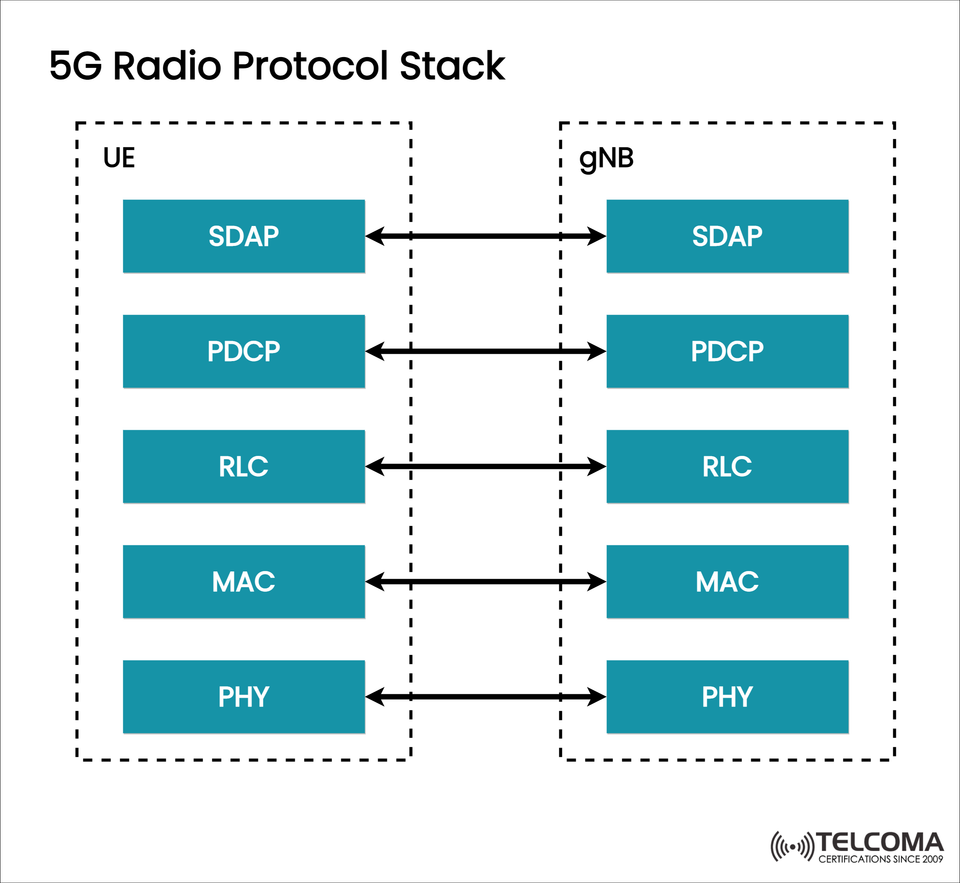
The image above shows the layers of the 5G radio protocol, highlighting how User Equipment (UE) interacts with the gNB (Next Generation NodeB). This layered setup makes sure data is sent efficiently, without errors, and tailored for various uses—from high-speed mobile internet to ultra-reliable low-latency communications (URLLC).
In this post, we’ll dive into each layer of the 5G radio protocol stack—SDAP, PDCP, RLC, MAC, and PHY—what they do, and how they come together to support next-gen connectivity.
What is the 5G Radio Protocol Stack?
The radio protocol stack is the set of communication protocols that dictate how data moves between the UE and the gNB in the radio access network (RAN).
It ensures:
Reliable data transfer
Error correction
Smart resource allocation
Support for various Quality of Service (QoS) needs
The 5G stack is meant to be flexible and scalable, accommodating different types of services like:
Enhanced Mobile Broadband (eMBB) – offering high-speed internet
Massive Machine-Type Communication (mMTC) – connecting a lot of IoT devices
Ultra-Reliable Low-Latency Communication (URLLC) – for critical applications
Layers of the 5G Radio Protocol Stack
The 5G radio protocol stack comprises five main layers on both the UE and gNB sides:
SDAP (Service Data Adaptation Protocol)
PDCP (Packet Data Convergence Protocol)
RLC (Radio Link Control)
MAC (Medium Access Control)
PHY (Physical Layer)
SDAP – Service Data Adaptation Protocol
Location in Stack: The top layer of the radio protocol stack.
Primary Role: Manages Quality of Service (QoS) flows in 5G.
Functions of SDAP:
Maps QoS flows to Data Radio Bearers (DRBs).
Ensures that applications with diverse needs (like video streaming versus IoT) receive the right kind of service.
Aids in network slicing by allocating resources for specific services.
Example:
If you’re watching 4K video while also using a smart home IoT sensor, SDAP makes sure both get the right QoS treatment—smooth video and reliable IoT updates.
PDCP – Packet Data Convergence Protocol
Location in Stack: Between SDAP and RLC.
Primary Role: Focuses on data integrity, compression, and security.
Functions of PDCP:
Header compression (ROHC – Robust Header Compression) to cut down on overhead.
Ciphering and integrity protection for secure data transfer.
Reordering and duplication detection, crucial in dual connectivity.
Example:
In 5G dual connectivity (when a device is connected to multiple cells at once), PDCP ensures that data packets aren’t duplicated and arrive in order.
RLC – Radio Link Control
Location in Stack: Below PDCP, above MAC.
Primary Role: Guarantees reliable delivery through segmentation and error correction.
Functions of RLC:
Segmentation and reassembly: Breaks large PDCP packets into smaller RLC units for sending.
Error correction: Uses ARQ (Automatic Repeat Request) for resending lost packets.
Operates in three modes:
AM (Acknowledged Mode) – allows retransmissions.
UM (Unacknowledged Mode) – no retransmissions (ideal for real-time apps).
TM (Transparent Mode) – raw data transmission, minimal processing.
Example:
For file downloads, RLC ensures packets are delivered reliably through retransmissions, while for VoIP calls, it uses UM mode to avoid delays from retransmissions.
MAC – Medium Access Control
Location in Stack: Between RLC and PHY.
Primary Role: Manages access to the shared radio channel.
Functions of MAC:
Scheduling: Dynamically allocates radio resources.
Multiplexing: Combines data from several RLC channels into one transport block.
HARQ (Hybrid Automatic Repeat Request): Allows for quick retransmissions for error correction.
Example:
When a ton of users connect to a cell tower, the MAC layer makes sure resources are allocated fairly and efficiently to avoid congestion.
PHY – Physical Layer
Location in Stack: The lowest layer, closest to the radio hardware.
Primary Role: Translates data into radio signals for transmission.
Functions of PHY:
Modulation and demodulation (like OFDM in 5G).
Channel coding (LDPC for data channels, Polar codes for control channels).
Beamforming and MIMO operations to enhance coverage and capacity.
Error detection using CRC (Cyclic Redundancy Check).
Example:
The PHY layer is what actually sends out 5G signals, enabling techniques like massive MIMO and beamforming to improve performance.
Putting It All Together: Data Flow in 5G
Here’s a simplified example of how a packet moves through the 5G protocol stack:
Application creates data → sends it to SDAP.
SDAP maps data to a QoS flow.
PDCP compresses headers, encrypts the data, and checks integrity.
RLC segments packets and ensures error correction (if needed).
MAC schedules transmission and uses HARQ.
PHY sends data as radio waves to the gNB.
On the receiving end (gNB or UE), this process reverses—decoding, correcting errors, reassembling, and delivering data to the application.
Table: Functions of the 5G Radio Protocol Stack Layers
Layer | Key Role | Example Function
SDAP | QoS flow mapping | Differentiating video from IoT traffic
PDCP | Integrity, compression, security | Header compression, ciphering
RLC | Reliable delivery, segmentation | Retransmissions for downloads
MAC | Resource scheduling, multiplexing | HARQ retransmissions
PHY | Physical transmission | Modulation, MIMO, beamforming
Why the Radio Protocol Stack Matters in 5G
The 5G protocol stack is more than just a technical structure—it has a direct impact on:
User experience: Smooth streaming, low-latency gaming, and dependable voice calls.
Network efficiency: Better spectrum usage and improved capacity handling.
Security: Ensuring encryption and integrity checks at multiple levels.
Industry applications: URLLC for factories, eMBB for consumers, mMTC for IoT.
By designing and fine-tuning these layers carefully, 5G networks can address the varied demands of both industries and consumers.
Conclusion
The 5G radio protocol stack is the core of next-gen communication, ensuring that data is transmitted efficiently, reliably, and securely between UE and gNB.
SDAP manages QoS mapping.
PDCP secures and compresses data.
RLC guarantees reliable delivery.
MAC oversees scheduling and error correction.
PHY is responsible for the actual radio transmission.
All these layers work together to make 5G capable of delivering high-speed broadband, scalable IoT, and ultra-reliable low-latency services.
For those in telecom or just curious about technology, understanding this protocol stack is key to grasping how 5G networks operate and how they’ll evolve into 6G.