
Understanding the 5G Spectrum: From 300 MHz to 100 GHz
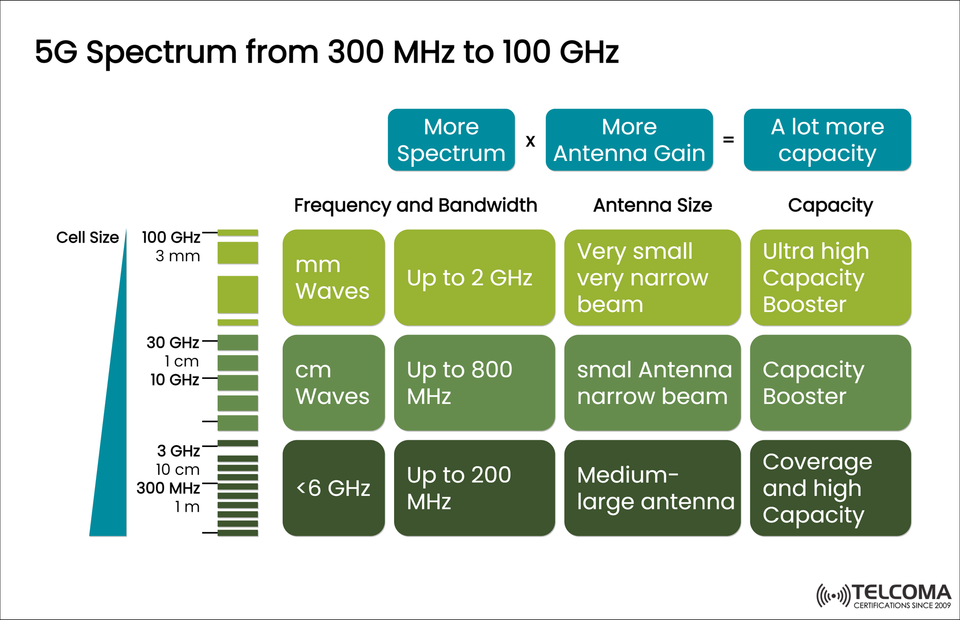

5G Spectrum from 300 MHz to 100 GHz: The Backbone of Next-Generation Connectivity
The 5G spectrum is a major breakthrough in wireless technology, probably one of the most significant since cellular networks first emerged. Unlike earlier generations, 5G isn’t limited to a small frequency band. Instead, it spans from 300 MHz up to 100 GHz, allowing for a variety of applications, like wide coverage for rural areas and super-fast data speeds in crowded urban centers.
The graphic above (by TELCOMA) gives a clear picture of this spectrum range, illustrating how different frequency bands (sub-6 GHz, centimeter wave, and millimeter wave) offer unique performance characteristics regarding bandwidth, antenna size, and capacity.
- The Expansive 5G Spectrum Range
5G’s broad spectrum is divided mainly into three frequency categories:
Frequency Range Common Name Wavelength Range Typical Use Case Below 6 GHzSub-6 GHz1 m – 5 cm Broad coverage, mobility, and strong penetration6–30 GHz Centimeter Waves (cm Wave)5 cm – 1 cm Urban capacity, mid-range throughput30–100 GHz Millimeter Waves (mm Wave)10 mm – 3 mm Ultra-high capacity, short-range, low-latency use cases
This wide frequency range gives operators the ability to customize network performance to meet the demands of specific environments and applications.
- The Fundamental 5G Equation
The image presents a straightforward yet impactful concept:
More Spectrum × More Antenna Gain = A Lot More Capacity
This equation sums up the key idea behind 5G engineering:
More Spectrum means more bandwidth for each user, leading to higher throughput.
More Antenna Gain—thanks to massive MIMO and beamforming—improves signal efficiency and extends range.
When combined, these factors lead to significantly higher capacity and better user experiences.
- Sub-6 GHz: The Coverage and Capacity Workhorse
Frequency and Bandwidth
Frequency Range: Up to 6 GHz (usually 600 MHz – 6 GHz)
Bandwidth: Up to 200 MHz
This band overlaps with the operational range of 4G LTE, making for smoother non-standalone (NSA) 5G rollouts along with solid backward compatibility.
Antenna Characteristics
Size: Medium to large antennas
Beam width: Wide, allowing for broad coverage of extensive areas
Performance and Capacity
Great coverage due to longer wavelengths (less signal loss, better penetration through walls and trees)
Perfect for nationwide 5G and mobile broadband
Offers a mix of coverage and capacity, efficiently balancing speed and range
Typical Use Cases
Coverage in rural and suburban areas
Indoor penetration (homes, offices)
Massive Machine-Type Communications (mMTC) like IoT and smart city projects
- Centimeter Waves (cmWave): The Mid-Band Powerhouse
Frequency and Bandwidth
Frequency Range: 6–30 GHz
Bandwidth: Up to 800 MHz
This mid-band range strikes a balance between range and speed, filling the gap between sub-6 GHz and mmWave.
Antenna Characteristics
Size: Smaller antennas with tighter beams compared to sub-6 GHz
Beam Control: Can support directional beamforming for focused transmission
Performance and Capacity
More capacity than sub-6 GHz thanks to increased bandwidth
Moderate distance—less coverage than sub-6 GHz but more than mmWave
Enables multi-gigabit speeds in urban and densely populated suburban areas
Typical Use Cases
Urban installations (smart cities, business hubs)
Indoor hotspots and private enterprise networks
Mid-band enhanced Mobile Broadband (eMBB) services
This frequency range is often seen as the “sweet spot” of 5G—striking a solid balance between coverage and capacity, making it crucial for scalable commercial 5G deployments.
- Millimeter Waves (mmWave): The Capacity Booster
Frequency and Bandwidth
Frequency Range: 30–100 GHz
Bandwidth: Up to 2 GHz
Millimeter waves deliver the largest available spectrum for 5G, with speeds surpassing 10 Gbps and latencies under 1 millisecond.
Antenna Characteristics
Size: Very small antennas with extremely narrow beams
Beamforming: Highly directed to overcome significant path loss
Facilitates massive MIMO arrays featuring dozens or even hundreds of antenna elements
Performance and Capacity
Ultra-high capacity and throughput
Limited coverage (often just a few hundred meters)
Susceptible to signal interference from buildings, rain, and foliage
Typical Use Cases
High-density areas like stadiums, airports, and malls
Fixed Wireless Access (FWA) for fast broadband
Industrial applications, AR/VR experiences, and connectivity for autonomous vehicles
mm Wave is the powerhouse of 5G, offering lightning speeds and supporting extremely dense networks. But due to its limited range, it’s best used in localized settings.
- Spectrum-to-Capacity Relationship
The chart also outlines how frequency, antenna size, and capacity scale together:
Band Type Band width Availability Antenna Size Beam width Capacity PotentialSub-6 GHz Up to 200 MHz Medium/Large Wide Moderate to High cm Wave Up to 800 MHz Small Narrow High mm Wave Up to 2 GHz Very Small Very Narrow Ultra-High
As frequency goes up:
Bandwidth increases
Antennas shrink in size
Beam width narrows
Capacity skyrockets
However, cell size gets smaller, which means more base stations are needed to ensure continuous coverage.
- Understanding Cell Size and Propagation
As the left side of the image illustrates, cell size has an inverse relationship with frequency:
Lower frequencies (like 700 MHz) can cover several kilometers.
Higher frequencies (such as 28 GHz) might only cover a few hundred meters.
This is due to:
Increased free-space path loss at higher frequencies.
A reduced ability to penetrate walls and other obstacles.
Thus, network planning for 5G needs to balance macro cells (for coverage) and small cells (for capacity)—creating a heterogeneous network (HetNet) structure.
- Practical Deployment Scenarios
Scenario Frequency Range Key Benefits Typical Use Rural 5GSub-6 GHz Broad coverage, lower latency Nationwide connectivity Urban/Suburban 5G6–30 GHz (cm Wave)High capacity, moderate range Public 5G networks, enterprises Dense Urban / Hotspots30–100 GHz (mm Wave)Extreme capacity, ultra-low latency Stadiums, campuses, smart factories
This layered frequency approach guarantees users enjoy seamless connectivity, whether they’re in remote locations or bustling city hotspots.
- Why Spectrum Diversity Matters
The strength of 5G lies in its spectrum diversity—using different frequency ranges for various layers of the network:
Low-band (sub-1 GHz): Great for wide area coverage and indoor penetration
Mid-band (1–6 GHz): Ideal mix of speed and coverage
High-band (24–100 GHz): Top-notch performance and ultra-low latency
This approach allows providers to deliver:
Consistent user experiences
Scalable capacity
Efficient use of spectral resources
On top of that, advanced technologies like Carrier Aggregation and Dynamic Spectrum Sharing (DSS) further boost efficiency across these layers.
- The Role of Antenna Technology
At the core of 5G’s spectrum management is innovative antenna technology:
Massive MIMO (Multiple-Input Multiple-Output): Enhances capacity by using many antenna elements.
Beamforming: Directs energy toward users, strengthening signal and spectral efficiency.
Adaptive Antennas: Change beam direction on the fly to maintain strong connections, even when users are moving.
As frequencies rise, the size of antennas shrinks, supporting compact, high-gain arrays—an essential aspect for cmWave and mmWave networks.
Conclusion
The 5G spectrum from 300 MHz to 100 GHz provides the foundation for 5G’s adaptability, scalability, and effectiveness.
Each layer has its own distinct role:
Sub-6 GHz: Delivers broad coverage and mobility.
cmWave: Balances capacity and range for populed areas.
mmWave: Offers ultra-fast speeds for high-demand use cases.
The combination of more spectrum and more antenna gain leads to massive network capacity, fulfilling the potential for reliable, high-speed, low-latency communication.
5G’s smart use of various frequency bands ensures that every device, user, and application gets the right performance in the right place — from rural communities to bustling smart cities.