
Understanding the 5G Standalone (SA) Access and Registration Procedure: A Complete Technical Breakdown
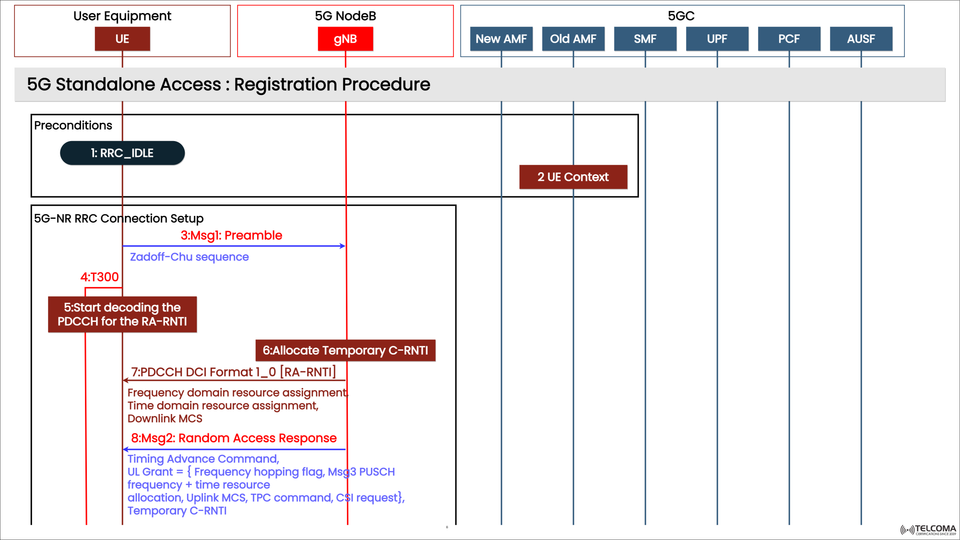

Explaining 5G Standalone Access and Registration Procedure
The 5G Standalone (SA) architecture marks a significant leap in mobile networks, offering ultra-low latency, high bandwidth, and cloud-native core capabilities. One of the key processes in this setup is the 5G registration procedure, where a User Equipment (UE) connects to a 5G NodeB (gNB) to establish a link with the 5G Core (5GC).
In this post, we'll break down the 5G Standalone Access Registration Procedure step-by-step, using a reference image to focus on the signaling between the UE, gNB, and 5GC components like AMF, SMF, UPF, PCF, and AUSF.
Understanding 5G Standalone Architecture
Before we dive into the message sequence, let’s clarify what “Standalone” means in the context of 5G:
Standalone (SA): This setup operates on a complete 5G Core (5GC) independently, without relying on the 4G LTE EPC—both the access and core are entirely 5G-based.
Non-Standalone (NSA): Here, 5G radio is utilized, but control signaling still goes through the 4G core (EPC).
In 5G SA, the gNB (5G base station) connects directly to the 5G Core, managing both user and control plane tasks.
Preconditions for Registration
The registration process kicks off with the UE in RRC _IDLE mode, meaning the device is on but not yet connected to the network.
At this point:
The UE hasn’t yet established an RRC (Radio Resource Control) connection.
No UE-specific context exists in the gNB.
The UE is busy scanning for synchronization and broadcast info.
Overview of the Random Access Procedure
The first step for a UE to connect to the 5G network is the Random Access Procedure (RAP). This is crucial for time synchronization and making initial contact with the radio network.
The RAP involves four key messages (Msg1–Msg4) that facilitate uplink resource allocation and give the UE a temporary identity.
Step Message Purpose Direction
Msg1 Preamble UE sends an access request to gNB UE → gNB
Msg2 Random Access Response (RAR) gNB replies with timing advance and UL grant gNB → UE
Msg3 RRC Connection Request UE asks for RRC setup UE → gNB
Msg4 RRC Connection Setup gNB finalizes setup and sends configuration gNB → UE
- Step-by-Step Breakdown of the Procedure (Based on Image)
Let’s decode each part of the 5G Standalone Access: Registration Procedure image.
Step 1: UE in RRC _IDLE
The UE begins in the RRC _IDLE state, waiting for synchronization and access opportunities, keeping an eye on the Physical Random Access Channel (PRACH) configuration that's broadcast by the gNB.
Step 2: UE Context Initialization
Before access can happen, the gNB sets up the context for handling the UE, like resource scheduling and timing setups. This doesn’t yet involve any specific UE identity.
Step 3: Msg1 – Preamble Transmission
The UE sends Msg1, the Preamble, to the gNB.
This is a Zadoff–Chu sequence, a mathematical sequence known for its ideal correlation properties, aiding the gNB in detecting the UE and measuring timing offset.
Its purpose is to establish time synchronization and to alert the gNB about an access attempt.
Step 4: Timer T300 Starts
After sending Msg1, the UE starts Timer T300, waiting for the network’s response (Msg2). If the timer runs out without a reply, the UE will try again using a new preamble.
Step 5: Decoding PDCCH for RA-RNTI
The UE checks the Physical Downlink Control Channel (PDCCH) for messages meant for the Random Access RNTI (RA-RNTI), which identifies responses to random access attempts.
The RA-RNTI comes from the preamble index and the time slot.
This step ensures the UE picks up the right response intended for its preamble.
Step 6: Allocation of Temporary C-RNTI
Once the access request is received, the gNB assigns a Temporary C-RNTI (Cell Radio Network Temporary Identifier) to the UE. This identifier helps in recognizing the UE during the early connection phase before any permanent identifiers are assigned.
Step 7: PDCCH DCI Format 1 0 [RA-RNTI]
The gNB sends a Downlink Control Information (DCI) message over the PDCCH, directed to the RA-RNTI. This message contains:
Frequency and time domain resource assignments
Downlink MCS (Modulation and Coding Scheme)
Uplink grants information (for Msg3)
Step 8: Msg2 – Random Access Response (RAR)
The Msg2 or Random Access Response (RAR) is sent from the gNB to the UE through the Physical Downlink Shared Channel (PDSCH).
This message includes:
Timing Advance Command – Adjusts the UE’s transmission timing.
Uplink Grant – Allocates resources for Msg3 transmission.
Temporary C-RNTI – Used to identify the UE until it gets a permanent RNTI.
Power Control Command (TPC) – Adjusts transmission power.
CSI Request – Asks the UE for channel state information.
After this message is received, the UE will proceed to send Msg3, which is the RRC Connection Request.
- Importance of Temporary Identifiers
The use of temporary identifiers (RA-RNTI, C-RNTI) is vital for keeping access control in check and managing resources efficiently during the initial registration phase.
RA-RNTI: Tied to the random access attempt and used until the UE is recognized.
Temporary C-RNTI: Written for ongoing communication until the RRC setup is finished.
- The Role of 5GC
While the reference image mainly covers signaling between the UE and gNB, it’s also important to recognize the 5G Core (5GC) components that get involved later in the registration process:
5GC Function Role in Registration
AMF (Access and Mobility Management Function) Handles registration, authentication, and mobility.
SMF (Session Management Function) Manages PDU sessions and IP address assignment.
UPF (User Plane Function) Handles forwarding user data.
PCF (Policy Control Function) Oversees QoS and policy rules.
AUSF (Authentication Server Function) Validates UE credentials via authentication procedures.
After the UE is authenticated, the AMF and SMF work together to set up a PDU Session, allowing for IP-based communication over 5G.
- Technical Insights
Zadoff–Chu Sequences: They provide perfect autocorrelation, making it easier to detect the UE accurately.
PDCCH Monitoring: The UE is always listening for DCI messages to know when it can transmit uplink data.
Timing Advance: This is crucial for aligning uplink signals so that multiple UEs can transmit accurately to the gNB.
- Common Registration Issues
Preamble Collision: Two UEs trying to use the same preamble at the same time.
Timing Mismatch: If timing advance fails, uplink messages may not get decoded right.
Weak Signal: Low SINR can cause Msg2 or Msg3 to be missed, resulting in retries.
Network optimization tools often track Random Access success rates to help ensure smooth registration.
Conclusion
The 5G Standalone Access and Registration Procedure is crucial for enabling smooth initial connectivity between the UE and the 5G Core network.
From being in the RRC _IDLE state to receiving the Random Access Response, each message—from Msg1 to Msg4—has an important role in synchronizing, identifying, and establishing a stable radio link.
For telecom professionals, grasping this process is essential for optimizing access success rates, reducing latency, and enhancing user experience in 5G SA rollouts.