
Understanding the 5G Timeline: From NSA to Release 17 Enhancements
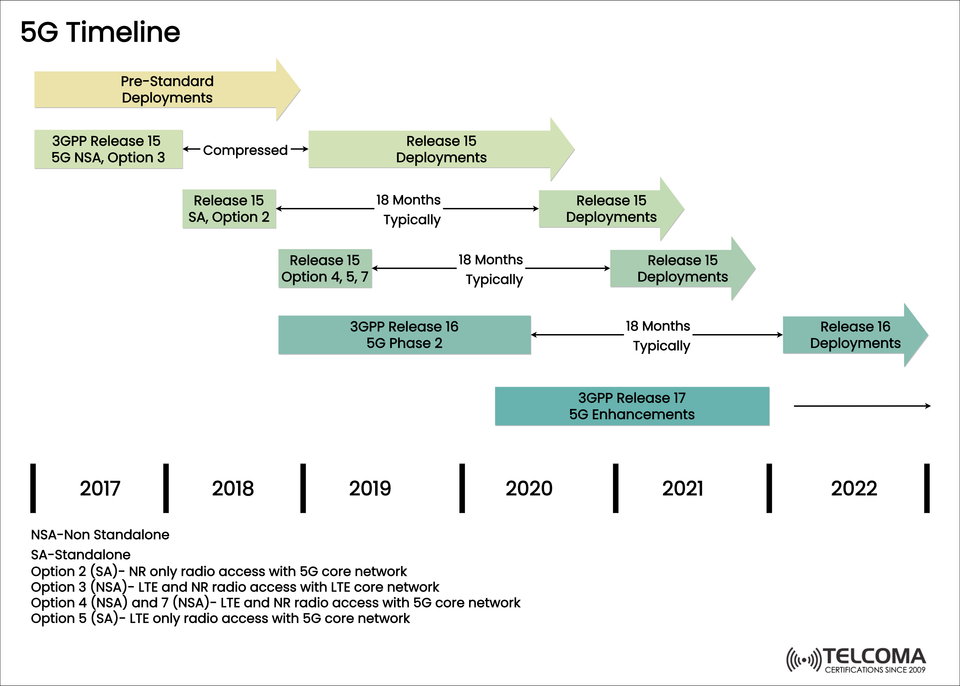

📡 5G Timeline Explained: From First Deployments to 3GPP Release 17
As 5G continues to transform communication around the globe; understanding the evolution of its development process is great for telecom professionals and interested technologists alike. The image above gives a visual overview of the major phases, 3GPP releases, and means of deployment that make up the transition from pre-standard deployments to the present including Release 17 improvements.
📖 What is the 3GPP and why do releases matter?
The 3rd Generation Partnership Project (3GPP) is a global telecommunications standards body responsible for specification development of wireless network technology, including 5G. These specifications are developed and documented in phases called "Releases," which add capabilities and standards for operators and vendors to implement.
🧭 5G Timeline Key Milestones
🕰️ 1. Pre-Standard Deployments (Pre-2018)
Before the completion of Release 15, numerous operators were trialing, and conducting non-standard deployments, to gain initial field experience, prepare the infrastructure, and to be first to market.
🚀 2. 3GPP Release 15 - The First "Official" 5G Standard
Initial Deployment Year: 2018
Topics of Interest
- Introduction of 5G New Radio (NR)
- Non-Standalone (NSA) Option 3: LTE anchor and NR data plane
- Standalone (SA) Option 2: Pure 5G core and NR radio access
Deployment Scenarios in Release 15
Release 15
Option Type Description
1 SA NR only radio with 5G Core
2 NSA LTE and NR radio with LTE Core
4/5/7 NSA/SA Mixed Hybrids using LTE or NR radio and a 5G Core for future deployment.
Typical release cadence is every 18 months.
Impact: This release provided clarity for global 5G rollouts and established concepts like dual connectivity to LTE and NR.
🧩 3. 3GPP Release 16 – 5G Phase 2
Started: 2020
Deployment Year: 2021
New Capabilities:
Ultra-Reliable Low Latency Communication (URLCC)
Network Slicing
Vehicle-to-Everything (V2X) enhancements
Integrated Access and Backhaul (IAB)
Bringing commercial maturity and wider industrial and enterprise use cases.
⚙️ 4. 3GPP Release 17 – 5G advancements
Started development: 2021 onwards
To:
Further extend 5G capabilities and create additional/enabled features
Further develop and deploy non-terrestrial networks ( NTN), (i.e., satellites, space-based)
Support improved IoT connectivity and energy efficiency
Support NR-Light reduced complexity devices
Defines phase projects to further enhance performance and costs going forward, in both rural and urban deployments.
🔍 Considerations for Deployment Strategy for Operators
Operators must consider how to employ their options wisely based on spectrum availability, core network readiness, and client demand.
🛠️ Recommended Path:
Option 3: NSA with LTE Core to accelerate rollouts to 5G.
Option 2: SA for full 5G experience with new Core.
Hybrid Options 4/5/7: Meet customer needs while continuing to move towards 5G versions but allow backward compatibility.
📈 Timeline Summary Table
Year Milestone Notes
2017 Pre-Standard Trials – Field Trials with Private 5G solutions None
2018 Release 15 (NSA Option 3) – LTE Core with NR, Initial Commercial Launches, etc. None
2019 Release 15 (SA Option 2 & Options 4/5/7) - Initial Availability of 5G Core and Standalone capabilities. None
2020 Release 16 – completed Focus on Industrial IoT and apps needing low latency; introduce new features.
2021 Release 16 Deployments; R&D release 17 Operators begin real-world deployments of Phase 2.
2022 Release 17 will continue to be developed and enhanced Operators will be adding new features and expanding capabilities of their networks with 5G.
🔚 Conclusive Thoughts: The Road to 5G Has Just Started
The 5G timeline is a strategic path for network evolution, showing the maturity of COTS technology from NSA configurations to enhanced SA architectures outlined in Release 17. For service providers, being aware of the pace of the 3GPP process is necessary to prepare for new upgrade paths and opportunities, such as thinking about 6G and Network Automated Services.
🧠 Strategic Takeaways for Telecomm Industry Executives
Understanding the 5G roadmap is about more than just understanding standards, it is about preparing your networks, businesses, and services for future demand and innovation. Some thought takeaways include:
📌Deployment Strategy:
Plan for Transition: If you are an NSA operator, start formulating a clear migration strategy towards Standalone (SA) to fully realize the benefits of 5G.
Utilize Release 16: Start using URLLC and network slicing to provide differentiated services (for example industrial IoT, smart grids, telemedicine etc...).
Preparation for 5G Advanced (Release 18): Release 18 was not clearly indicated in the timeline, however, it is in active development - be on the lookout for the focus on artificial intelligence / machine learning (AI/ML), extended reality (XR) and enhanced energy efficiency.
🔮 Market Readiness:
For operators beginning to standardize on Release 16 and beyond, the potential to deliver on the 5G defined visionary promises beyond speed, such as low-latency, network slicing and support for tremendous numbers of connected devices is near.
For enterprises, ensure to align with vendor partners that support 3GPP-compliant releases as this ensures future-proof compatibility and optimised performance.
🌐 What Does the Future Hold? The Voyage to 6G
5G may only just be deploying in different parts of the world, but the research ecosystem are already preparing for 6G by mapping the future of target standards and normative bodies towards future developments.
Release 18 and Release 19 will ultimately inform the catching 6G ecosystem as we begin to see:
Artificial intelligence to enable solutions such as real-time network management.
📚 Further Reading and Resources
Here are a few references resources of significance to expand on further details:
💬 Conclusion:
The present and future of 5G - as presented in the timeline from 3GPP is not just releases on a sequence in time, but an intentional and joint effort to progress the experience of mobile based technology to help support the world's war for ever increasing connectivity, latency, scalability and intelligence. For telecom and tech folks, the timeline serves as an overall map of innovation, standardization and future readiness.