
Understanding the 5G User Plane Protocol Stack: A Complete Guide for Telecom Professionals

Understanding the 5G User Plane Protocol Stack
With the jump from 4G LTE to 5G, mobile networks have seen some major upgrades, particularly in how they handle and transmit user data. A key part of this new setup is the User Plane Protocol Stack, which manages how user data flows between User Equipment (UE) and gNodeB (gNB).
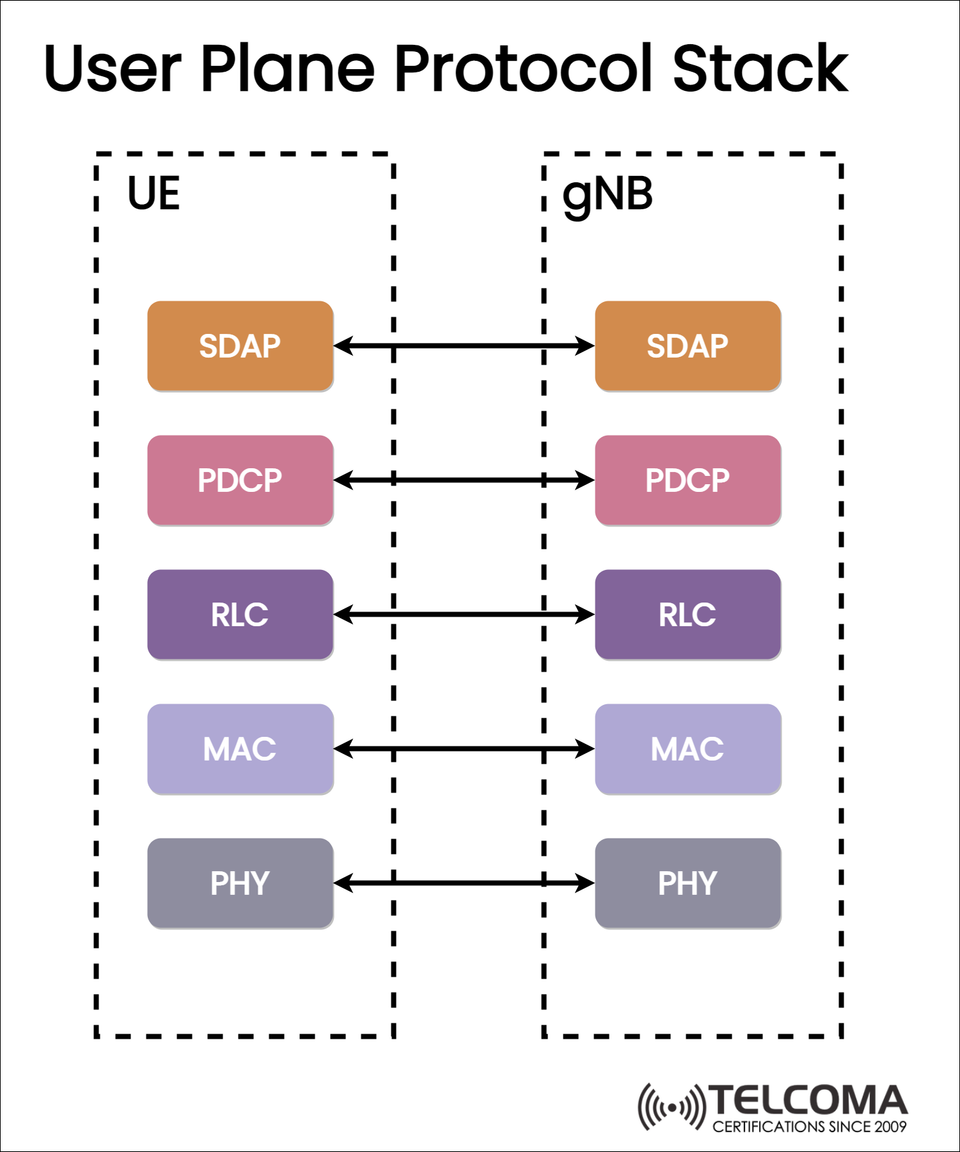
The image included shows the layered protocol stack for the 5G User Plane, pinpointing the roles of SDAP, PDCP, RLC, MAC, and PHY layers. In this article, we’ll take a closer look at each layer, what it does, and its significance in ensuring that data is transmitted reliably, efficiently, and with low latency in 5G networks.
What is the User Plane in 5G?
The User Plane in 5G is all about transmitting actual user traffic — think stuff like internet browsing, streaming videos, VoIP calls, gaming data, and application packets. This differs from the Control Plane, which focuses on signaling and managing network functions. The User Plane is simply about data forwarding between the UE and the gNB, eventually connecting to the 5G Core (5GC).
The User Plane Protocol Stack plays a vital role in making sure this traffic gets through accurately, securely, and with minimal delay, which is super important for 5G applications like Ultra-Reliable Low Latency Communication (URLLC), enhanced Mobile Broadband (eMBB), and massive IoT (mIoT).
Overview of the 5G User Plane Protocol Stack
As you can see in the image, the 5G User Plane Protocol Stack contains these layers:
Service Data Adaptation Protocol (SDAP)
Packet Data Convergence Protocol (PDCP)
Radio Link Control (RLC)
Medium Access Control (MAC)
Physical Layer (PHY)
Each of these layers works on both the UE and the gNB (the Next Generation Node B, or 5G base station). They communicate back and forth, ensuring data flows smoothly.
Layer-by-Layer Explanation
- Service Data Adaptation Protocol (SDAP)
The SDAP layer is something new for 5G and focuses on the user plane. Its main job is to connect Quality of Service (QoS) flows with the right Data Radio Bearer (DRB).
Functions of SDAP:
QoS flow mapping: Links data packets to correct bearers based on different QoS needs.
Differentiates services: Makes sure latency-sensitive applications like AR/VR and VoIP get priority over other traffic.
Provides QoS enforcement in the radio interface.
- Packet Data Convergence Protocol (PDCP)
The PDCP layer is key for providing services like header compression, security, and data integrity.
Functions of PDCP:
Header compression (ROHC): Cuts down on overhead in IP packets to improve efficiency.
Ciphering and integrity protection: Keeps user data secure.
In-sequence delivery: Makes sure packets arrive in the right order, even if there are retransmissions.
Duplicate elimination: Stops duplicate packets when switching between network connections.
This layer is essential for secure and efficient data transmission, especially when users are on the move.
- Radio Link Control (RLC)
The RLC layer is tasked with error correction and breaking down data packets.
Functions of RLC:
Segmentation and reassembly: Breaks larger PDCP packets into smaller units for easier transmission.
Error correction via ARQ (Automatic Repeat Request).
Data delivery modes:
Acknowledged Mode (AM): Makes sure data gets delivered reliably with retransmissions.
Unacknowledged Mode (UM): Sends data without retransmissions, great for real-time services like voice.
Transparent Mode (TM): For scenarios where higher layers manage reliability.
The RLC layer strikes a balance between throughput and latency, based on what's needed for the service.
- Medium Access Control (MAC)
The MAC layer is all about allocating resources and scheduling. It works closely with the physical layer to decide how to share resources among different users.
Functions of MAC:
Multiplexing and demultiplexing of RLC data.
Hybrid Automatic Repeat Request (HARQ): Offers quick retransmission of faulty packets, boosting reliability.
Scheduling: Adjusts radio resources on the fly to optimize performance.
Priority handling: Ensures that essential data gets top priority.
The MAC layer is vital for keeping spectral efficiency and fair resource allocation in check within 5G networks.
- Physical Layer (PHY)
At the base of the stack, there's the PHY layer, which handles the real transmission of data over the air interface using OFDM techniques in 5G.
Functions of PHY:
Modulation and coding: Turns bits into symbols for wireless sending.
MIMO support: Enables massive MIMO and beamforming for better data rates and coverage.
Error detection using CRC (Cyclic Redundancy Check).
Channel coding (LDPC and Polar codes in 5G).
The PHY layer has a direct effect on data rate, reliability, and latency — all key factors for 5G performance.
Summary Table of User Plane Layers
Layer Key Functions Importance in 5GSDAPMaps QoS flows to DRBs Enables QoS differentiation PDCP Header compression, security, integrity Efficient & secure transmission RLC Segmentation, ARQ, delivery modes Reliability & error correction MAC Scheduling, HARQ, multiplexing Resource allocation & fairness PHY Modulation, coding, MIMO, error detection Physical transmission over air
How the User Plane Protocol Stack Enables 5G Use Cases
This protocol stack is designed so that 5G can cater to various service needs:
Enhanced Mobile Broadband (eMBB): PDCP header compression and MIMO at the PHY layer enhance throughput.
Ultra-Reliable Low Latency Communication (URLLC): Low-latency modes in RLC and quick HARQ in MAC provide minimal delay.
Massive IoT (mIoT): Smart multiplexing in MAC accommodates a large number of devices.
By distributing tasks across layers, the User Plane Stack delivers scalability, flexibility, and efficiency.
Conclusion
The 5G User Plane Protocol Stack is an organized, layered framework that ensures reliable and efficient delivery of user data between the UE and gNB. Each layer — SDAP, PDCP, RLC, MAC, and PHY — has a unique and important role in making high-speed, low-latency, and secure communication happen.
For anyone in telecom or a tech enthusiast, diving into this stack is crucial for understanding how 5G networks roll out next-gen services. From immersive AR/VR experiences to critical IoT applications, the User Plane Stack is what makes it all possible.