
Understanding the Combination of 5G Core and LTE Core Network: NSA Option 3 Explained
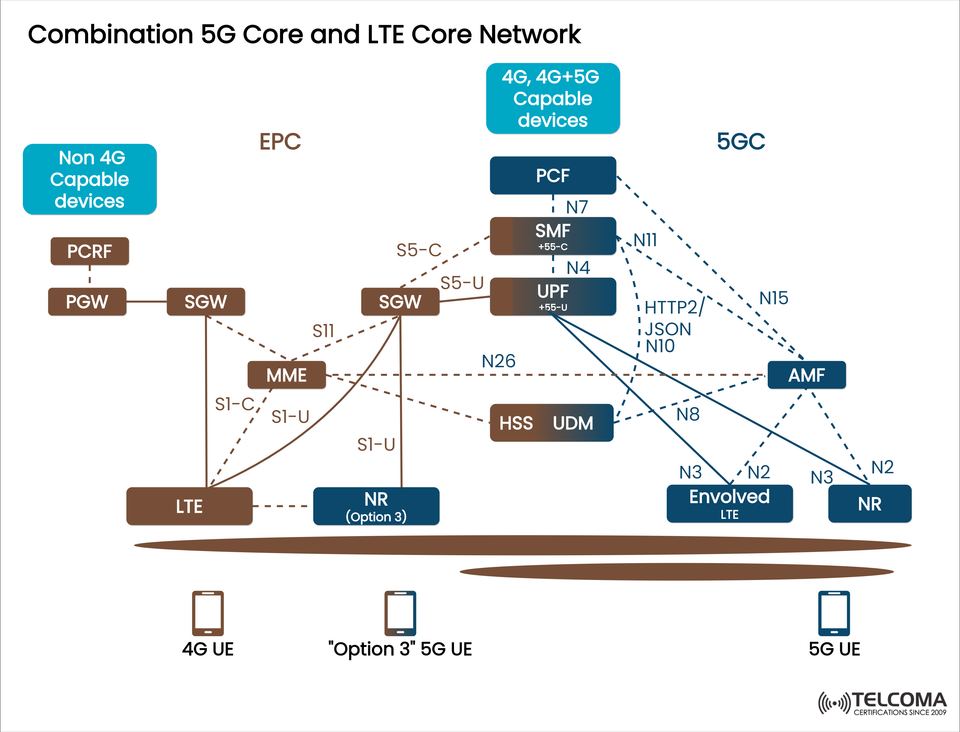

If you're looking for any 5G Network Planning expert to help plan your 5G network, EPC and the 5GC are the lie on the same the layer of 5G Planning for EPC and 5GC are close together. Under the 5G Non-Standalone (NSA) Option 3 architecture, transition to the next generation of mobile Internet (5G) from the preceding 4G mobile Internet generation (LTE), will be used with existing EPC infrastructure (MNOs will still take advantage of the foundational elements of prior generations, since they will not change). Therefore it's important to utilize an updated EPC could exist for considerable time in the future.
The uploaded diagram will help show the two cores (evolved packet core (EPC) and the 5G Core (5GC)) running simultaneously to provide legacy devices and next-generation devices. We will drill down on the elements in this blog, with some clarity.
➢ Elements of the Diagram
♦ LTE/EPC Core (Left Side)
MME (Mobility Management Entity): perform the signalling and controls for the membership session.
SGW (Serving Gateway) & PGW (Packet Gateway): route and forward user data packets.
PCRF: QoS and rules management.
LTE eNodeB: the LTE eNodeB provides access to 4G UEs to the EPC.
♦ 5G Core (Right Side)
AMF (Access and Mobility Function): will replace the MME in 5GC (managing access and mobility).
SMF (Session Management Function): controls the session states and IP address allocation.
UPF (User Plane Function): forwards user data and handle packet routing
PCF (Policy Control Function): the PCRF equivalent for 5G.
UDM (Unified Data Management) & HSS (Home Subscriber Server): manages subscriber profiles.
🔌 Data Flow in NSA (or Option 3)
Initial Attach - In this dimension, the UE will connect to LTE first through MME and then since the user is authenticated for access, NR can be interjected for user data.
Dual Connectivity - Now that the user is authenticated and connected, NR is added for high-speed data.
Bearer Split - SGW and PGW provide a route for the user traffic over the LTE and NR bearer split. The network will determine where the user traffic will flow/based on the available capacity.
This architecture allows carriers to effectively deliver enhanced mobile broadband (eMBB) services, while still taking advantage of existing LTE cores, without having to transition entirely.
🌐 5G Core Integration: Towards a Unified Network
As the networks evolve and mature, the 3rd dimension, or Option 3 will become 2 or 7, or SA (option 2) or NSA (option 7), where:
The AMF and SMF manage all management and control functions
The UPF is the center of the packet flow
The EPC and 5GC interworking should allow for seamless migration
Key interfaces (Nn) such as N3 N2, N4 and N11, stem the session continuity across both network cores permitting handovers and roaming across different networks architecture.
⚙️ Interface Summary
Interface Purpose
S1-U/C Connects LTE to EPC (user/control)
N2 Connects RAN to AMF
N3 Connects RAN to UPF (user traffic)
N4 Connects SMF to UPF
N10/N11 Control messages - actions JSON/HTTP2-
N26 EPC and 5GC interworking
🚀 Why This Architecture is Important
Understanding the hybrid model is important for telecom engineers and operators to do the following:
Scale network capacity using NR with no interruptions to LTE.
Support multi-generation UE.
Launch early 5G services while setting up for a complete 5GC transition.
We consider this model to be a cheap and technically feasible way for telecom operators to move forward towards the final goal of standalone, cloud-native 5G networks.
🧾 Conclusion: Forming the 5G Bridge with NSA Option 3
This combination of 5G Core and LTE Core networks with NSA Option 3 should not be seen merely as a workaround - although it is essential for PNF transition, this model is important step in the rollout of 5G. It allows operators to deliver enhanced services today, while building the infrastructure for future 5G SA services.
🏗️ Real-World Examples of NSA Option 3 Usage
Telecom operators around the world have deployed NSA Option 3 to provide commercial 5G services in a rapid, affordable manner. Here are some examples:
Verizon (USA): Deployed Option 3x for eMBB services without needing to modify the LTE EPC
Deutsche Telekom (Germany): Used dual connectivity between LTE and NR to improve coverage reliability during the introduction of new bands for 5G network.
SK Telecom (South Korea): Deployed NR services and leveraged LTE anchoring to deliver dependable services while managing density in urban areas.
These deployments emphasize how Option 3 can combine the reliability of LTE as an anchor with the potential of 5G across heterogeneous spectrum bands.
🧭 Steering toward Future Use Cases Beyond NSA: Transitioning past Option 3
Once the foundational 5G systems mature, service providers can focus on:
✅ Option 2 (SA - Standalone):
NR radio is directly connected to 5G Core (5GC).
Significantly lower latency and supports network slicing, ramp up IoT scalability and edge computing.
Perfect for enterprise/private 5G use cases.
✅ Option 7 (NSA):
LTE and NR RAN (radio access network) together but with the 5G Core as the anchor instead of LTE EPC.
Applicable, during transition, where full SA is not economically case possible.
Model RAN Anchor Core network Typical use case
3 LTE - EPC Initial 5G rollouts (2018−2021)
7 LTE/NR 5GC Intermediate 5G Expansion
2 NR 5GC Full standalone deployments (2022+)
🔐 Security Implications of NSA Deployments
There may be security implications from NSA deployments:
Control plane anchoring to EPC still has legacy vulnerabilities.
Session handovers between LTE and NR increase signaling overhead.
Inter-core communication (N26) must be protected from spoofing and eavesdropping.
Modern deployments typically defend against this with:
TLS-based encryption, mutual role authentication between network functions.
📣 In Conclusion: The Utilitarian Role of NSA Option 3
The NSA Option 3, connecting both the 5G Core and LTE Core networks, is a strategic inflection point in creating a unified evolution of telecom. It enables operators to:
Access 5G's incredibly speed capabilities,
Not disrupt customers who rely on LTE,
And properly transition into a cloud-native, standalone 5G future.
5GC has the service-based architecture (SBA) which allows for secured APIs, plus function registration.
📊 Visualising the Data Flow (Simplified)
Here is a high-level flow of how the data path and control signals flow under NSA Option 3:
scss
Copy
Edit
[UE] --> LTE eNodeB --> EPC (MME→SGW→PGW)
↓
NR gNB (user data split)
↓
EPC (SGW) --> Internet
The split bearer retains the hook into IGW for session management but allows the NR to access high-speed user data.
🧱 Why A Combination Core Deployment is Beneficial
CapEx optimized: No requirement to deploy a brand-new LTE network as a subset of the assignment is to utilize existing infrastructure.