
Understanding the DECT-2020 Frame Structure: A Deep Dive into Time-Frequency Resource Allocation

Understanding the DECT-2020 Frame Structure: Time and Frequency in Harmony
In the fast-paced realm of wireless communication, how well time and frequency are managed can make or break a network. One standout solution is DECT-2020, a key part of the DECT-2020 NR (New Radio) standard.
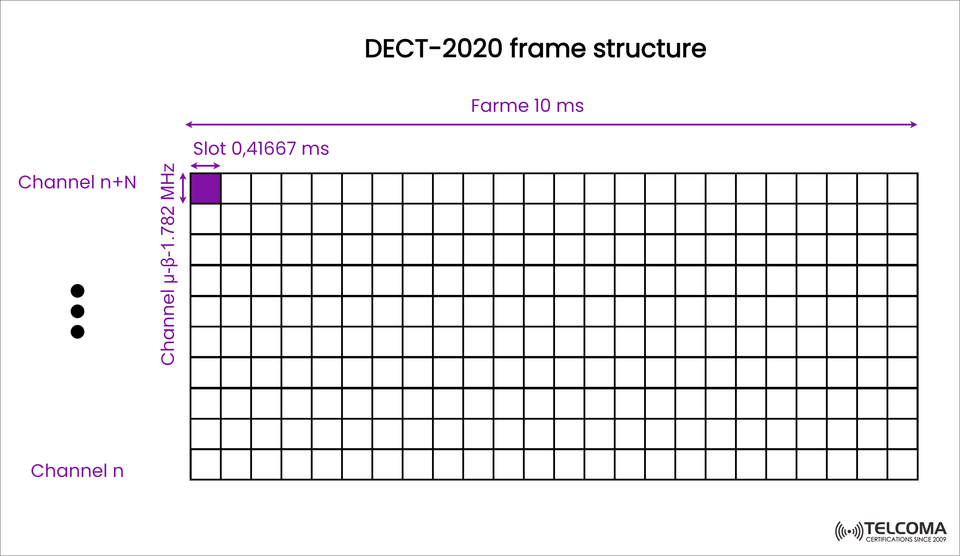
The image titled “DECT-2020 Frame Structure” clearly illustrates how DECT-2020 organizes its communication resources. It showcases the time division (slots) and frequency division (channels) within a frame, which are essential for ultra-reliable, low-latency communications (URLLC) and industrial IoT applications.
This article will delve into the frame structure, slot duration, and channel allocation depicted in the image, providing telecom professionals and engineers with insights into how DECT-2020 maximizes spectrum usage and timing for the networks of the future.
What is DECT-2020?
DECT-2020 NR is an open and standardized radio technology developed by the ETSI (European Telecommunications Standards Institute). It expands on traditional DECT technology by catering to massive IoT and industrial automation, ensuring reliable connectivity for both fixed and mobile devices.
Key Highlights of DECT-2020 NR:
Tailored for IoT, M2M, and industrial communication
Operates on unlicensed spectrum (1.9 GHz band)
Supports massive device connectivity
Offers low latency and high reliability
Accommodates both star and mesh topologies
Unlike cellular systems like LTE or 5G, DECT-2020 NR emphasizes decentralized coordination, enabling devices to act independently without constant oversight from a base station.
Breaking Down the Frame Structure (As Shown in the Image)
The image features a time-frequency grid that serves as the backbone for DECT-2020 transmissions.
Key Components in the Diagram:
Horizontal Axis – Time Dimension: The full frame length is 10 ms, which is divided into smaller 0.41667 ms slots. Each slot provides a transmission window for a device.
Vertical Axis – Frequency Dimension: Each channel covers 1.782 MHz, denoting the frequency allocation for a communication link. The diagram illustrates multiple channels, labeled from Channel n to Channel n + N, indicating that the system can utilize several channels at once.
Purple Highlight (Top-Left Corner): This block indicates one active slot within a designated channel and time, showing where actual transmission or reception takes place.
These axes combine to create a two-dimensional resource grid — the essential unit for scheduling and communication in DECT-2020 NR.
Frame and Slot Configuration
The DECT-2020 frame consists of defined time slots, ensuring reliable latency and synchronization across devices.
Parameter | Value | Description
Frame Duration | 10 ms | Total time for one communication frame
Slot Duration | 0.41667 ms | Smallest time unit within a frame
Number of Slots per Frame | 24 slots | 10 ms / 0.41667 ms = 24
Channel Bandwidth | 1.782 MHz | Bandwidth per frequency channel
Frequency Division | Multiple parallel channels | Channels can operate independently or be reused spatially
Each 10 ms frame comprises 24 sequential slots, which can be designated for uplink, downlink, or control based on the system setup.
Time Domain: Slot Structure
In DECT-2020, a slot is the fundamental time unit for sending or receiving packets. With a duration of 0.41667 ms, it allows for quick switching and precise scheduling.
Key Features of Each Slot:
Bidirectional Support: A slot can be used for either uplink (UL) or downlink (DL) transmission.
Short Duration: This ensures low-latency communication, which is vital for real-time industrial and IoT functions.
Multiple Symbols: Each slot usually carries several OFDM symbols, enhancing data efficiency.
Guard Periods: Brief timing gaps help prevent overlap between consecutive slots.
The brief slot duration promotes flexibility in resource allocation, letting DECT-2020 handle various traffic patterns — from continuous streams to sporadic IoT bursts.
Frequency Domain: Channel Configuration
On the frequency side, each DECT-2020 channel spans 1.782 MHz. The system supports several channels (marked from Channel n to Channel n + N), enabling frequency diversity and parallel operation.
Channel Organization:
Channels operate independently — each can cater to different devices or parts of a mesh network.
They can either be statically allocated (fixed per node) or dynamically selected (based on interference and demand).
Multiple channels boost capacity and allow for simultaneous communication among several users or clusters.
Benefits of a Multi-Channel Approach:
Higher throughput from parallel transmissions
Less interference through channel hopping or selection
Greater reliability from frequency diversity
This adaptability helps DECT-2020 function efficiently, even in dense and interference-heavy settings.
Time-Frequency Resource Grid
The merging of time (slots) and frequency (channels) results in a two-dimensional grid — the Time-Frequency Resource Grid.
This grid acts like a map for resource allocation, with each small rectangle (block) representing a resource element for communication.
Image Details:
The grid cells depict resource blocks.
The colored square illustrates an active transmission within one time slot and one channel.
Uncolored cells signify idle or unused resources.
The scheduler (whether centralized or distributed) decides which resource elements are assigned to each device, ensuring effective utilization and minimal collisions.
DECT-2020 vs. Traditional DECT
Feature | Traditional DECT | DECT-2020 NR
Standardization | Voice-centric (cordless phones) | IoT and data-centric
Frame Duration | 10 ms | 10 ms
Slot Duration | ~0.5 ms | 0.41667 ms
Bandwidth | 1.728 MHz | 1.782 MHz
Technology Type | TDMA | OFDM-based
Network Topology | Star (base station-centric) | Mesh, peer-to-peer
Use Cases | Voice communication | IoT, URLLC, industrial automation
This evolution illustrates how DECT-2020 builds on the framework of its predecessor, enhancing it with OFDM, mesh networking, and improved efficiency.
Benefits of the DECT-2020 Frame Structure
- Predictable Latency
Each frame and slot are timed consistently, allowing for reliable communication — perfect for industrial automation and mission-critical IoT.
- Efficient Spectrum Use
By splitting both time and frequency, DECT-2020 can handle a high user density with minimal interference, even in unlicensed bands.
- Flexible Resource Assignment
Slots can be allocated dynamically based on device importance or data load, ensuring scalable performance across varied scenarios.
- Energy Efficiency
Short transmission bursts within allocated slots cut down on active radio time, which is great for low-power IoT devices.
- Robustness
Utilizing multi-channel diversity and synchronized frames helps decrease packet loss and boost reliability in challenging RF settings.
Applications of DECT-2020 NR
The frame structure of DECT-2020 NR supports various applications:
Industrial IoT and automation
Smart grids and utilities
Factory robotics and process control
Private 5G alternatives
Smart city infrastructure
Wireless sensors and monitoring systems
Thanks to its precise frame timing and decentralized management, it's particularly suited for non-cellular, locally managed industrial networks.
Final Thoughts
The DECT-2020 frame structure represents a smart combination of time division and frequency allocation, enabling strong, low-latency communication in unlicensed frequency bands.
The image you provided captures the essence of this concept — a 10 ms frame split into 0.41667 ms slots across several 1.782 MHz channels, forming a flexible time-frequency grid.
By adopting this well-structured yet adaptable framework, DECT-2020 NR emerges as a powerful, open, and scalable solution for the industrial IoT era — balancing efficiency, reliability, and autonomy better than many wireless systems can.