
Understanding the Distributed Unit Functional Module in 5G Networks
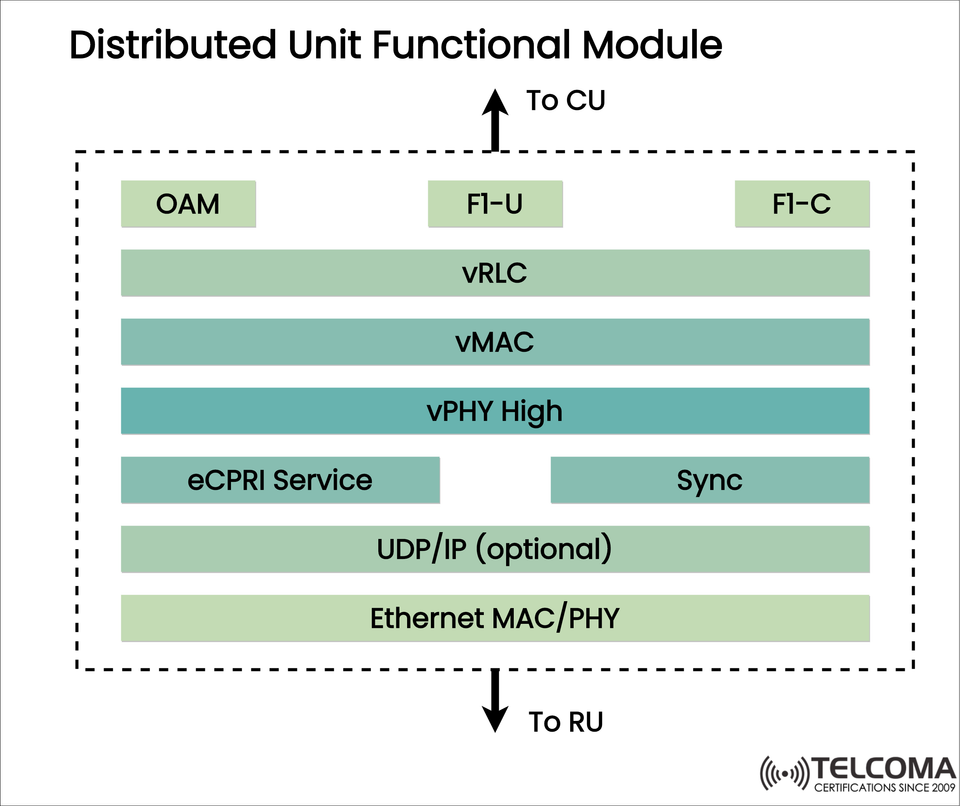

Delving into the Distributed Unit Functional Module in 5G RAN Architecture
5G networks will continue to evolve, and thus 5G architecture is being disaggregated to support the requirements of scale, flexibility and ultra-low latency. A Distributed Unit is a central part of this architecture - this blog post will unpack the Distributed Unit Functional Module, based on the visual decomposition identified, and demonstrate where it fits into the 5G Radio Access Network (RAN).
What is a Distributed Unit?
The 5G RAN includes a set of base station techniques divided into three logical entities:
Central Unit (CU) - Non-real time functions
Distributed Unit (DU) - Real time lower layer protocols
Radio Unit (RU) - Radio frequency functions
The DU is a layer between the CU and RU - a real time component completing Layer 2 functional processing and parts of Layer 1 functional processing only - this is what contributes to the low latency characteristics and optimal utilization on data processing.
Component Function
OAM Operations, Administration and Maintenance for DU management and control.
F1-U and F1-C Interfaces to the Central Unit for user plane (F1-U) and control plane (F1-C).
vRLC Virtual Radio Link Control layer - provides segmentation, reassembly and error correction.
vMAC Virtual Medium Access Control - performs scheduling and HARQ processing.
vPHY High High layer PHY - performs encoding, decoding, and MIMO processing.
eCPRI Service Provides enhanced CPRI protocol for the fronthaul from DU to RU.
Sync Provides time and frequency synchronization for receivers to sample signal accurately.
UDP/IP (Optional) Provides optional transport encapsulation using standard protocols.
Ethernet MAC/PHY Provides the physical and data link layers for Ethernet based transport.
Interface Connections
To CU (Central Unit):
The communication will occur over an interface called F1, which is separated into user plane (F1-U) and. control plane (F1-C) for performance and separation of concerns.
To RU (Radio Unit):
In this configuration the DU connects to the RW via eCPRI protocol that has been optimized for low-latency, high-throughput transport over Ethernet.
Experts Notes about DU Functions in 5G
If you're already familiar with telecom networks, here are some additional, technical notes on the different functional layers of the DU:
- L2/L1 Virtualized
The DU has both Layer 2 (L2) and part of Layer 1 (L1) implemented in a virtualized manner (denoted vRLC, vMAC, vPHY High). This allows:
Resource pooling in cloud-native or containerized environments.
Dynamic scaling accounting for traffic demand and radio conditions.
Multi-access Edge Computing (MEC) for compute close to the user.
- eCPRI Protocol
The addition of eCPRI service layer (Enhanced Common Public Radio Interface) provides
Fronthaul transport over Ethernet, rather than Traditional CPRI over Fibre.
Low transport latency by packet-based data flow.
Functional splitting support (e.g., Option 7.2x) used in O-RAN deployments.
- Synchronization (Sync)
Time and frequency sync are important in 5G NR, especially for:
TDD (Traffic Division Duplexing) operation.
Aligning massive MIMO, beamforming, and carrier aggregation.
IEEE 1588v2 PTP (Precision Time Protocol) is typically implemented to achieve this at the DU level.
- Optional UDP/IP Layer
Although not always required, the development of an optional UDP/ IP encapsulation layer enables:
More diverse options in supporting multi-vendor transport networks.
Compatibility with SDN/ NFV frameworks.
Integration with O-RAN Architecture
The DU is integrated nicely as an element of the O-RAN (Open Radio Access Network), which describes open interfaces and disaggregated elements. Also under an O-RAN scenario:
The DU communicates with the CU over the F1 interface (defined by 3GPP).
The DU communicates with the RU over the Open Fronthaul interface (Option 7.2x).
DU functions can be controlled via O1 interface for orchestration and lifecycle management.
KEY POINTS The DU is an intermediate node that is critical in a disaggregated 5G RAN.
It can virtualize the RLC, MAC and high PHY layers to achieve a smart balance of performance and flexibility.
It can use eCPRI and Ethernet to allow scalable deployments with maximum cost efficiency.
It can allow high-speed, low-latency networks where timing and transport layers are all properly synchronized.
ACTIONABLE ADVICE
If you are a telecom engineer, network architect or system integrator, the following actionable considerations to pursue:
- Read 3GPP TS 38.401 for approved specifications of the DU-CU split.
- Learn more about O-RAN opportunities.
Real-World Applications of the DU Functional Module
- Smart Cities
Examples in smart cities that require low latency include real-time applications such as traffic management, surveillance, and public safety applications and services like DUs that are deployed near (e.g. with RUs form a cluster) to RUs (i.e. on a light pole or micro data center), with their availability of getting traffic according to where RU is located, will require, in many of these deployments, will require a reduced backhaul to data centers. - Private 5G Networks for Enterprises
As factories, warehouses, and campuses begin to utilize on-premise DUs to manage their private 5G networks, government/corporate locations will require private networks with high security and local breakout/control to support very low latency real-time applications around robotics, AR/VR applications and autonomous transportation. - Urban 5G Small Cells
In highly dense urban areas, operators are deploying virtualized DUs on COTS (Commercial Off-The-Shelf) hardware to control multiple small cells (and where possible distinguish the DUs to optimize for various terrains), allowing the operator to reduced CAPEX/OPEX and service dynamic traffic as required. - Remote Coverage and Rural Deployment
Operators in most cases are deploying centralized DUs to manage multiple RUs dispersed in rural areas, and with a well designed fronthaul (e.g. using eCPRI), it is possible to provide 5G connectivity with very little investment in additional infrastructure.
Challenges of Deploying DUs)
Despite the advantages in deploying a DU, there are certain challenges regard the deployment of an effective DU so that it realizes its full potential. The possible challenges for the DU:
- Fronthaul constraints: there is a requirement of a low latency, high throughput link between the DU and RU. Fronthaul transport would need to be via fiber or some wireless transport that has been optimized for the transport of data.
- Synchronisation: High precision is very important using time synchronisation to avoid inter-cell interference and in most cases without the high precision of synchronisation you would not be able to support mobility at speed.