
Understanding the Generic 5G Architecture: Core Elements and Network Slicing
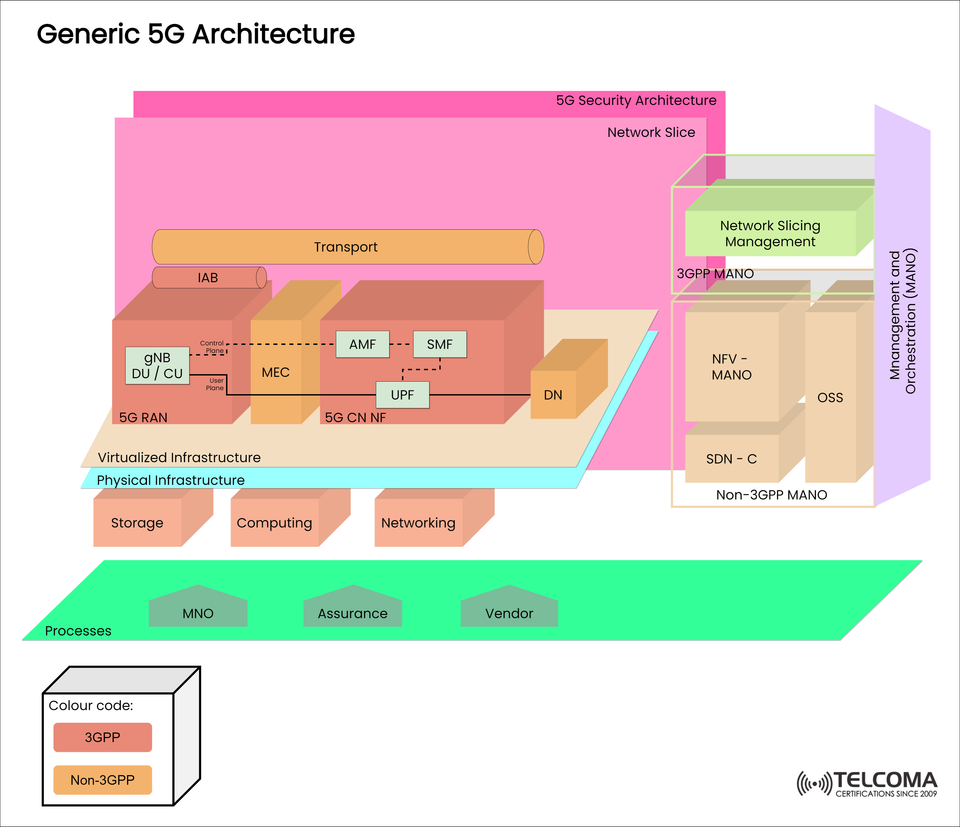

📡 Understanding the Generic 5G Architecture from RAN to Slicing
The transition to 5G represents both a modular and highly virtualised network architecture, designed to allow for ultra-low latency, massive IoT, and enhanced mobile broadband (eMBB). In this post, we will break down the Generic 5G Architecture diagram and explain how each of the components of the Generic 5G Architecture will contribute to the overall performance, flexibility, and scalability of the network.
🧱 5G Architecture Components
The generic 5G architecture shown in the image illustrates a 5G system with 4 layers: RAN, transport, core, and orchestration; separated by 3GPP and non-3GPP domains.
🔶 5G RADIO ACCESS NETWORK
gNB (gNodeB): The gNB has both the Central Unit (CU) and the Distributed Unit (DU).
IAB (Integrated Access and Backhaul): This method enables coverage to be extended by combining the access and transport through the air interface.
MEC (Multi-access Edge Computing): Compute and storage that is closer to the users will allow for lower latency in applications.
🔶 5G CORE NETWORK (5G CN NF)
AMF (Access and Mobility Management Function) - Connects the user and manages mobility.
SMF (Session Management Function) - Manages the setup of sessions and IP allocation.
UPF (User Plane Function) - The user traffic processing function; separates the control and user plane.
DN (Data Network) - External data networks such as the Internet or enterprise clouds.
🌐 Transport and Infrastructure Layers
📡 Transport - High-speed transport links allowing data to move between the RAN, MEC, slin the core.
🧱 Virtual and Physical Infrastructure
Virtualized Layer: Software-based implementation of network functions.
Physical Layer: The hardware's foundation—storage, compute, and networking equipment.
🧩 Network Slicing and Management
🧭 Network Slicing
Allows for multiple virtual networks to exist over a common physical infrastructure.
Each slice is separate and tailored to specific use-cases (for example IoT, URLLC).
🛠️ Management & Orchestration (MANO)
🟨 3GPP MANO
Network Slicing Management and basic orchestration conforming to 3GPP specifications.
🟫 Non-3GPP MANO
Includes:
NFV-MANO: Orchestration of virtual functions (ETSI defined)
SDN Controller (SDN-C): Manages programmability of the network.
OSS (Operations Support System): The traditional form of telecommunications service management.
🔁 Integrated Processes and Stakeholders
At the bottom of the architecture:
MNO (Mobile Network Operator): Owns and operates the network.
Vendor: Provides network hardware and/or software solutions.
Assurance: Guaranteeing user reliability, performance and meeting SLA.
🗂️ Summary Table: Key Elements
Layer Components Description
RAN gNB, DU/CU, IAB Radio interface and edge access
Transport High-speed backhaul Connect RAN to Core network.
Core AMF, SMF, UPF, DN Central Management and data layers.
MEC Edge computing Reduced latency/services for URLLC
Slicing Slice Mgmt, MANO Logical partitioning for services
Infra Virtual & Physical Cloud-native deployment layer
Mgmt OSS, SDN-C Automation and control of network.
🧠 Conclusion: The Importance of Generic 5G Architecture
The generic 5G architecture defines future networks as service-oriented, scalable, and flexible. Using virtualized infrastructure, disaggregated components, and automated orchestration, operators can provide tailored services, limit costs, and ensure performance, location and end user experience for many 5G initiatives - AR/VR, autonomous, etc.
The layered and standardized design allows interoperability between 3GPP functions and orchestration of non-3GPP orchestration solutions, making 5G a truly end-to-end service platform.
🚀 Use Cases Driven by the Generic 5G Architecture
The flexibly structured and modular options for the generic 5G architecture make it valuable for many mission-critical and high-performance applications:
- Enhanced Mobile Broadband (eMBB)
Fast and efficient connectivity for smartphones, AR/VR devices, and streaming of 4K/8K content.
Ability to use MEC and UPF placement to improve content delivery.
- Ultra-Reliable Low Latency Communications (URLLC)
Facilitating remote surgeries, autonomous driving, and industrial robotics.
MEC and dedicated slicing reduces latency and enhances reliability.
- Massive Machine-Type Communications (mMTC)
Supports billions of devices using IoT, (smart meters, agriculture sensors, xxx).
5G Core better coordinates these devices using slicing in slice cases where slice latency and slice bandwidth must be different.
🧩 Advantages of Modular 5G Architecture
The architecture's design fosters operational agility, scalability, and business innovation. A few of the benefits are:
✅ Network Slicing Flexibility: Multiple service types can run on a single infrastructure.
✅ Cloud-Native Deployment: time to market and scalability improves.
✅ Vendor-Neutral Interoperability: open standards allow 3GPP and non-3GPP components to be mixed and matched.
✅ Edge-Enabled Capability: MEC allows for the processing of local content and delivers low-latency services.
✅ Service-Based Architecture (SBA): use of modular reusable services for each network function.
🛡️ Security and Governance for 5G Architecture
Security is embedded in:
5G Security Architecture Overlay: for protection against unauthorized network slice access, user identify theft and session integrity.
Policy-based Control with SDN and MANO: real-time monitoring and adapting to network events.
Segmentation with Virtualization: breach impact can be limited using micro-segmentation and secure multitenancy.
📘 Best Practices for Telecom Operators
For an operator to realize the architecture benefits in full, they should all aim to:
🔍 Invest in AI/ML based orchestration to future-proof SLAs.
🧩 Design custom slices for each enterprise vertical (e.g. Manufacturing, Healthcare).
☁️ Adopt cloud-native principles when deploying CNFs (Cloud-native Network Functions).
📊 Monitor resource and service performance continually through OSS ande NFV-MANO.
🔐 Adopt zero-trust models across access, transport and core.
🔚 Conclusion:
Shaping the Future of Networks -
The generic 5G architecture serves as more than just a reference; it represents a framework for operators to use to build networks that are intelligent, flexible, and service based. Its layered approach allows for efficient integration of radio access, core, virtual infrastructure, and orchestration systems, with the expectation of accommodating future developments in areas such as 6G, AI-native networking, and quantum communications.
By implementing and articulating this architecture effectively, telecom professionals and network designers can be on the forefront of providing secure, scalable, and user-oriented 5G solutions across the planet.