
Understanding the IMS Core Network Architecture: Key Components and Functional Flow Explained

Getting to Know the IMS Core Network Architecture: A Look at Key Components and How They Work
The IP Multimedia Subsystem (IMS) is essentially the backbone of today's telecom networks, allowing for voice, video, and data services over IP infrastructure. As the industry shifts towards 5G and an all-IP setup, IMS is crucial for supporting VoLTE (Voice over LTE), VoWiFi, Rich Communication Services (RCS), and a range of multimedia applications.
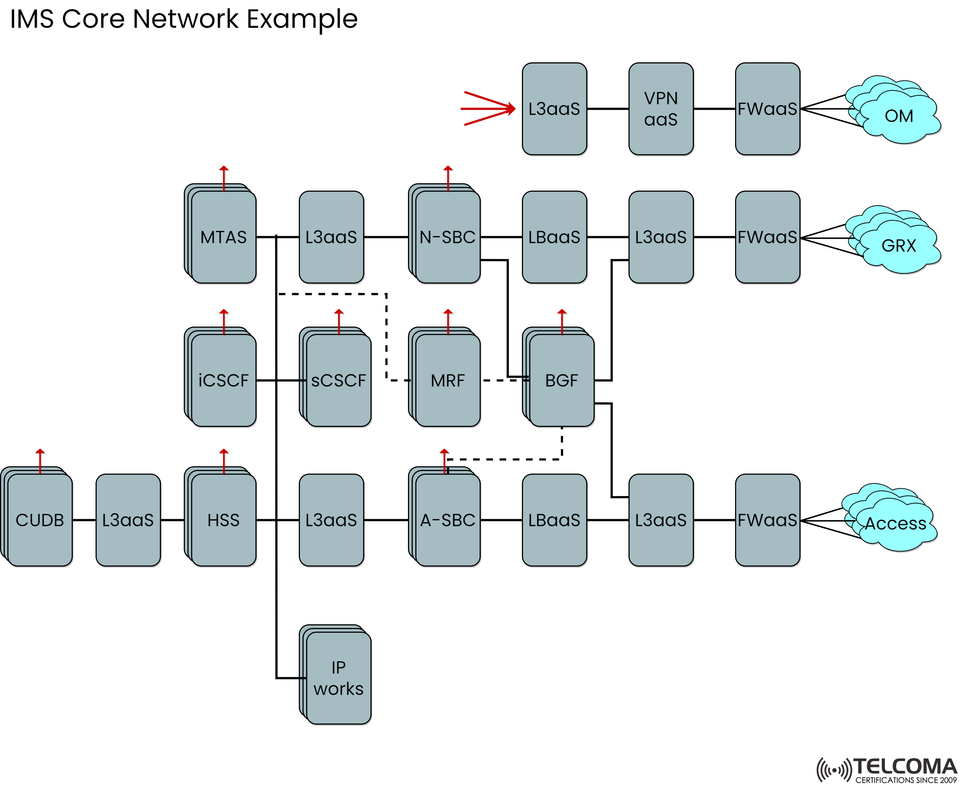
The uploaded diagram illustrates a clear example of an IMS Core Network, highlighting how various components interact—from signaling and control to session management and security. Let’s dive into how IMS operates, the specific roles of its elements, and how it connects with access and external networks.
What exactly is IMS?
The IMS (IP Multimedia Subsystem) is a standardized architecture put forth by the 3GPP (3rd Generation Partnership Project) designed for delivering IP-based multimedia services.
It does this by separating control and media planes, which allows service providers to:
Manage user sessions and identities from a central point.
Offer converged services like voice, video, and messaging.
Ensure that mobile, fixed, and Wi-Fi networks can work together seamlessly.
IMS is vital for technologies such as VoLTE, VoNR (Voice over New Radio), and its integration with 5G Core.
Main Layers of IMS Architecture
The IMS Core Network can be broken down into three primary layers:
Layer Function Access Layer: This layer connects users to the IMS network through LTE, Wi-Fi, or fixed broadband.
Control Layer: This one takes care of session control, signaling, and policy management via CSCF and SBC.
Application & Service Layer: This layer is where application servers and multimedia functions like MTAS and MRF are located.
The diagram pulls these layers together and shows how they connect through critical IMS components, including CSCFs, SBCs, and BGFs.
Components of the IMS Core Network (Based on the Diagram)
The IMS structure comprises various functional entities that work together to deliver services from end-to-end. Let’s break these down based on the uploaded image.
A. CSCF – Call Session Control Functions
These functions are essentially the brains of IMS signaling control. The diagram depicts three types of CSCFs: P-CSCF, I-CSCF, and S-CSCF (shown as iCSCF and sCSCF).
P-CSCF (Proxy-CSCF):
First contact point for user equipment (UE).
Routes SIP messages to the IMS network.
Implements security (IPSec) and QoS policies.
I-CSCF (Interrogating-CSCF):
Acts as a point of contact within an operator’s network for external connections.
Queries the HSS to locate the user’s assigned S-CSCF.
S-CSCF (Serving-CSCF):
The core session control entity.
Registers users, keeps track of their session states, and connects with application servers like MTAS.
Together, these CSCFs create the signaling backbone of the IMS core.
B. SBC – Session Border Controller
In the illustration, SBC is represented as A-SBC (Access SBC) and N-SBC (Network SBC).
A-SBC: This protects the network from threats that may come from the access side (like from subscribers).
N-SBC: It manages connections with other service providers or external networks.
SBCs also handle media anchoring, NAT traversal, and topology hiding, ensuring that media flows securely and efficiently.
C. MRF – Media Resource Function
The MRF takes care of media-related processing tasks such as:
Playing announcements.
Mixing audio for conference calls.
Transcoding between different codecs.
In the diagram, MRF connects to the BGF (Border Gateway Function), which manages and routes media streams.
D. HSS – Home Subscriber Server
The HSS is a crucial database holding user profiles, authentication information, and subscription details.
It primarily interacts with the S-CSCF and iCSCF to:
Authenticate users when they register.
Provide routing information.
Store IMS identities and service preferences.
E. MTAS – Multimedia Telephony Application Server
The MTAS delivers telephony services like call forwarding, call waiting, and conferencing over IP networks.
It connects with the S-CSCF to provide additional services, acting as a service enabler for VoLTE and VoWiFi.
F. CUDb – Centralized User Database
The CUDb is there to support data storage for subscribers and service-related information. It often complements HSS for data used by various IMS services that don’t require authentication.
G. BGF – Border Gateway Function
The BGF acts as a control point for media streams at the borders of networks. It works with both MRF and SBC to enforce policies, handle NAT, and manage quality of service (QoS).
H. IP Works
This section represents the IP core backbone, which provides connectivity, routing, and IP addressing for all IMS components. It ensures that IP packets are transported efficiently between IMS entities and external networks.
I. Supporting Network Services
The image also highlights several “as-a-Service” components that illustrate modern cloud-based network functions:
L3aaS (Layer 3 as a Service): This offers virtualized layer-3 networking for routing, segmentation, and traffic management.
LBaaS (Load Balancer as a Service): This evenly distributes signaling and media loads across IMS components for scalability.
FWaaS (Firewall as a Service): This provides virtualized security functions at various entry and exit points (Access, GRX, OM).
VPNaaS: This allows for secure connections for operations or management systems.
These cloud-native services make the IMS architecture modular, scalable, and cloud-compatible—fitting in nicely with the industry's shift toward Network Function Virtualization (NFV) and Cloud-Native Network Functions (CNFs).
External Interfaces and Connectivity of IMS
The diagram also points out three main external cloud interfaces:
Access Cloud: It connects users through LTE, Wi-Fi, or 5G NR.
GRX (GPRS Roaming Exchange): This manages roaming connections between different mobile operators.
OM (Operations & Management): It handles network monitoring, analytics, and management through layers like VPNaaS and FWaaS.
Each of these interfaces is secured and managed via L3aaS, VPNaaS, and FWaaS, which helps optimize security and performance across the board.
Overview of IMS Functional Flow
Here’s a simplified breakdown of how IMS processes a VoLTE or IP call:
Registration:
UE connects through Access Network → A-SBC → P-CSCF → I-CSCF → HSS → S-CSCF.
Users get authenticated and session parameters are established.
Session Establishment:
SIP INVITE is sent through CSCFs.
Media resources are allocated via MRF and directed by BGF.
Media Transfer:
RTP streams flow through SBC and BGF to ensure quality and security.
Service Control:
MTAS and application servers handle additional features (like call hold and transfer).
Termination or Roaming:
The session concludes or transitions via GRX for roaming.
Advantages of a Cloud-Based IMS
Shifting IMS to a cloud-native architecture (as shown by L3aaS, FWaaS, and LBaaS in the diagram) brings several benefits:
Scalability: It allows for elastic scaling during high traffic times.
Resilience: Microservices-based redundancy helps to maintain uptime.
Automation: This integrates with CI/CD pipelines for quick deployment.
Cost Efficiency: There's less dependency on hardware because of NFV.
Interoperability: It allows smooth integration with 5G Core (5GC) and edge computing.
In Conclusion
The IMS Core Network is still the backbone of IP-based communication in modern telecom systems. As illustrated in the diagram, its intelligent architecture—spanning from CSCFs and SBCs to cloud-native services like L3aaS and FWaaS—ensures reliable, safe, and scalable delivery of multimedia services.
With the ongoing advancements in 5G, VoNR, and edge computing, IMS is evolving into a fully cloud-native environment, blending the reliability of traditional telecom with the agility of modern IT.
For those working in telecom, grasping how IMS functions is essential for navigating next-generation voice and multimedia service delivery—this is what lays the foundation for a connected, converged digital future.