
Understanding the Long Preamble Packet Type in Wireless Communication Systems

Long Preamble Packet Type Explained: The Backbone of Reliable Wireless Communication
In any wireless communication setup, having timing synchronization, channel estimation, and data integrity are crucial for keeping the link reliable. One of the key elements that help make these processes possible is the preamble.
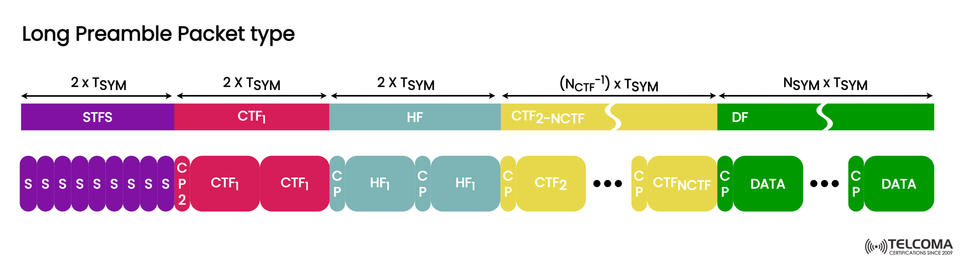
The image labeled “Long Preamble Packet Type” dives into how the Long Preamble Packet is built within an OFDM-based system — highlighting various fields like STFS, CTF, HF, and DF. Each part is essential for ensuring smooth communication between transmitters and receivers, even when the conditions are noisy or complex.
This article breaks down the structure, timing, and purpose of each field within the long preamble, shedding light on how it enables strong wireless transmission across modern standards like Wi-Fi, 5G, and DECT-2020 NR.
What is a Long Preamble Packet Type?
A preamble is basically a set sequence of symbols that gets sent out before the actual data payload. It's there to help the receiver:
Spot the beginning of a packet,
Gauge channel conditions,
Get time and frequency synchronized.
The Long Preamble Packet Type comes into play when there's a need for more precise channel estimation and synchronization — usually in scenarios involving high mobility or high interference.
To put it simply, the long preamble makes sure that the receiver can accurately “lock onto” the incoming signal, even when the transmission conditions are tough.
Understanding the Image: Structure of a Long Preamble Packet
The image shows the time-domain structure of a Long Preamble Packet, broken down into several fields that each serve different roles. The duration of each field is given as a multiple of the symbol period (TSYM).
The Major Components Shown:
STFS – Short Training Field Sequence (2 × TSYM)
CTF₁ – Channel Training Field 1 (2 × TSYM)
HF – Header Field (2 × TSYM)
CTF₂–NCTF – Channel Training Fields (NCTF × TSYM)
DF – Data Field (NSYM × TSYM)
Every field has cyclic prefixes (CP) to help deal with inter-symbol interference (ISI) and keep the orthogonality between OFDM symbols.
Field-by-Field Breakdown of the Long Preamble Packet
- STFS (Short Training Field Sequence)
Duration: 2 × TSYM
Purpose: For signal detection, AGC (Automatic Gain Control), and coarse time synchronization.
Explanation: The STFS is made up of short repetitive sequences that allow the receiver to spot the start of a new frame. It also helps estimate the carrier frequency offset (CFO), which is a critical step in OFDM systems for making sure subcarrier alignment is spot on.
Key Functions:
Identifies when a packet arrives
Adjusts the receiver’s gain automatically
Performs initial timing correction
- CTF₁ (Channel Training Field 1)
Duration: 2 × TSYM
Purpose: For fine synchronization and initial channel estimation.
Explanation: CTF₁ features known pilot symbols that help measure the channel response at each subcarrier. This data allows the receiver to balance the channel and compensate for things like multipath fading or frequency selectivity.
Key Functions:
Enables precise correction of time/frequency offsets
Estimates the wireless channel's impulse response
- HF (Header Field)
Duration: 2 × TSYM
Purpose: To provide packet control information.
Explanation: The header includes important metadata such as modulation type, coding rate, packet length, and transmission mode. It helps the receiver understand the information that follows correctly.
Key Functions:
Identifies transmission parameters
Defines modulation and coding settings
Ensures compatibility and decoding accuracy
- DF (Data Field)
Duration: NSYM × TSYM
Purpose: Contains the actual payload data.
Explanation: Once synchronization and channel estimation are done, the DF sends out user data. Each OFDM symbol is preceded by a cyclic prefix (CP) to guard against multipath interference.
Key Functions:
Sends encoded user information
Maintains orthogonality using cyclic prefixes
Allows for high data throughput
Timing and Symbol Structure
The symbol time (TSYM) is the basic time unit for expressing durations in the diagram. The length of each field is a multiple of TSYM, which provides deterministic timing and frame synchronization.
Symbol Timing in the Long Preamble:
Field Duration (in TSYM) Primary Function
STFS 2 × TSYM Coarse synchronization
CTF₁ 2 × TSYM Fine channel estimation
HF 2 × TSYM Header and control info
CTF₂–NCTF (NCTF−1) × TSYM Ongoing channel tracking
DF NSYM × TSYM Data transmission
Why Use a Long Preamble Instead of a Short One?
Long preambles are picked when having reliable communication is more important than being efficient. Although short preambles allow for quicker transmission starts, they don't offer the same level of accuracy in synchronization and channel estimation.
Advantages of Long Preambles:
Better accuracy for channel estimation
Greater resilience in high noise or interference
Reliable synchronization in settings with multipath
Vital for longer packets or high-mobility situations
Trade-Offs:
A bit more overhead (longer preamble duration)
Lower spectral efficiency for quick data bursts
Still, in scenarios like industrial IoT, vehicular communications, or long-range wireless systems, this trade-off makes sense for achieving better link stability and packet reliability.
Real-World Applications of Long Preamble Packet Types
Long preambles are key in various OFDM-based wireless systems, such as:
Wi-Fi (IEEE 802.11 family): Utilized for long training fields (LTF) and short training fields (STF).
5G NR and LTE: Preambles are essential in synchronization signals and random access channels.
DECT-2020 NR: Used for improved synchronization and channel tracking within IoT mesh networks.
IEEE 802.15.4g/e: In smart grid and industrial sensor networks.
These systems all rely on the same fundamental idea — accurate synchronization and channel estimation ahead of transmitting the actual data.
Benefits of the Long Preamble Packet Type
Accurate Synchronization: This allows for precise alignment of symbol boundaries for decoding.
Reliable Channel Estimation: It guarantees the receiver can effectively equalize multipath fading.
Dynamic Channel Tracking: Keeps performance up over time with periodic training fields.
Robust Data Transmission: Reduces bit errors, even when conditions are fast-fading or highly interfered.
Flexibility Across Standards: The same principles hold across Wi-Fi, DECT-2020, and other OFDM-based technologies.
Conclusion
The Long Preamble Packet Type is essential for ensuring reliable wireless communication. As the image shows, it starts with training and synchronization fields (STFS and CTF), moves onto a header field (HF), includes channel tracking fields (CTF₂–NCTF), and wraps up with the data field (DF).
This well-organized preamble makes sure the receiver can synchronize, estimate, and decode the transmitted data accurately, even when the conditions are tough.
In a landscape where low latency, high reliability, and massive connectivity define the next-gen networks, getting a handle on preamble structures like this one is key for both wireless engineers and telecom innovators.