
Understanding the MEC-in-NFV Reference Architecture: Integration for Next-Gen Telecom Networks
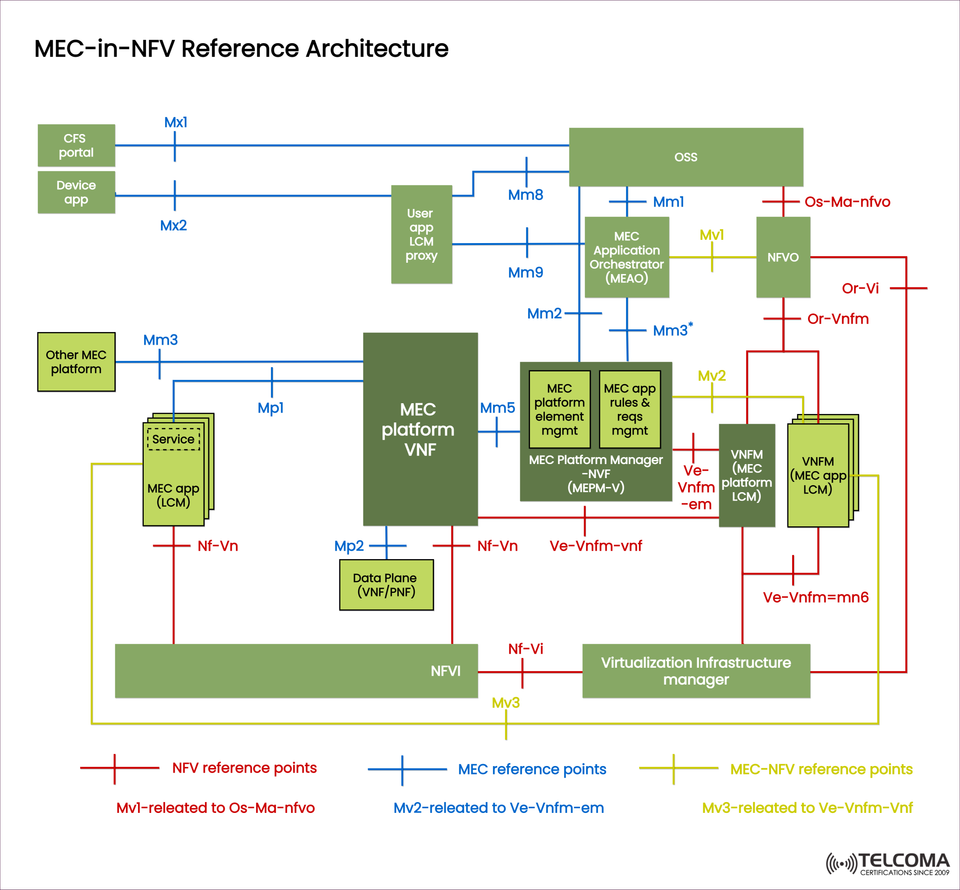

MEC-in-NFV Reference Architecture: The Backbone of Future Telecom Networks
The shift toward distributed, cloud-native, and virtualized architectures has been fueled by the development of 5G and beyond. A key player in this transformation is MEC-in-NFV, which combines Multi-access Edge Computing (MEC) and Network Functions Virtualization (NFV).
This blog will break down the MEC-in-NFV Reference Architecture using the diagram that’s been uploaded, illustrating how these two technologies collaborate to enhance network performance, boost scalability, and provide real-time, low-latency services.
What’s MEC-in-NFV?
Before we get into the architecture details, let’s clarify what MEC (Multi-access Edge Computing) and NFV (Network Function Virtualization) bring to the table.
MEC shifts computing and storage capabilities closer to users, installing resources at the network edge. This setup enables extremely low latency and high-performance applications.
NFV takes traditional network functions – think firewalls, load balancers, or EPC (Evolved Packet Core) – and virtualizes them, allowing them to run as software on standard hardware, which enhances flexibility and scalability.
MEC-in-NFV means incorporating MEC capabilities as Virtualized Network Functions (VNFs) within the NFV setup. This blend lets telecom operators run edge applications on the same infrastructure as their virtualized network functions, making operations and resource management much more straightforward.
Architecture Overview
The uploaded diagram offers a high-level perspective of the MEC-in-NFV Reference Architecture, showcasing how the MEC and NFV components interact via standardized interfaces and reference points.
The main components include:
MEC Platform VNF
MEC Platform Manager (MEPM-V)
MEC Application Orchestrator (MEAO)
Virtual Network Function Manager (VNFM)
NFV Orchestrator (NFVO)
Virtualization Infrastructure Manager (VIM)
Operations Support System (OSS)
User Applications and Device Components
Each of these elements is vital for managing the lifecycle, orchestration, and resource allocation for MEC services hosted on a virtualized NFV infrastructure.
Core Components Breakdown
- MEC Platform VNF
The MEC Platform operates as a VNF (Virtual Network Function), allowing it to run on shared NFV infrastructure. Its offerings include:
Service APIs for MEC applications
Traffic routing and DNS management
Application rules and requirements management
Virtualization facilitates dynamic instantiation, scaling, and termination of MEC services, just like other VNFs.
- MEC Platform Manager (MEPM-V)
The MEC Platform Manager, or MEPM-V, is in charge of managing the lifecycle of MEC platform VNFs and their associated applications.
It encompasses:
MEC Platform Element Management (Mgmt): Handles configuration and fault management of MEC elements.
MEC App Rules & Requirements Management: Ensures applications adhere to network policies and resource necessities.
These functions link with the VNFM (Virtual Network Function Manager) and NFVO for seamless deployment and updates in the NFV environment.
- MEC Application Orchestrator (MEAO)
The MEAO orchestrates MEC applications across various distributed edge locations. It works with:
The OSS for managing operations.
The NFVO for coordinating network functions.
The MEPM-V for managing the lifecycle of both applications and MEC platforms.
Through its orchestration, the MEAO optimizes resource usage while providing low-latency services.
- Virtual Network Function Manager (VNFM)
The VNFM oversees the lifecycle of VNFs, which includes:
MEC platform VNF
MEC application VNFs
It collaborates with NFVO using Or-Vnfm reference points and communicates with MEPM-V via Ve-Vnfm-em interfaces to carry out management tasks.
In essence, the VNFM connects MEC platform orchestration and NFV resource management.
- NFV Orchestrator (NFVO)
Functioning at the system level, the NFVO serves as the main orchestration unit, managing:
VNF lifecycles (instantiation, scaling, and termination)
Resource coordination between data centers and edge sites
Interactions with OSS/BSS systems for policy-driven automation
It communicates using the Os-Ma-nfvo interface with the OSS and the Or-Vnfm interface with the VNFM.
- Virtualization Infrastructure Manager (VIM)
The VIM supervises the NFV Infrastructure (NFVI), controlling compute, storage, and network resources. It ensures that resources are available for both VNFs and MEC applications, connecting through:
Nf-Vi (NFV interface)
Mv3 (MEC-NFV interface)
In the context of MEC-in-NFV, the VIM is crucial for dynamically allocating virtual resources to meet latency and performance demands.
- Operations Support System (OSS)
The OSS manages network operations, service assurance, and orchestration workflows overall. It interacts with:
NFVO for orchestration information
MEAO for managing the lifecycle of MEC services
Using the Os-Ma-nfvo interface, OSS provides visibility and automation for services spanning both edge and core environments.
- User Applications and Device Components
On the user side:
Device apps and CFS (Customer-Facing Service) portals connect to the MEC platform via Mx1 and Mx2 reference points.
The User App LCM Proxy enables communication for application lifecycle management between devices and orchestration elements.
This setup makes real-time edge applications possible, such as AR/VR, IoT analytics, and autonomous systems.
Reference Points and Interfaces
The architecture includes three sets of reference points, color-coded in the diagram:
Color Type Purpose Red NFV Reference Points Standard NFV interfaces connecting the NFVO, VNFM, and VIM. Blue MEC Reference Points Facilitate communication among MEC components and external systems. Yellow MEC-NFV Reference Points Integration interfaces between MEC and NFV management layers.
Key Interfaces:
Mvi (Yellow): Connects OSS to NFVO.
Mv2: Links MEPM-V with VNFM for coordination.
Mv3: Supports interaction between NFVI and MEC components.
Ve-Vn fm-em: Establishes management connectivity between MEPM-V and VNFM.
Mm5, Mm8, Mm9: Used for managing and orchestrating the MEC platform.
These standard reference points guarantee smooth interoperability and reliable communication across both MEC and NFV layers.
Data and Control Flow Summary
User requests come from device applications or CFS portals.
The MEC Platform VNF processes these requests, routing data locally to cut down on latency.
MEAO and MEPM-V dynamically manage and orchestrate MEC apps and platforms.
The VNFM carries out lifecycle commands it receives from orchestrators.
The NFVO allocates virtual resources via the VIM, optimizing infrastructure use.
The OSS provides central monitoring and service assurance across the network.
This process ensures automated deployment and scaling of MEC applications within a virtualized framework.
Benefits of MEC-in-NFV Integration
- Unified Infrastructure
Bridges MEC and NFV environments, cutting down on duplication and simplifying resource management.
- Enhanced Scalability
Virtualized functions permit on-demand scaling across various edge locations.
- Automation and Orchestration
Centralized lifecycle management via NFVO and MEAO ensures zero-touch provisioning and agile orchestration.
- Cost and Energy Efficiency
A shared infrastructure and pooled resources lead to lower CAPEX and OPEX for operators.
- Low Latency and Edge Intelligence
Embedding MEC applications within NFV minimizes data travel, which is critical for real-time applications like AR/VR, IoT, and autonomous vehicles.
Conclusion
The MEC-in-NFV Reference Architecture symbolizes the merging of two groundbreaking technologies — edge computing and network virtualization. By integrating MEC functionalities into the NFV framework, telecom operators can construct scalable, agile, and intelligent networks that are primed for 5G and beyond.
This integration not only simplifies operations but also paves the way for innovative edge services, enabling a genuinely interconnected and responsive digital landscape.