
Understanding the NDL Architectural Context in Modern Telecom Networks

Understanding the Architectural Context for NDL: A Critical Component of Modern Telecom Network Design
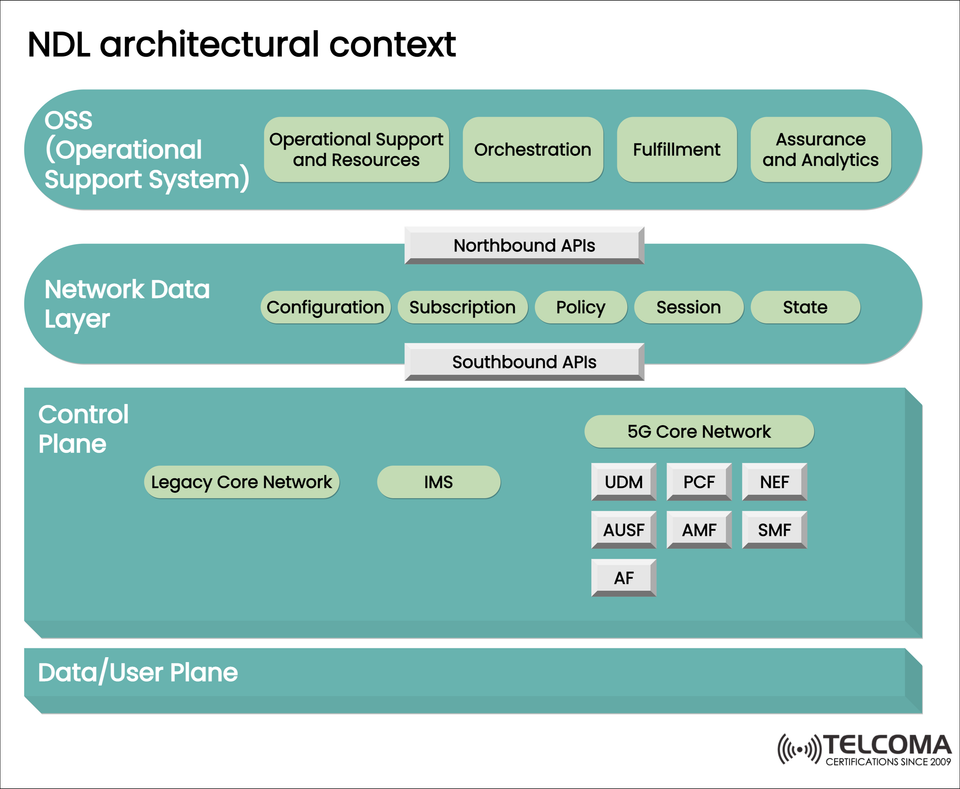
As networks evolve to support software-defined, cloud-native sets of technologies, the NDL (Network Data Layer) is a central component for connecting operational support systems (OSS) with network control elements. The architectural diagram above presents the layers of telecom systems; the NDL provides the ability to compose OSS, control plane, and data/user plane as it standardizes APIs and establishes data domains.
In this blog, we will unpack each layer within the NDL architectural context to support network architects, telecom engineers and digital transformation leaders in understanding its role, and how it contributes to agile, scalable and intelligent network operations.
The NDL Architectural Overview
The NDL acts as the central nervous system of the telecom network providing a single layer for network data access and control. NDL makes data that is in real-time from the network available to OSS tools and orchestration layers through Northbound APIs, and also communicates with the network control functions through Southbound APIs.
Key Architectural Layers
- OSS (Operational Support System) Layer
This layer enables network operations, provisioning, and monitoring.
Key Functions:
Operational Support and Resources: Ability to manage infrastructure and network assets.
Orchestration: Automation of service environment creation and lifecycle management.
- Network Data Layer (NDL)
The NDL is a middleware layer between OSS and network functions. The NDL is the layer that provides a data federation and access layer and abstracts all the underlying complexity from OSS, thus enabling the necessary service development agility.
Data Domains in the NDL:
Configuration: Contains the device and configuration data to set up the network.
Subscription: Contains the entitlements for the network from the user to service level.
Policy: The rules that define how the network behaves (e.g., QoS, slicing).
Session: Connection states are for users and devices.
State: Shows real-time state and historical states of the various network elements.
API Exposure:
Northbound APIs: APIs that are used for interacting with OSS, orchestration software, and analytic tools.
Southbound APIs: APIs used to interact with the underlying network control layer (5G or legacies).
Value: Provides separation between OSS and underlying infrastructure to deliver development agility and modularity.
- Control Plane
This layer contains the core of the network functions required to make and/or signal decisions within either a legacy network or a 5G network.
Data Domains:
Network Type Control Plane Elements
Legacy Core Legacy Control Entities
IMS IP Multimedia Subsystem
5G Core UDM, PCF, NEF, AUSF, AMF, SMF, AF
Functions of the 5G Core Elements:
UDM: Unified Data Management
PCF: Policy Control Function
NEF: Network Exposure Function
AUSF: Authentication Server Function
AMF: Access and Mobility Management
SMF: Session Management Function
AF: Application Function
Data/User Plane
While this layer is not detailed in the diagram, the data/user plane is responsible for the actual transmission of data between endpoints (e.g. mobile device, base station, or internet service). It is capable of ensuring maximum speed, maximum throughput, and QoS (quality of service), while following the control plane.
Why NDL is an Important Concept in 5g+ Development
NDL is architected to support and serve the cloud-native, disaggregated, and service- based architecture of 5G and the prospective 6G.
Benefits of NDL:
Data- we need to ease the access to real-time network state and user data from a single source.
Agility- we need to enable dynamic orchestration and slicing for enterprise services.
Interoperability- we need to facilitate integration with multi-vendor systems.
Automation-ready- we need to facilitate zero touch provisioning and closed-loop automation.
Summary Table of NDL Architectural Context
Layer Primary Role Interfaces
OSS Network/service lifecycle operations Northbound APIs
Network Data Layer Data abstraction and control Northbound & Southbound
Control Plane Network logic, signaling, policies Southbound APIs
Data/User Plane Packet forwarding and transport Directed by the control plane
Conclusion: NDL is a Foundational Layer in Intelligent Networks
The NDL architectural context outlines the patterns of a modular, API-driven telecom network that can adapt to the speed and complexity of telecommunications requirements in meeting connectivity needs. As a data-centric integration layer, NDL focuses on OSS as a platform.
Real-life Use of the NDL Architecture
Telecom operators today are embarking on a digital transformation journey toward hyper-automation, AI/ML driven enterprise operations, and real-time service delivery. As a uniform information backbone to support intelligent decision-making, the NDL architecture supports these enterprise visions.
Examples of Where NDL Supports Use Cases:
5G Network Slicing: Support for real-time policy control and user state awareness for delivering active slices (e.g., smart factory, autonomous vehicles).
Closed Loop Automation: OSS uses network state and session data provided through its northbound APIs to automatically initiate healing, scaling and optimization processes.
Multi-Access Edge Computing (MEC): NDL enables distributed service intelligence at the edge by synchronizing policy and state data with local control elements.
Customer Experience Management (CEM): Assurance/analytics functions leverage session/state data provided via NDL to monitor customer experiences and invoke SLAs proactively in real-time.
NDL’s Role to Enable Open & Disaggregated Networks
Operators want to adopt Open RAN, virtualized network functions (VNFs), and disaggregated core networks. With all this complexity, interoperability is a necessity.
NDL acts as a data and API abstraction layer, decoupling OSS/BSS systems from network hardware. This decoupling will provide real value with respect to:
Supporting vendor-neutral integration
Rapidly deploying features
Accelerating time-to-market for new services
Strategic Use-Cases for Telco Professionals
These are the points of emphasis for telco executives, practitioners and specialists.
📌 For Network Architects:
Confirm that you NDL supports horizontal/vertical-scale and data federation among public cloud, private cloud, hybrid cloud and multi-cloud topologies.
📌 For OSS/BSS architects:
Implement your northbound integration as modular and microservice based consuming NDL data to greater advantage.
📌 For Security & Compliance Teams:
Watch for anomalous activity or violations of policy across network function examine the usage and state access of your API request and responses in your NDL.
📌 For Transformation Leaders:
Implement your NDL in phases along-side your 5G core implementation to prevent the need for duplicative OSS re-architecture.