
Understanding the O-RAN E2 Interface: Near-Real-Time RIC Signaling and Control Workflow Explained

Introduction: The E2 Interface — Heart of Smart RAN Control
As the telecom industry shifts toward Open RAN (O-RAN) and AI-driven network automation, one interface shines as a crucial link between the RAN and its smart controllers — the E2 Interface.
This interface connects the Near-Real-Time RIC (RAN Intelligent Controller) with E2 nodes like the O-DU (Distributed Unit) and O-CU (Central Unit). Thanks to this connection, the RIC can monitor, control, and fine-tune RAN performance on the fly, usually within about 10 milliseconds to 1 second.
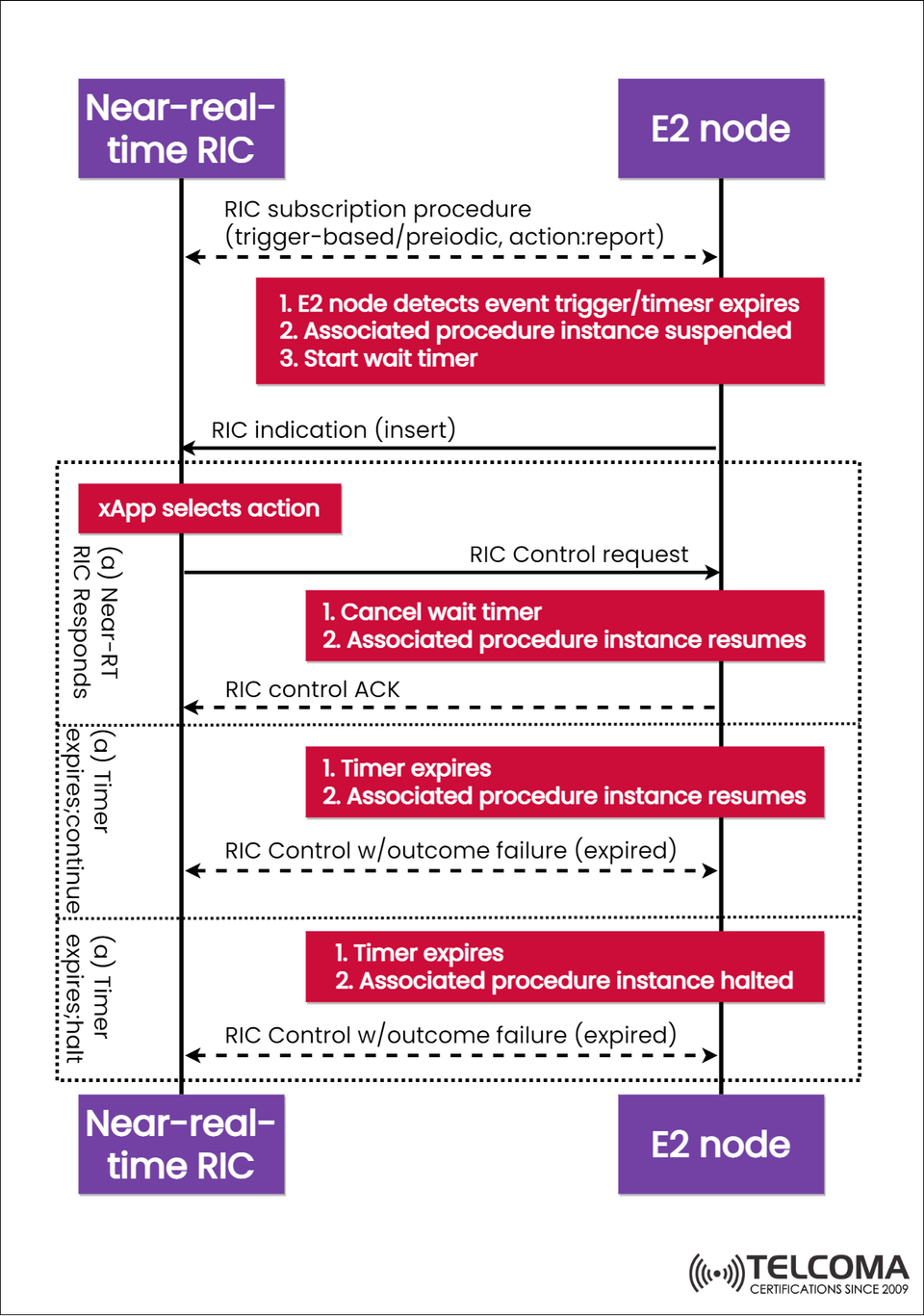
The image above showcases a detailed E2 control procedure, illustrating the step-by-step communication flow between the Near-RT RIC, xApps, and E2 nodes. It emphasizes how events are triggered, actions are initiated, and timers coordinate the interaction between these components, forming the bedrock of closed-loop network intelligence.
Understanding the O-RAN E2 Interface
The E2 Interface is a standardized control and monitoring interface set forth by the O-RAN Alliance. It allows the Near-Real-Time RIC to engage with the RAN in real time, facilitating policy-based control, optimization, and data collection.
Key Features of the E2 Interface:
Real-time control: Supports quick decision-making (10 ms – 1 s).
Open standards: Vendor-neutral, promoting interoperability.
xApp integration: Allows control through RIC applications (xApps).
Event-driven architecture: Relies on triggers and timers to manage RAN events.
The E2 Interface is vital in implementing RAN intelligence, such as load balancing, interference management, handover optimization, and energy efficiency.
E2 Interface Architecture Overview
The E2 interface operates between two main entities:
Component Function | Near-Real-Time RIC
Executes AI/ML-driven control actions via xApps
E2 Node | RAN elements like O-CU and O-DU that act on RIC instructions
These parts communicate through E2 Application Protocol (E2AP) messages over SCTP/IP transport, but in diagrams (like the one shown), the control logic is depicted at a higher functional level — focusing on how the RIC and nodes work together through subscriptions, indications, and control messages.
E2 Interface Functional Flow Explained (Based on the Diagram)
The uploaded image illustrates a control message exchange between the Near-Real-Time RIC and the E2 node during an event-triggered process. Let’s break it down step by step.
Step 1: RIC Subscription Procedure
It all kicks off when the Near-RT RIC subscribes to specific RAN events using a RIC subscription procedure.
Subscription can be trigger-based (when an event happens) or periodic (at set intervals).
The action type is typically “report,” meaning the E2 node will relay data back to the RIC.
This sets up a framework for ongoing data and control exchanges.
Step 2: E2 Node Detects Event Trigger
When something happens (like a KPI threshold getting exceeded or a timer running out), the E2 node:
Spots the event trigger or timer expiry.
Pauses the current procedure instance.
Kicks off a wait timer to maintain timing sync.
This way, the node holds off on moving forward until it gets the go-ahead from the RIC or the timer runs out.
Step 3: RIC Indication and Action Selection
The E2 node sends a RIC Indication (insert) message to the Near-RT RIC, containing details about the event and measurement data linked to the trigger condition.
Once the RIC gets this indication:
The xApp (operating on the Near-RT RIC) checks out the event context.
The xApp chooses an action — whether that’s tweaking power levels, adjusting scheduling parameters, or optimizing handover thresholds.
This decision-making process forms the intelligent layer of O-RAN control.
Step 4: RIC Control Request
The Near-RT RIC sends a RIC Control Request back to the E2 node, letting it know what action to take.
When the E2 node receives this request:
It cancels the earlier initiated wait timer.
Resumes the associated procedure instance, carrying out the control command.
The RIC Control Request thus represents a closed-loop action based on real-time data.
Step 5: RIC Control Acknowledgment (ACK)
The E2 node replies with a RIC Control ACK, confirming that it received and accepted the control request.
If everything goes well, the node takes the action; if not, it heads into error handling as detailed below.
Step 6: Handling Timeouts and Failures
If the timer runs out before successful communication:
The associated procedure instance resumes on its own.
If it fails or times out, the RIC control is labeled as failed.
This keeps things in sync — even if messages are lost, delayed, or if there are system issues — preventing any deadlock in RAN operations.
Multiple timer expirations, as shown in the lower section of the image, indicate that the RIC retries until it hits a clear success or failure.
E2 Control Procedures: Summary of Stages
Stage Entity Message/ActionDescription1Near-RT RIC → E2 Node RIC Subscription Defines event triggers and actions2E2 Node Event Detection Detects trigger, starts wait timer3E2 Node → Near-RT RICRIC Indication Reports event occurrence4xApp on RIC Action Selection Determines appropriate control response5Near-RT RIC → E2 Node RIC Control Request Sends control instructions6E2 Node → Near-RT RICRIC Control ACK Confirms control reception7SystemTimer Expiry Handling Resumes or halts procedure based on timer
This structured interaction enables real-time adaptability, allowing the RAN to respond swiftly to network changes and user needs.
- Role of xApps in the E2 Control Flow
The xApps (RIC applications) are modular software components running on the Near-RT RIC platform. They process telemetry data from RAN nodes and issue control actions through the E2 interface.
Common xApp Use Cases:
Load Balancing: Shifting users across cells.
Interference Management: Modifying transmission parameters.
Handover Optimization: Enhancing user mobility experience.
Energy Efficiency: Cutting down power usage during quiet periods.
Using E2AP messages, xApps can continually fine-tune the RAN, ensuring top performance with minimal manual oversight.
Timing and Reliability Mechanisms
The image illustrates how timers coordinate the control and response messages:
Wait Timer: Guarantees sync between RIC request and node response.
Retry Timer: Allows repeat attempts if no acknowledgment comes back.
Timeout Handling: Stops endless waiting and frees up network resources.
These timers guarantee a resilient, fault-tolerant control, which is crucial in distributed, low-latency environments like 5G RAN.
- Benefits of the E2 Interface
Benefit Description Real-Time Intelligence Enables immediate RAN optimization based on live data. Open Ecosystem Supports third-party xApps through standardized APIs. Improved Efficiency Automates RAN control, lowering OPEX and human errors. Enhanced User Experience Optimizes KPIs like throughput, latency, and mobility. Scalable Design Accommodates growing complexity in multi-vendor 5G deployments.
- E2 Interface in Closed-Loop Automation
The E2 Interface is essential for closed-loop control — a process where the RIC continuously watches, analyzes, and reacts to network data.
Data Collection: E2 node sends indications and metrics.
Decision-Making: Near-RT RIC processes data using AI models.
Action Execution: RIC dispatches control commands back to the node.
This self-correcting feedback loop paves the way for Zero-Touch Network Operations (ZTO), getting telecom networks closer to autonomous operation.
Relationship Between E2 and Other O-RAN Interfaces
Interface Purpose Communication PartnersA1Policy and ML model exchange Non-RT RIC ↔ Near-RT RICE2Real-time RAN control Near-RT RIC ↔ E2 nodesO1Network management SMO ↔ O-RAN componentsO2Cloud orchestration SMO ↔ NFVI / VNFs
The E2 Interface acts as the execution arm of the O-RAN control plane, transforming intelligence from A1 policies into immediate, actionable changes within the RAN.
Practical Example: Handover Optimization
Let’s consider a handover optimization xApp running on the Near-RT RIC:
The xApp subscribes to handover events through the E2 interface.
When a UE’s signal weakens, the E2 node sends an indication.
The xApp assesses neighboring cells and picks the best target cell.
It sends a RIC Control Request to initiate the handover.
The E2 node acknowledges and carries out the handover.
This whole process unfolds in mere milliseconds, guaranteeing smooth mobility and optimized throughput.
Conclusion: The E2 Interface – Facilitating Real-Time RAN Intelligence
The O-RAN E2 Interface is central to near-real-time control, allowing the RIC to make intelligent, context-aware choices that directly impact network performance.
By supporting seamless communication between the Near-RT RIC and E2 nodes, it enables real-time optimizations, dynamic control loops, and lays the groundwork for autonomous, AI-driven RAN systems.
As we transition from 5G to 6G, the E2 interface will remain crucial — evolving radio networks from reactive infrastructures into proactive, self-optimizing ecosystems.