
Understanding the O-RAN Fronthaul Interface: CU-plane, S-plane, and M-plane Explained

Introduction: Understanding the O-RAN Fronthaul Interface
The Open Radio Access Network (O-RAN) initiative is changing the telecom game by encouraging interoperability, flexibility, and vendor choice in mobile networks. A key part of this vision is the O-RAN Fronthaul Interface, which sets the standards for communication between the O-RAN Distributed Unit (O-DU) and the O-RAN Radio Unit (O-RU).
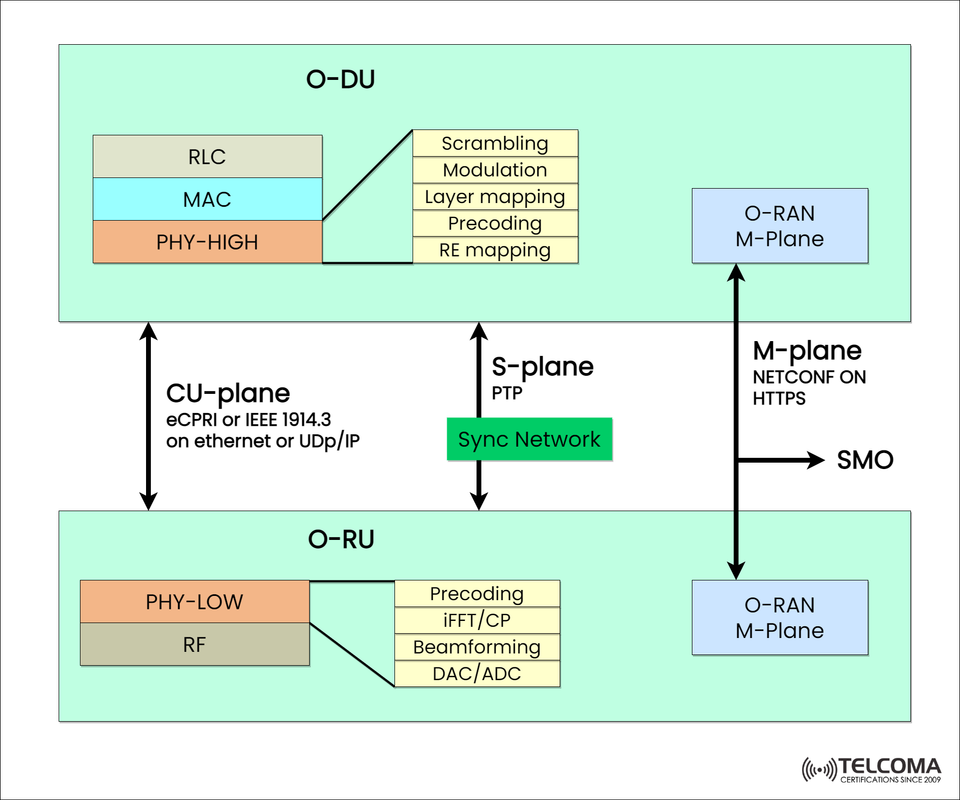
If you take a look at the image above, you’ll see a clear architectural representation showing how O-DU and O-RU communicate via three logical planes:
CU-plane (Control/User Plane)
S-plane (Synchronization Plane)
M-plane (Management Plane)
Together, these planes facilitate smooth data transfer, accurate synchronization, and centralized management, forming the backbone of an open and disaggregated RAN.
Overview of the O-RAN Fronthaul Architecture
In the past, traditional RAN systems tightly integrated the baseband and radio functions into a single unit. But O-RAN shakes things up by breaking this down into functional blocks connected by open interfaces.
The O-DU (Distributed Unit) takes care of the higher PHY, MAC, and RLC layers, focusing on tasks like scheduling, modulation, and processing data.
The O-RU (Radio Unit) is in charge of RF processing, beamforming, and low-PHY functions, converting digital signals into radio waves for transmission.
These two components communicate through the O-RAN Fronthaul Interface, which is designed to handle strict requirements for low latency, high throughput, and accurate synchronization.
Key Components in the Architecture
Component | Function
O-DU (Distributed Unit) | Handles higher PHY (physical layer), MAC, and RLC processing, managing scheduling and resource allocation.
O-RU (Radio Unit) | Performs low-PHY and RF processing, converting digital signals to analog for transmission.
SMO (Service Management and Orchestration) | Responsible for configuration, fault management, and overall orchestration using O1 and M-plane interfaces.
The way these entities work together ensures that every radio transmission is perfectly timed and optimized.
CU-plane: Data and Control Flow Layer
The CU-plane (Control/User Plane) is where user data and control messages are exchanged between the O-DU and O-RU. In the diagram, this plane is shown by the connection linking the O-DU’s PHY-HIGH and O-RU’s PHY-LOW layers.
CU-plane Protocols:
eCPRI (enhanced Common Public Radio Interface)
IEEE 1914.3 (Radio over Ethernet standard)
These protocols can work through Ethernet or UDP/IP, providing high bandwidth and low-latency communication.
CU-plane Functions:
Transporting I/Q data between O-DU and O-RU.
Sending control information for scheduling and link adaptation.
Supporting both uplink and downlink traffic at the same time.
By using Ethernet-based fronthaul, O-RAN enables cost-effective, scalable, and vendor-agnostic transport solutions.
S-plane: Synchronization and Timing
The S-plane (Synchronization Plane) makes sure that all O-RUs and O-DUs are perfectly synchronized, which is crucial for coordinated 5G operations like MIMO and beamforming.
This plane utilizes PTP (Precision Time Protocol) to achieve timing accuracy within sub-microseconds across the fronthaul network.
S-plane Functions:
Syncing clocks between O-DU and O-RU.
Ensuring precise frame timing for both transmission and reception.
Supporting frequency and phase alignment, which is vital for coordinating multiple cells.
The Sync Network, as illustrated in the image, gives both O-DU and O-RU the timing reference needed to keep radio transmissions coherent across different units.
M-plane: Management and Configuration Layer
The M-plane (Management Plane) deals with configuration, monitoring, and fault management for both O-DU and O-RU components.
This plane employs NETCONF (Network Configuration Protocol) over HTTPS, enabling secure, standards-based communication with the Service Management and Orchestration (SMO) system.
Key Duties of the M-plane:
Configuration Management: From initial setup and software upgrades to parameter adjustments.
Fault Management: Detecting, reporting, and fixing operational faults.
Performance Monitoring: Gathering KPIs and telemetry data to refine performance.
Security and Authentication: Ensuring secure management command exchanges.
With the M-plane, SMO can remotely manage thousands of O-RUs and O-DUs in a distributed RAN setup.
The O-RAN M-Plane
The O-RAN M-plane integrates directly with the SMO (Service Management and Orchestration) layer. If you look at the image, you can see that both O-DU and O-RU have their own O-RAN M-plane modules that connect with the SMO.
Benefits of SMO Integration:
Centralized configuration and monitoring.
Automated lifecycle management of RAN components.
Open API-based orchestration that works well with cloud-native environments.
This setup allows for zero-touch provisioning, quicker fault recovery, and dynamic network optimization.
Advantages of the O-RAN Fronthaul Architecture
Benefit | Description
Interoperability | Open interfaces let O-DUs and O-RUs from different vendors work together without a hitch.
Cost Efficiency | Ethernet-based fronthaul cuts down reliance on proprietary hardware.
Scalability | Modular design allows for quick deployment and scaling of 5G cells.
Centralized Intelligence | AI/ML-driven decisions can be centralized in the O-DU or Near-RT RIC.
Enhanced Synchronization | PTP-based S-plane ensures accurate timing for advanced 5G functionalities.
Secure Management | NETCONF/HTTPS offers encrypted management and control.
Real-World Use Case: Coordinated Beamforming
A standout example of the O-RAN fronthaul capability is coordinated beamforming:
The O-DU computes the optimal beamforming weights using channel state information.
It then sends these weights to the O-RU through the CU-plane.
The O-RU applies them in real-time, adjusting antenna patterns on the fly.
This entire process requires precise synchronization (S-plane) and dependable control signaling (CU-plane)—both of which are crucial for the O-RAN structure.
Conclusion
The O-RAN Fronthaul Interface is a fundamental element of contemporary 5G networks, linking the O-DU and O-RU through open, standardized planes: the CU-plane, S-plane, and M-plane.
By breaking down control, synchronization, and management functions, O-RAN provides greater flexibility, cost savings, and rapid innovation. The architecture guarantees real-time coordination, accurate timing, and secure management, which are all vital for enabling AI-driven automation, massive MIMO, and network slicing in the next-gen RAN deployments.
As networks transition towards 6G, the O-RAN fronthaul will keep playing a crucial role in achieving open, intelligent, and software-defined radio access globally.