
Understanding the Ontology of AI, Machine Learning, and Deep Learning
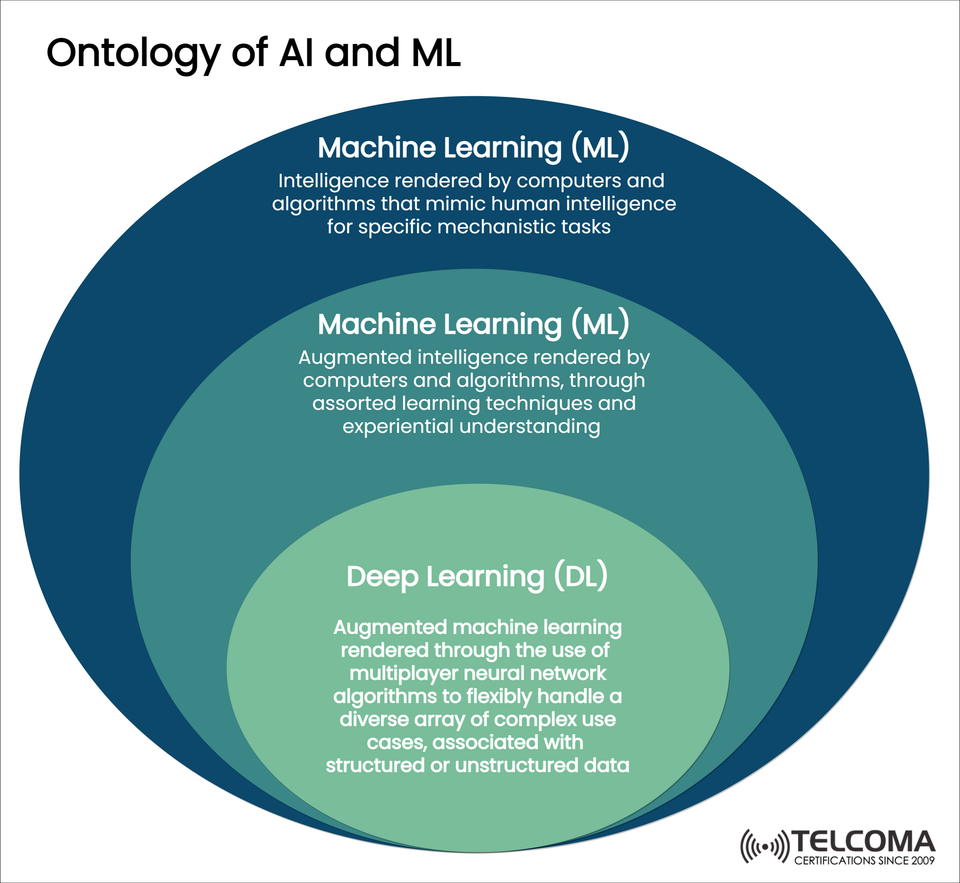

Ontology of AI and ML: The Hierarchy of Intelligent Systems Artificial Intelligence (AI), Machine Learning (ML) and Deep Learning (DL) are terms that are frequently used interchangeably, yet each has specific meanings within a hierarch of intelligent systems. The image supplied outlines the ontology of AI, ML and DL—depicting DL as a subset of ML, which is a core method utilized for AI.
Whether in the telecom context for industry professionals or for general technology enthusiasts, understanding the distinctions between AI, ML, and DL is an important capacity being introduced, as they are informing intelligence, automation and optimization approaches for networks in the 5G and beyond era.
🧠 What is Machine Learning (ML)?
Machine Learning (ML) sits on the outer layer of the ontological framework, which represents a large set of computational techniques where machines use human-like intelligence mechanisms to complete tasks.
Definition: ML refers to the intelligence produced by computers and algorithms that learn from data to automate tasks without pre-programing.
📌 Identifying Characteristics:
Supervised, Unsupervised and Reinforcement learning models
Prediction and pattern recognition
Use in fault detection, traffic prediction, anomaly detection
🧠 Augmented Machine Learning
The next layer of refinement is the notion of ML, which is to say Augmented Intelligence—this is to say that we are referring to a variety of human and algorithmic learning methods, with an experiential understanding.
🙌 New Capabilities:
Real-time decision support
Human-in-the-loop systems
Learning from smaller, diverse datasets
This level of ML applies directly to telecom operations which utilize both contextual awareness and policy-based decisions, combined with the AI-based models.
👨💻 Deep Learning (DL): The Heart of Intelligent Automation
At the centre, we discover Deep Learning (DL) - a subset of ML, leaving aside that the resemblance to the human brain learning structure, based on multi-layer neural networks allowing computations to process large, high-dimensional, unstructured data.
Definition: DL complicates use cases similarly to the human brain learning processes, as DL employs deep neural architectures to design and process structured and unstructured data.
🔎 Deep Learning Features:
Best works with large datasets
Applies automatic extraction of features
High-level accuracy for image, voice and text recognition
📡 DL Use cases in Telecom
Classifying network traffic
Analyzing customer sentiment with NLP (Natural Language Processing)
Doing predictive maintenance and fault localization
Visual object recognition in security and surveillance systems
📊 Quick Comparison Matrix
Attribute Machine Learning (ML) Deep Learning (DL)
Definition Algorithms learn from data Neural networks process raw data to mimic human brain structures
Data Requirement Normally medium to small datasets Very large datasets, eg preferred to use TB (terabyte) datasets
Feature Engineering User manual feature extraction required Entails automatic feature extraction
Complexity level Medium complexity level High complexity level
Potential Use Cases in Telecom Anomaly detection, forecasting Image recognition, NLP, and advanced analytics
🌍 Why Ontology is Important in Telecom
📶 Real World Applications of AI, ML and DL in Telecom
The telecom industry has quickly embraced the use of AI-based technologies to change how we operate, optimize and monetize our networks. The following are real world use cases structured to the 3-level ontology:
📍 Machine Learning (ML) in Telecom
- Anomaly Detection: ML models source and analyze performance data to accurately identify anomalous network behavior before it leads to considerable service outage(s).
- Churn Prediction: Algorithms predict customer churn using usage patterns and behavioral data.
- Traffic Prediction: ML is used to predict bandwidth-utilization requirements, using historical and real-time data trends that assist network planning.
📍 Augmented ML Techniques
- Adaptive Network Management: Combines machine learning insights with human-defined policies to create sophisticated network control.
- Contextual Service Delivery: ML is used to enhance the user experience by dynamically adapting user-specific services based on learned behavior patterns and customer context.
📍 Deep Learning (DL) in Telecom
- Network Intrusion Detection: DL models review and predict complicated network traffic patterns to determine malicious behavior.
- Natural Language Processing (NLP): DL-based NLP engines are used to create chatbots/virtual assistants for customer support.
- Video Analytics: Real-time video analytics enable filtering of service content and surveillance via convolutional neural networks (CNNs).
✅ Conclusion
The ontology of artificial intelligence and machine learning represents a classification system that goes beyond definitions—representing an intentional pathway to employ the appropriate level of intelligence, on the appropriate use case. This hierarchy allows you to adopt the right level of intelligence to create maximum impact whether optimising network automation, implementing predictive maintenance or improving customer engagement.
As the capabilities of AI mature and telecom networks broaden, comprehending the tiers of machine learning and deep learning will be required to maintain a competitive, agile, and future-ready stance in the market.
📣 Tips for professionals working in the telecommunications industry
Whether you are a telecommunications operator, network architect or AI engineer, as you navigate the future of intelligent automation, below are the key lessons learnt based on the ontology of AI/ML/DL:
✅ Utilize a Layered Approach:
Use ML for tasks that require real-time decision-making (e.g., use for predicting traffic and network load balancing or assurance).
Use DL where the level of complexity requires a level of abstraction (e.g., visual data interpretation or deep packet inspection).
Aim for hybrid models that integrate human judgement with AI, ensuring accuracy but also accountability.
✅ Develop AI-friendly Infrastructure:
Build scalable compute environments (e.g., edge nodes and GPUs).
Develop data pipelines to leverage structured and unstructured data from the RAN, core and OSS/BSS systems.
Pick AI platforms that build your ability to deploy models and manage the model life-cycle.
🔗 Recommended Internal Linking for Search Engine Optimization
Strengthen your SEO and user engagement by linking to related topics/reports from your blog from this article and in the following places:
"System Context for Autonomous Networking Operation in 5G"
→ link to the section called "AI and Intelligent Assurance."
"5G Network Automation with Closed-Loop Control"
→ link to the discussion for "Closed-Loop Automation."
"AI for Network Slicing and QoS Governance"
→ link to the section discussing the dynamic orchestration of slices.
"Deep Learning Capabilities for Network Intrusion Detection"
→ useful in describing real world depth learning security applications.
🗂️ Turn This Post About AI, ML, and DL into Series of Content
Consider developing this blog post topic into a content series with high effect on your blog:
Part 1: Introduction to AI, ML and DL in Telecoms
Part 2: Machine Learning Models and Specific Use Cases in OSS/BSS
Part 3: Deep Learning use in Network Security and Fault Management
Part 4: Building AI-Native 6G networks.
Each blog could build upon the previous article ontologically diving further into use cases, architectures, tools, and emerging standards (TS Forum AI Ops, ETSI ZSM, ORAN AI/ML Framework).
🏁 Final Thought
The ontology of AI and ML provides a clear, structured appreciation of how intelligent systems are layered and employed, moving from general models of learning to specific solutions based on deep neural intuition. For telecommunications, understanding this hierarchy is imperative as networks